
Abstract:
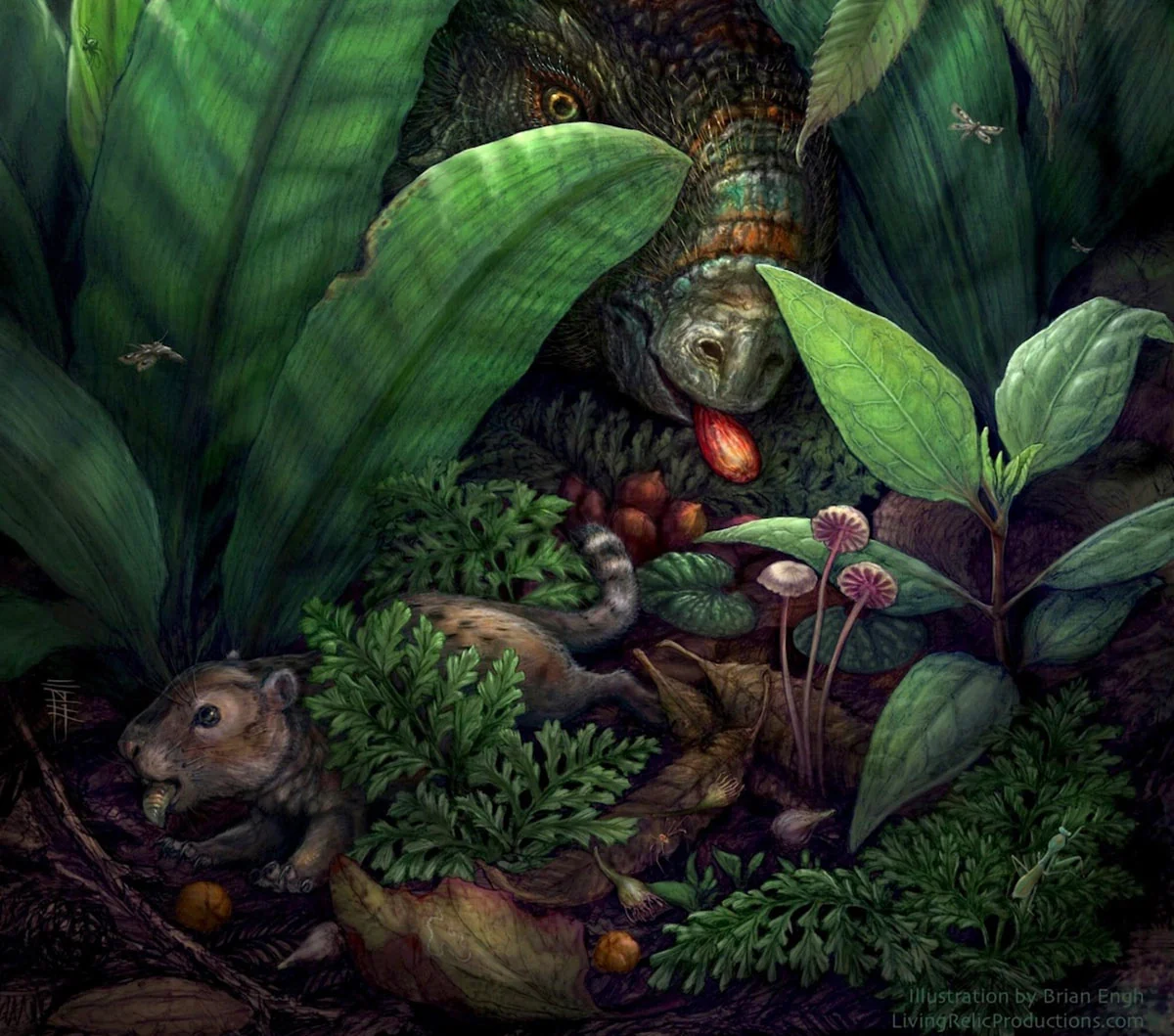
Flowering plants during the dinosaur era may have been more diverse than scientists previously thought, a new paleobotanical study finds. An ancient forest fossil from New Mexico, USA, about 74 million years old, preserves a large number of fruits, seeds and other plant reproductive structures, some of which are as large as modern grapes. This means that before the extinction of non-avian dinosaurs, flowering plants had developed more complex reproductive strategies, and large animals such as dinosaurs may have already participated in the dispersal of plant seeds.
This research was carried out by scientists from the University of Kansas and other institutions. The research results were published in the magazine Science on June 25, 2026. The paper was titled "Diversification of Angiosperm Reproductive Strategies Predated the End-Cretaceous Mass Extinction".
The core material of the study comes from a special fossil site near Truth or Consequences, New Mexico. About 74 million years ago, there was once a lush forest here, which was quickly buried by ash from volcanic eruptions. The volcanic ash gradually hardened into tuff through a long geological process, preserving the plants and their growth environment at that time.
This fossil deposit stretches for more than 1 kilometer. Researchers can not only find plant leaves and branches, but also fruits, seeds and other reproductive organs. Because so many plants were buried at similar times, scientists can even learn from the distribution of fossils how they were spatially arranged in the forest at that time.
James Saulsbury, a postdoctoral researcher at the Biodiversity Institute at the University of Kansas who participated in the study, calls this site the "Pompeii" of botany because it preserves a forest landscape that existed about 74 million years ago with an extremely rare degree of completeness.
For a long time, the scientific community has generally believed that the reproductive structure of early flowering plants is relatively simple. Flowering plants appeared about 136 million years ago, but for much of the Cretaceous period they are generally thought to have been primarily smaller plants with tiny seeds that relied primarily on wind or other non-animal pathways for dispersal.
Many flowering plant seeds of the time were thought to be only dust particles to the size of poppy seeds. Large, fleshy fruits and complex ecological relationships that rely on animals to spread seeds are generally thought to have developed with the rapid diversification of mammals after the mass extinction at the end of the Cretaceous about 66 million years ago.
However, New Mexico fossils provide different evidence. The researchers examined hundreds of fossil seeds and classified them into different morphological types based on their shape and structure. Since fossils often lack enough characteristics to identify specific species, the research team did not rush to determine the species identity of each seed, but used morphological classification methods for analysis.
The results show that there is a considerable abundance of fruit and seed types in this ancient forest, some of which are close to the size of modern grapes. This is an astonishing size for a flowering plant that dates back 74 million years, and far exceeds scientists' previous understanding of plant reproductive structures of that era.
Researchers believe that these large fruits probably mean that plants at that time had begun to use animals to help spread seeds. Many modern flowering plants attract animals with their bright, fleshy fruits, which eat the fruits and excrete the seeds elsewhere, helping the plants expand their range.
Fruit size can also reflect the ecological environment in which the plant lives. The researchers noted that large fruits are generally more likely to occur in moist, densely forested environments. This also shows that, at least in some Cretaceous forests, some of the ecological structures and plant reproductive relationships of modern forests actually appeared earlier than previously thought.
The discovery could also change scientists' understanding of the relationship between dinosaurs and plants. If large, fleshy fruits existed in abundance, it is unlikely that the only animals that helped disperse seeds were early mammals. Large dinosaurs and other prehistoric animals may also have participated in plant reproduction by eating fruits and carrying seeds.
In other words, dinosaurs may not only have been large herbivores in the forest at that time, but also participated to a certain extent in shaping the distribution of plant communities. Their movement, foraging and migration through the forest may help flowering plants spread their seeds over greater distances.
The researchers also emphasized that the rich plant diversity displayed at this site is not entirely an illusion caused by the special preservation conditions of the fossils. They believe the forest itself may be an environment with unique ecological characteristics. However, the existing evidence mainly comes from one fossil site in New Mexico, so it cannot be directly inferred that flowering plants in all regions at that time had the same complex reproductive methods.
The most important significance of this research is that it significantly advances the time point for diversification of reproductive strategies of flowering plants. The ecological relationship in which plants use large fruits to attract animals and use animals to spread seeds does not have to wait until the non-avian dinosaurs become extinct and mammals begin to expand on a large scale. By at least the late Cretaceous, some forests had fairly sophisticated plant-animal interactions.
This discovery also allows people to re-understand the forests of the dinosaur age: they were not just a primitive world composed of ferns, gymnosperms and giant dinosaurs. Some of the ecological relationships may have been very similar to today's forests.
Comments