
Abstract:
According to a report in the "Astronomy and Astrophysics" magazine on the 24th, the European Space Agency's Euclid Space Telescope discovered the most distant quasar ever observed. The mass of this distant object's central black hole is about 360 million times that of the sun. The light it emits comes from a period of only 630 million years after the Big Bang, providing new clues for studying the formation and evolution of supermassive black holes in the early universe.
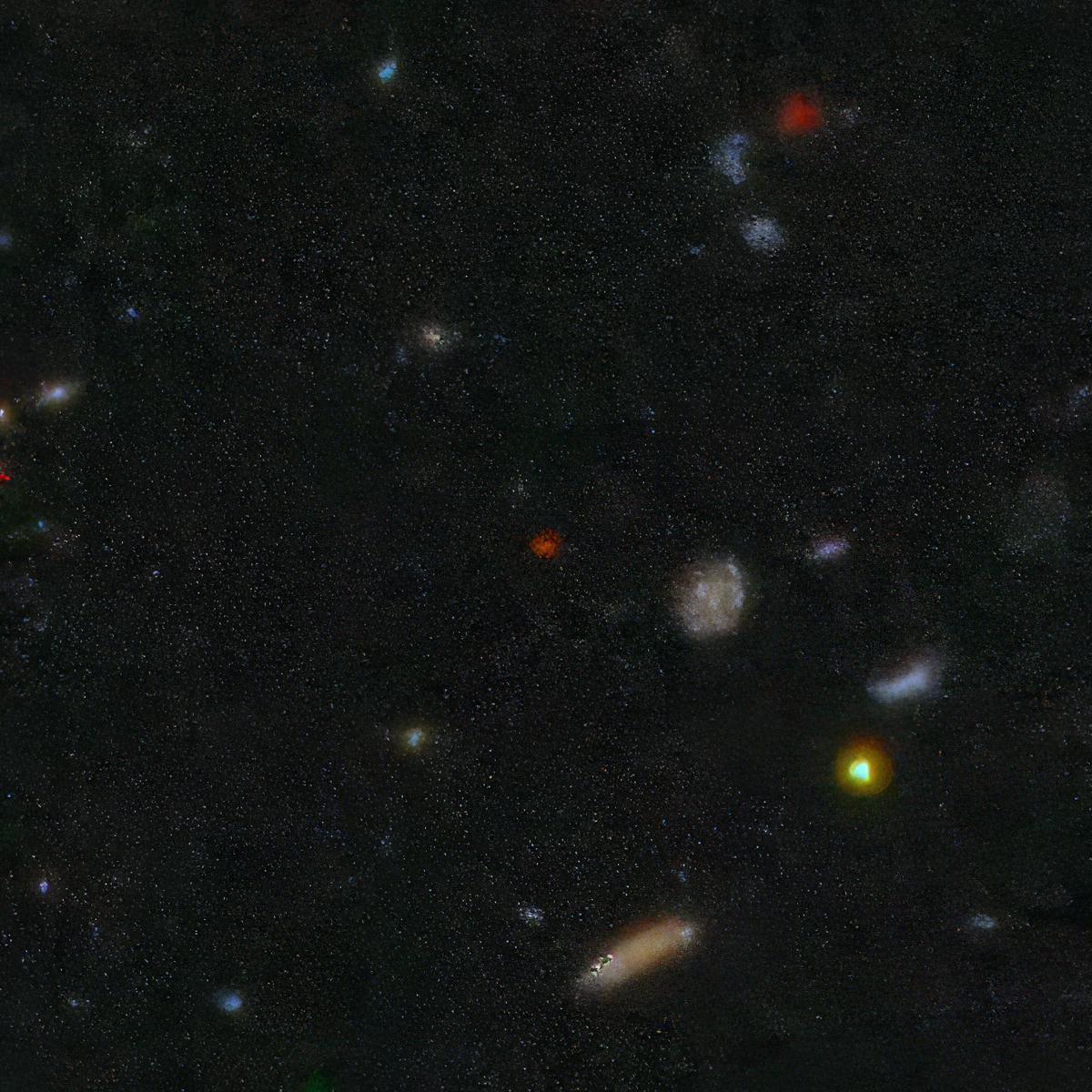
The newly discovered object, officially known as J1504+6252, is the red dot in the center of the image. It was identified from millions of objects during about 18 months of data collection by the Euclid Telescope. Image source: European Space Agency/Euclidean Space Telescope/Euclidean Project Joint Team/NASA
Quasars are galactic cores powered by supermassive black holes. When the gas near the core of the galaxy gathers toward the black hole under the influence of gravity and gradually falls into the black hole, it releases huge energy, causing the core of the galaxy to emit extremely bright light.
This newly discovered quasar is numbered J1504+6252, with a redshift value of 8.13, making it the first quasar with a redshift value exceeding 8. The larger the redshift value, the farther the celestial body is from the earth, and the older the universe observed by scientists. This observation is equivalent to seeing the universe about 13.1 billion years ago. At that time, only about 630 million years had passed since the Big Bang, and the universe was less than 5% of its current age.
Scientists identified the target among millions of celestial objects in approximately 18 months of observation data from the Euclid Telescope. Subsequently, ground and space observation equipment such as Keck Observatory, Large Binocular Telescope Observatory, Hubble Space Telescope and James Webb Space Telescope carried out follow-up observations, finally confirming its identity as a quasar and determining that the mass of its central black hole is approximately 360 million times that of the sun.
So far, the Euclid Telescope has been operating for only one and a half years and has discovered 31 early universe quasars, 12 of which have redshift values exceeding 7. Previously, other sky survey projects took 15 years to reach this number of discoveries.
Comments