
Abstract:
An open source project called d4r recently released a new version, bringing experimental support for NVIDIA DLSS 4 and DLSS 4.5 technologies to AMD Radeon RX 9000 series graphics cards. This means that the AI super-resolution model originally designed for GeForce RTX graphics cards can run on AMD graphics cards based on RDNA 4 architecture for the first time.
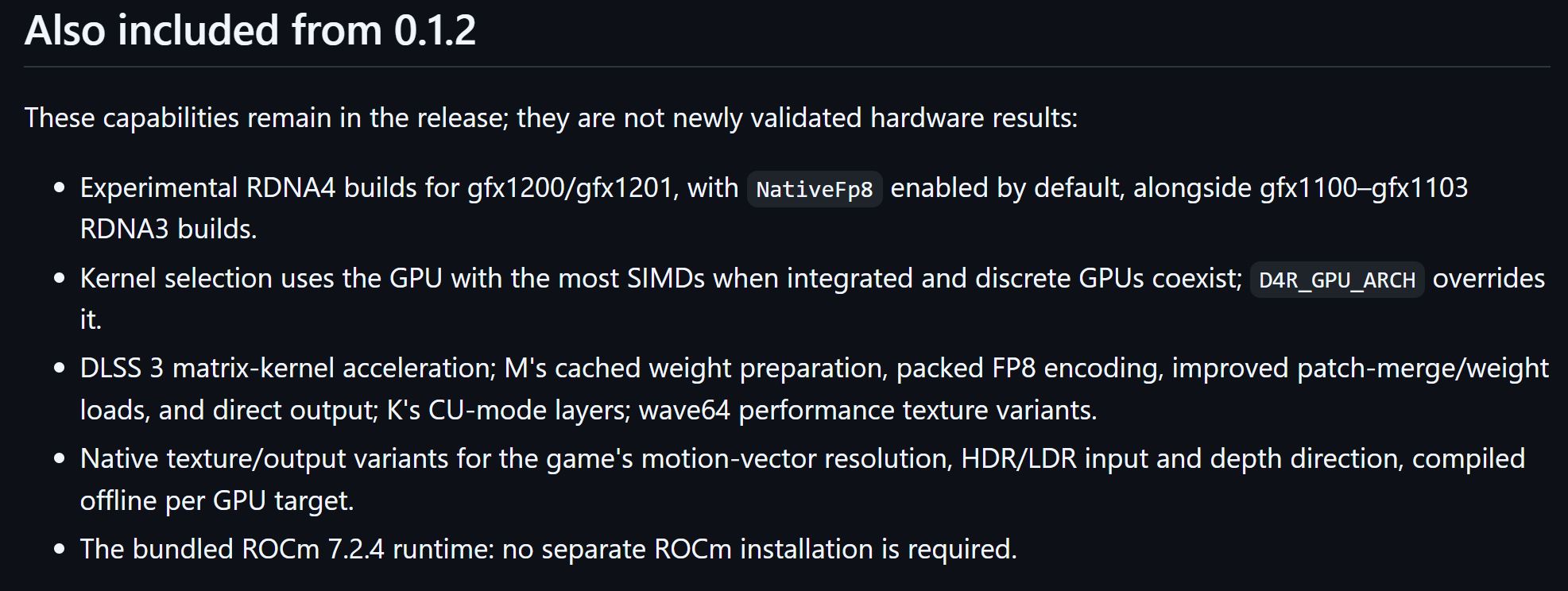
Developer "countervolts" has added experimental adaptation support to the RDNA 4 architecture in the latest update, enabling RX 9000 series products such as Radeon RX 9060 and RX 9070 to build and execute native DLSS 4 and DLSS 4.5 kernels. The key to this breakthrough is that the RDNA 4 architecture has native support for FP8 calculations, and FP8 is the data format widely used by the new generation of DLSS models.
Because it can directly handle FP8 operations, the new version of d4r no longer needs to convert FP8 to FP16 for execution, which is expected to reduce the additional performance overhead incurred when running DLSS and improve overall efficiency.
However, the project developer also emphasized that the current support for the RDNA 4 platform is still in a very early experimental stage. Although d4r versions 0.1.2 and 0.1.3 have listed graphics cards such as RX 9070 XT and RX 9070 as supported targets, the relevant operating performance and performance data have not yet been fully verified. At present, the only hardware actually tested by the project is the Radeon RX 7700 XT of the previous generation RDNA 3 architecture.
From a technical implementation perspective, d4r does not directly transplant the DLSS source code, but runs the nvngx_dlss.dll file officially provided by NVIDIA through the Linux and Proton environments, and uses the ZLUDA compatibility layer to convert the CUDA workload into instructions that the AMD graphics card can execute. At the same time, the project also developed dedicated cores for the RDNA 3 and RDNA 4 architectures to undertake some of the key computing tasks of DLSS.
The developer stated that the project currently supports multiple versions of DLSS 3, DLSS 4 and DLSS 4.5. In previous tests on RX 7700 XT, after using the native optimized kernel, the performance has been better than simply relying on translation to run DLSS code, showing the potential for further optimization.
Despite this, d4r is currently still regarded as an experimental project for technical verification rather than a mature solution for ordinary users. The project is still far from being used in daily games, and it cannot replace AMD's official FSR super-resolution technology.
This progress once again shows the improvement of RDNA 4 architecture in AI computing capabilities. With the addition of native FP8 support, AMD's latest generation graphics cards can not only run their own AI functions more efficiently, but also provide new possibilities for third-party developers to explore running NVIDIA's advanced AI models across platforms.
Learn more:
https://github.com/countervolts/d4r/releases/
Comments