
Abstract:
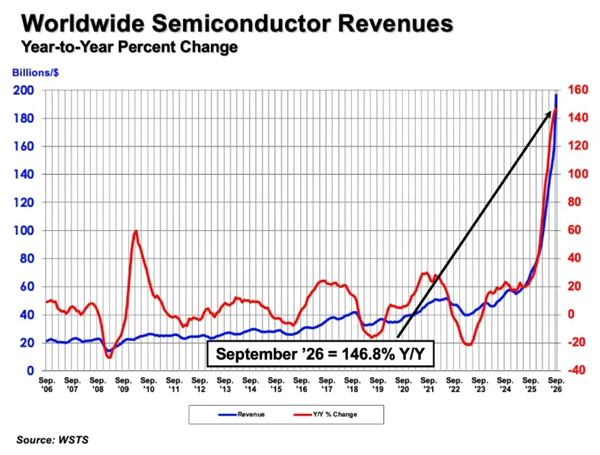
The latest data from the U.S. Semiconductor Industry Association (SIA) shows that global semiconductor sales reached US$517.7 billion in the third quarter of 2026 (Quick Technology Note: approximately RMB 3.47 trillion), a month-on-month increase of 24.1%, once again setting a new historical record.
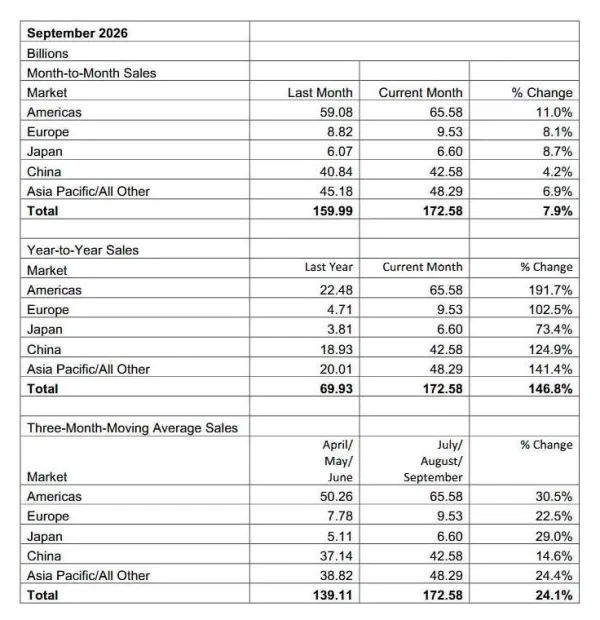
The regional market is in full swing. In September alone, sales in the Americas increased by as high as 191.7% year-on-year, Asia-Pacific and other regions increased by 141.4%, China increased by 124.9%, Europe increased by 102.5%, and Japan also saw a significant increase of 73.4%. All major regional markets around the world recorded strong year-on-year growth.
The core engine of this super boom cycle is the structural demand brought about by the construction of AI computing power infrastructure. The demand for high-end memory chips such as HBM and DDR5 in AI servers continues to surge, and it also squeezes out the wafer production capacity of general storage.
Omdia previously predicted that global semiconductor revenue will exceed US$500 billion in the third quarter of 2026, and the cumulative revenue in the first three quarters has exceeded 50% of the total in 2025.
The tight supply-side situation provides strong support for prices. A Goldman Sachs research report pointed out that the global supply and demand gaps for DRAM, NAND and HBM will reach 4.9%, 4.2% and 5.1% respectively in 2026, which are the highest levels since 2011.
SK Hynix and Micron have publicly announced that all HBM production capacity will be sold out in 2026, and some customers have even begun to lock in supply from 2027 to 2028. The seller's market structure of memory chips is converting the demand for AI computing power into real sales figures.
SIA President and CEO Michael Robbins said that the global chip market achieved substantial growth in the third quarter. Global sales increased by more than 20% quarter-on-quarter for the third consecutive quarter. Year-on-year sales in all major regional markets remained strong, highlighting the irreplaceable role of the semiconductor industry in promoting innovation, improving productivity and enhancing economic competitiveness.
He also emphasized that in the context of AI infrastructure investment showing no signs of slowing down, this semiconductor boom cycle driven by computing power and storage will most likely continue until 2027.
Comments