
Abstract:
Affected by the sharp increase in prices of memory, solid-state drives and other key components, the global personal computer market suffered a significant decline in the third quarter of 2026. Data from market research firm Counterpoint Research shows that global PC shipments fell by about 21% year-on-year, ending a growth trend that lasted for more than two years. As the demand for memory resources in artificial intelligence data centers continues to rise, consumer computers are facing multiple pressures such as rising costs, reduced supply of low-priced models, and consumers delaying replacement.
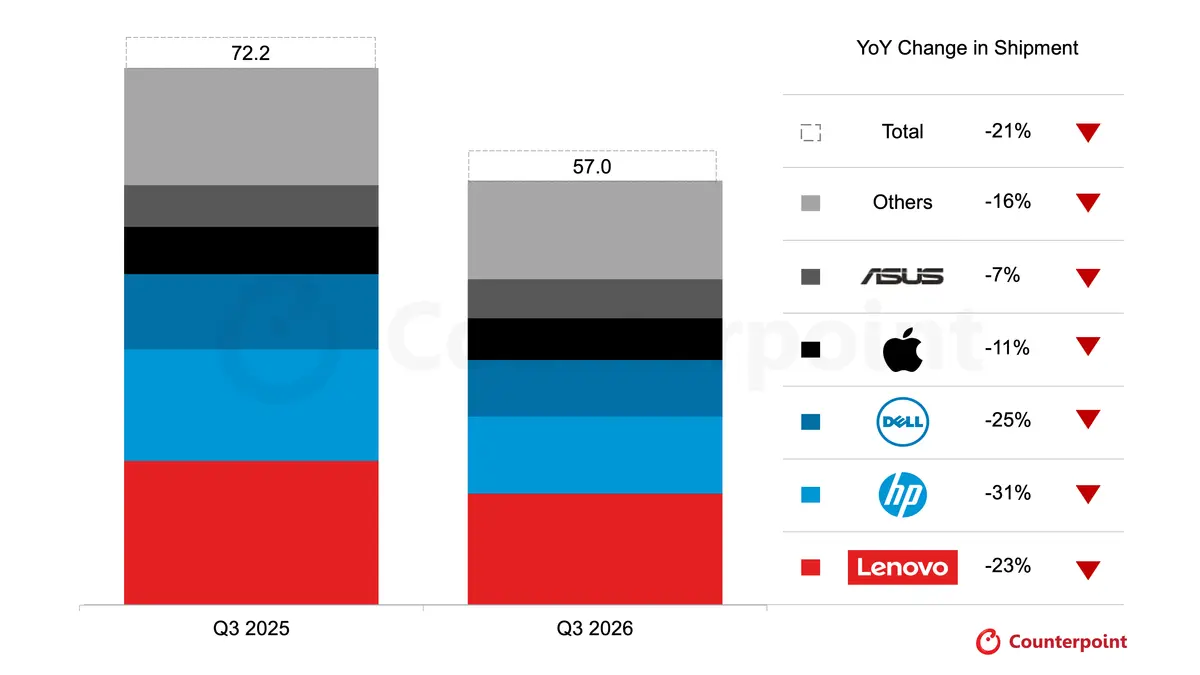
According to data released by market research firm Omdia, in the third quarter of 2026, global shipments of desktops, laptops and workstations were approximately 58.1 million units, a year-on-year decrease of 21.2%. Among them, the shipment volume of desktop computers and desktop workstations was approximately 11.7 million units, a year-on-year decrease of 23.5%; the shipment volume of notebook computers and mobile workstations was approximately 46.4 million units, a year-on-year decrease of 20.6%. Data from Gartner, another research institution, showed that global PC shipments during the same period were approximately 55.4 million units, a year-on-year decrease of 22.4%. The statistical calibers of different institutions vary, but they all point to the same conclusion: the PC market is experiencing one of the most serious quarterly declines in recent years.
This market downturn is closely related to the rapid expansion of the artificial intelligence industry. As large-scale AI model training and inference business continues to grow, the demand for high-bandwidth memory, server DRAM and storage devices in data centers has increased significantly. Major memory chip manufacturers such as Samsung, SK Hynix and Micron are investing more and more resources in the more profitable data center market, while consumer electronics manufacturers have to face tight supply and rising procurement costs.
Changes in memory prices have significantly affected the cost of the entire machine. Omdia pointed out that DRAM and solid-state drives usually accounted for about 15% of the total cost of PC materials in the past, but now this proportion is close to 40%, and the price of related components has increased more than four times. Gartner also said that DRAM costs will increase approximately five times year-on-year in the second quarter of 2026, and related costs will then gradually be transmitted to the selling price of the whole machine.
For PC manufacturers, price increases cannot completely solve the problem. On the one hand, manufacturers need to increase selling prices to make up for the rising cost of parts; on the other hand, rising prices will weaken consumers' willingness to buy. Budget users, in particular, often choose to stick with their existing devices rather than upgrade immediately when the prices of entry-level laptops and low-priced desktops no longer make them attractive.
Parts shortages have also changed manufacturers' product strategies. Due to the tight supply of some memory, processors, graphics cards and other integrated circuits, manufacturers have begun to prioritize products with higher profit margins and reduce resource investment in low-priced models. Gartner believes that the reduction in the supply of low-priced equipment and the increase in overall selling prices are one of the important reasons why consumers delay replacement. At the same time, enterprise customers are more inclined to focus their budgets on specific-purpose equipment such as workstations and AI PCs, rather than large-scale updates of general office computers.
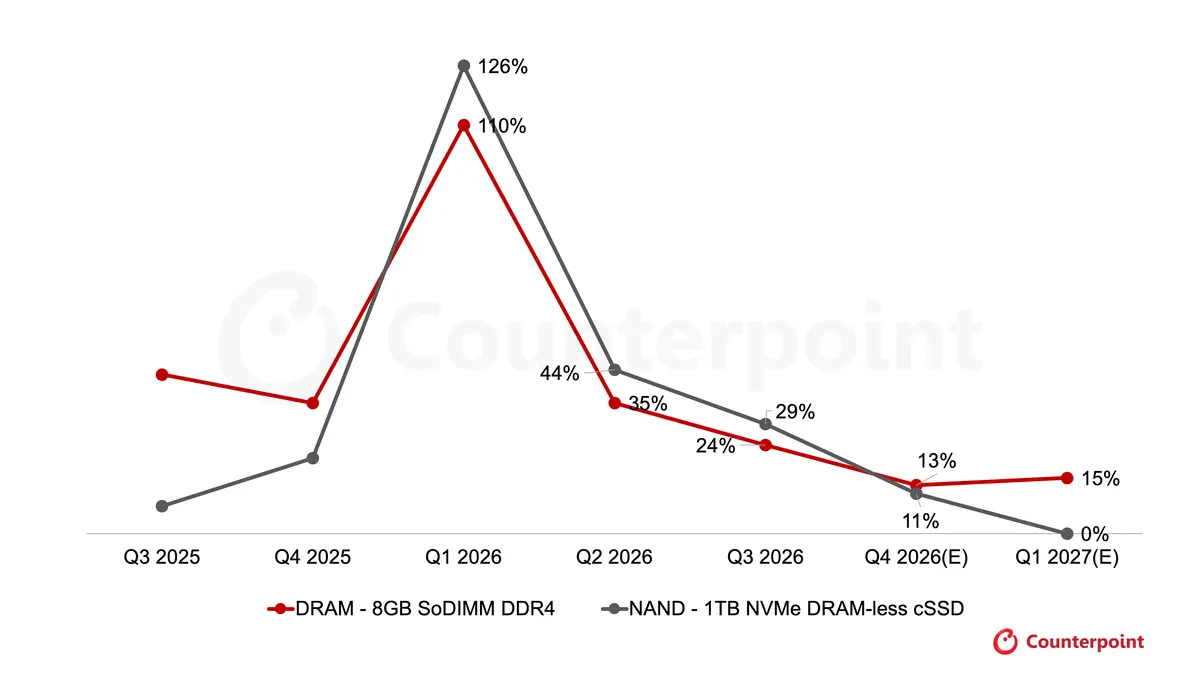
The market decline is also affected by early purchases in the first half of 2026. As manufacturers, distributors and corporate customers expect component prices to continue to rise, some procurement needs will be released ahead of schedule, resulting in support for shipments in the first half of the year. When the demand for these early purchases subsided in the third quarter, the market retreated significantly. At the same time, channels are still digesting previously accumulated inventory, further limiting manufacturers' shipping performance.
Judging from the performance of major PC manufacturers, Lenovo continues to maintain its number one position in the global market, but its shipments have also declined significantly. Omdia data shows that Lenovo shipped approximately 14.9 million units in the third quarter, with a market share of approximately 26%. The year-on-year decline was close to that of the overall market. HP shipped about 10.3 million units, ranking second, but it fell by about 31% year-on-year, one of the largest declines among major manufacturers. Dell shipped approximately 7.6 million units, ranking third; Apple shipped approximately 6.8 million units, ranking fourth; Asus ranked fifth with approximately 5.4 million units.
Although Apple was also affected by the market decline, its performance was relatively stable. Omdia data shows that Apple's Mac shipments fell by about 11% year-on-year, lower than most major competitors, and its market share has increased. Research institutions believe that Apple's relatively high-end product positioning gives it a certain buffering ability in an environment of rising costs. Estimates of Apple shipments and declines from different agencies are not entirely consistent, but the overall trend is the same: Apple has been relatively less affected.
Looking forward, research institutions remain cautious about the short-term prospects of the PC market. Omdia predicts that global PC shipments may fall by approximately 24% year-on-year in the fourth quarter of 2026, and may further decline by approximately 7% throughout 2027. This means that the impact of rising prices of memory and storage devices may not disappear in the short term. PC manufacturers also need to deal with issues such as weak consumer demand, channel inventory adjustments, and high supply chain costs.
For consumers, low-priced PCs may become more difficult to purchase in the future, and some mainstream models may continue to increase in price. However, if channel dealers increase promotion efforts due to concerns about inventory backlog, there may still be a chance for short-term discounts on some products. But this kind of promotion may not bring the price of the whole machine back to the level of a year ago.
The sharp decline in the PC market also reflects the other side of the expansion of the AI industry: while artificial intelligence data centers are getting more memory and computing resources, the cost for ordinary consumers to buy computers is rising. Although AI PC is regarded by manufacturers as an important product to promote the next wave of replacement, it remains to be seen whether the AI function can stimulate enough consumers to replace their devices as the price of the whole machine continues to rise and the supply of low-priced models shrinks.
Comments