
Abstract:
Transcend recently launched a new generation of 64GB DDR5-6400 CUDIMM and CSODIMM embedded memory modules. While maintaining the high-frequency transmission capabilities of DDR5, it further increases the capacity of a single module to 64GB, providing new options for industrial computing, edge computing and other embedded devices with high demand for large-capacity memory.
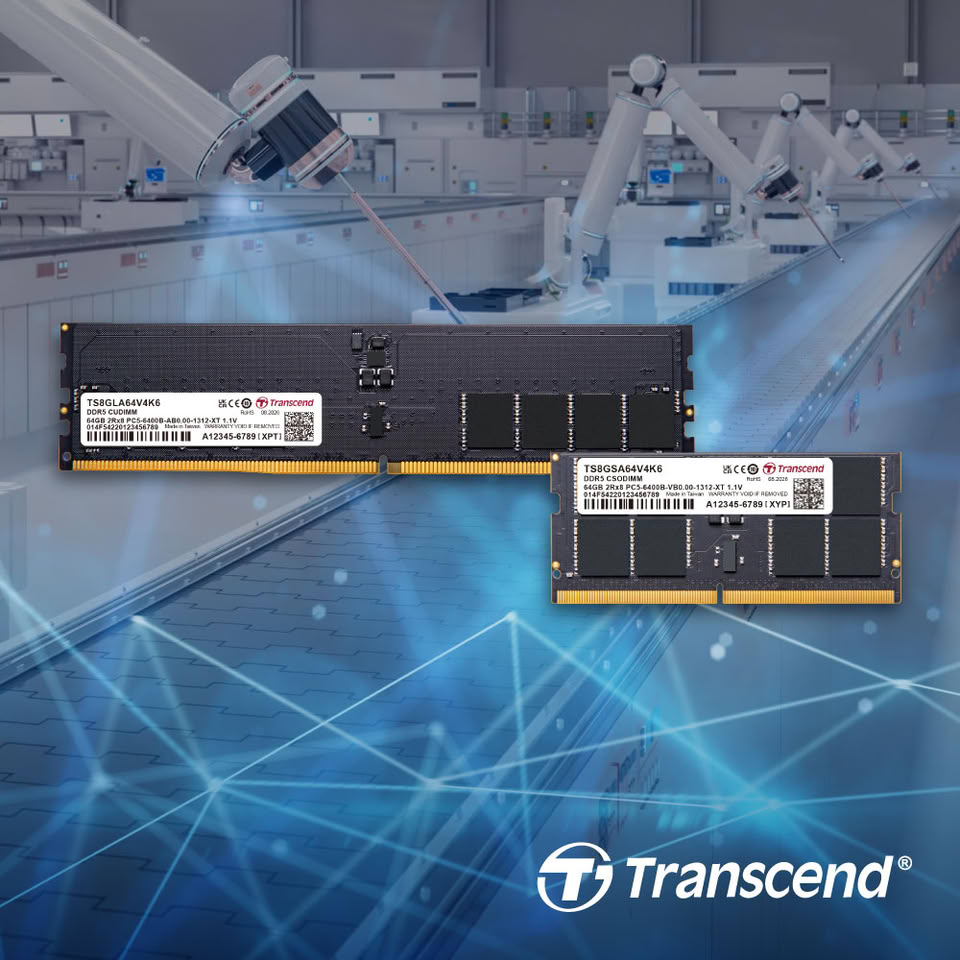
The products launched this time adopt DDR5-6400 specifications, the operating voltage is 1.1V, and are available in both CUDIMM and CSODIMM forms. Among them, CUDIMM is mainly aimed at devices using standard desktop memory slots, while CSODIMM is designed for notebook computers, small computers and other space-constrained embedded platforms. Transcend has now included the 64GB version in its DDR5 embedded memory product lineup.
Both modules use 16 DRAM chips to form a single 64GB memory. The chip organization is 4G×8 and adopts 2R×8, which is a dual-Rank design. This configuration can increase the single memory capacity to 64GB without changing the standard DDR5 interface specifications, allowing the device to obtain a larger total memory capacity with a limited number of memory slots.
This is especially important for small devices. As workloads such as artificial intelligence reasoning, edge computing, industrial vision, autonomous driving, and data analysis gradually move to terminal devices, the scale of data that embedded platforms need to process is increasing. The traditional 16GB or 32GB single memory can no longer meet the needs of some high-end applications. The 64GB module allows devices with only two memory slots to easily reach 128GB capacity.
Transcend’s products adopt CUDIMM and CSODIMM specifications, which also reflects that DDR5 memory is further expanding from the traditional PC market to high-performance embedded computing platforms. Compared with traditional UDIMM and SO-DIMM, one of the biggest differences between CUDIMM and CSODIMM is the addition of CKD, which is the Client Clock Driver.
CKD is responsible for re-driving and distributing the clock signal on the memory module, which can reduce clock jitter generated during high-speed DDR5 operation and improve signal integrity. As the frequency of DDR5 continues to increase, the signal transmission between the motherboard and the memory becomes more and more sensitive, so CKD plays an important role in maintaining the stable operation of high-speed memory.
Transcend has previously launched DDR5-6400 CUDIMM and CSODIMM products, and provides 16GB, 32GB and some 48GB capacity versions. The addition of the 64GB model further expands its DDR5-6400 product line to higher capacities. Transcend's existing standard desktop CUDIMM products already cover up to 48GB, while the embedded product line further provides 64GB versions.
In addition to standard temperature versions, Transcend's embedded DDR5 products also offer wide-temperature models for industrial environments. Related products can operate in a wider temperature range and are suitable for industrial control, transportation equipment, edge servers, and other scenarios that require long-term stable operation. The embedded DDR5 module products announced by Transcend also support transmission rates up to 6400 MT/s and are equipped with functions such as On-die ECC and onboard PMIC.
Among them, On-die ECC is one of the important features of the DDR5 standard itself. It can correct some data errors inside the DRAM chip and improve data reliability under high-speed operating conditions. The PMIC is responsible for managing the power supply of the memory module so that the module can obtain a more stable power supply.
Transcend also emphasized that these industrial-grade DDR5 modules have undergone rigorous verification and environmental testing and can cope with complex working environments such as temperature changes, vibration, and long-term continuous operation. Some embedded products also offer optional three-proof coating to enhance the module’s resistance to moisture, dust and other contaminants.
The 64GB capacity is especially meaningful for artificial intelligence and edge computing devices. More and more AI models are being deployed from the cloud to local devices. In addition to computing power, model operation also requires a large amount of system memory for loading model parameters, caching data, and performing intermediate calculations. If the device uses traditional 16GB or 32GB memory, it will easily be limited by the memory capacity when running larger models.
In industrial vision systems, large-capacity memory can also reduce bottlenecks in data processing. For example, high-resolution industrial cameras can continuously generate large amounts of image data, and the system needs to temporarily cache this data and conduct real-time analysis. If the device can use two 64GB modules to form 128GB of memory, it can provide a larger data buffer space without increasing the size of the device.
CSODIMM is particularly suitable for small AI PCs, embedded workstations and high-performance notebook platforms. Compared with the standard 288-pin CUDIMM, CSODIMM uses a 262-pin interface, the module size is more compact, and it can provide higher memory capacity in a limited body space. Transcend currently offers both 64GB DDR5-6400 CUDIMM and CSODIMM versions.
It is worth noting that Transcend did not further increase the frequency of its 64GB products, but chose to continue to use the JEDEC standard DDR5-6400 specification. For industrial and embedded devices, this option focuses more on long-term stability and compatibility rather than pursuing extreme overclocking performance.
This is also somewhat different from the consumer DDR5 memory market. At present, high-end desktop DDR5 products have appeared with products far higher than 6400 MT/s, but industrial computing equipment usually pays more attention to stable operation, life cycle, temperature range and platform compatibility. For industrial equipment that needs to run continuously for several years or even longer, a rigorously verified DDR5-6400 memory is often more valuable than a higher-frequency product that requires complex tuning.
Judging from Transcend's current product layout, the company is covering the traditional PC memory, embedded memory and industrial-grade memory markets at the same time. Its DDR5 embedded products have formed a capacity gradient from 8GB, 16GB, 32GB to 64GB, and also provide different specifications such as CUDIMM, CSODIMM and ECC to meet the needs of different platforms.
As DDR5 gradually becomes the mainstream memory standard for PCs and embedded computing platforms, it will become an important trend to continue to increase the capacity of a single memory stick. For mini PCs, edge servers, industrial computers, and AI terminals, obtaining 128GB or even 256GB of system memory while maintaining miniaturization will increasingly be of practical value.
Transcend’s launch of 64GB DDR5-6400 CUDIMM and CSODIMM is actually designed to address this trend. It does not simply pursue higher memory frequencies, but provides larger memory space and more stable high-speed data transmission capabilities for the new generation of high-load embedded computing devices through higher single-strip capacity, CKD clock management, and the reliability characteristics of DDR5 itself.
Comments