
Abstract:
The specifications of Intel's next-generation desktop processor Nova Lake-S have been exposed recently. This batch of products is expected to bring substantial CPU architecture upgrades and may be equipped with competitive integrated graphics cards. It is known that Nova Lake-S is likely to need to be equipped with a new LGA1954 socket motherboard, and is also expected to introduce bLLC large-capacity last-level cache technology similar to AMD 3D V-Cache. With bLLC, the performance of integrated graphics cards may be significantly improved, even making entry-level discrete graphics cards useless.

In terms of CPU core configuration, VideoCardz said it obtained a Nova Lake-related document, which lists seven Nova Lake-S desktop processors based on C1 and A0 stepping quality samples (QS). The first thing that attracts attention is the change in naming. Intel seems to be using the Core Ultra 4000 series instead of the previously expected Core Ultra 400. Leaked specs show that Intel is preparing several interesting configurations, especially the high-end Core Ultra 9 and Core Ultra 7 models.
The flagship model Core Ultra 9 4970K BFC will be equipped with 28 cores, including 8 performance cores, 16 energy efficiency cores and 4 low-power energy efficiency cores. It has 144MB level 3 cache, a maximum acceleration frequency of 5.5GHz, and a basic power consumption of 125W. The regular version of Core Ultra 9 4950K may also use 28 cores and 125W basic power consumption, but the third-level cache is greatly reduced to 36MB, and the maximum acceleration frequency is also slightly lower, at 5.4GHz. There is also a locked multiplier Core Ultra 9 4900 BFC, equipped with 22 cores, 120MB level 3 cache, a maximum acceleration frequency of 5.3GHz, and a much lower basic power consumption of only 65W.
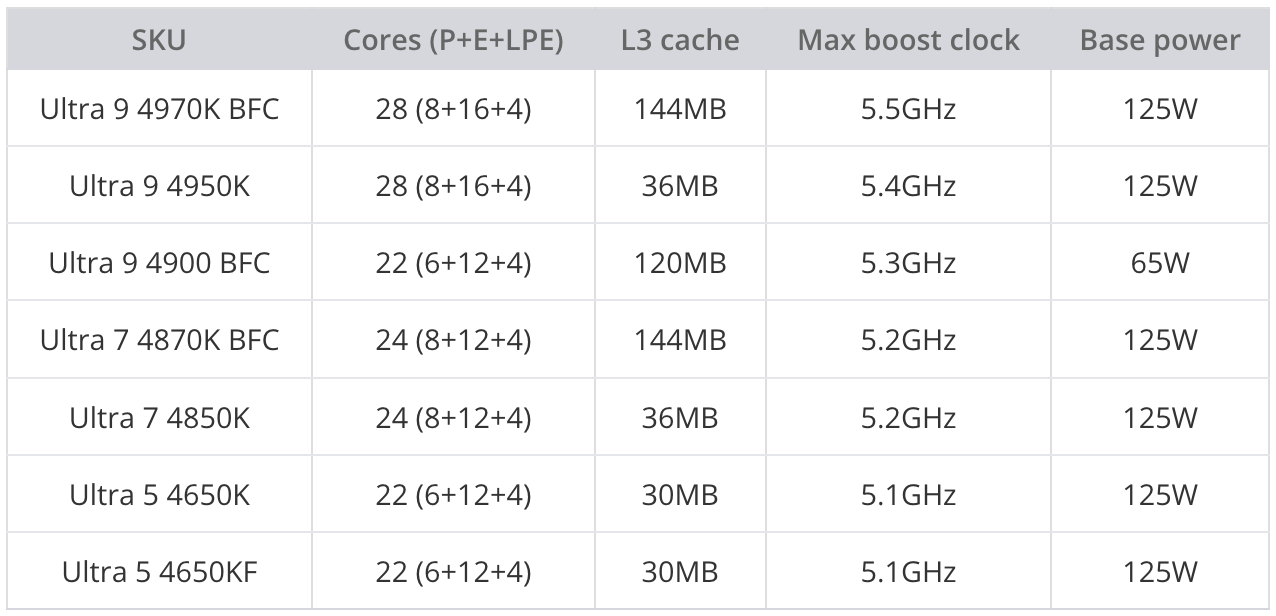
Core Ultra 7 series reportedly includes 4870K BFC and 4850K, both of which have 24 cores and a maximum acceleration frequency of 5.2GHz. However, similar to the Core Ultra 9 model, the BFC version is equipped with up to 144MB of L3 cache, while the regular version is only 36MB. Regarding the Core Ultra 5 series, Intel is said to be preparing 4650K and 4650KF, both of which use 22-core configurations, including 6 performance cores, 12 energy-efficiency cores and 4 low-power energy-efficiency cores. The third-level cache is 30MB, and the maximum acceleration frequency is 5.1GHz. The KF suffix means that the model may not be equipped with integrated graphics.
The seven exposed models all support DDR5-8000 memory, which is significantly improved compared to the DDR5-6400 supported by the current Arrow Lake-S desktop platform. Intel also lists up to 256GB of memory capacity, 24 CPU PCIe lanes, and an integrated NPU of 77 TOPS. The frequency of the integrated graphics card varies between 2.9GHz and 3.1GHz depending on the processor. The media engine is also said to have been enhanced, supporting DNx, XAVC, JPEG-XS and VVC decoding, and supporting AV1 High and Professional profiles. Upcoming AV2 codec support was not mentioned, but that's understandable considering the standard is still nascent.
It should be noted that these are QS sample specifications. Intel seems to have warned that the clock frequency may change, and the performance does not necessarily represent the final retail product. However, since it is already in the latter part of the release cycle, the final specifications are not expected to be much different. VideoCardz also reports that Intel may be planning to hold a desktop product event in Berlin from February 22 to 25. Therefore, the CES 2027 exhibition may be mainly aimed at motherboard manufacturers and channel vendors, who are expected to display LGA1954 platform Z990, Z970, B960, Q970 and W980 chipset motherboards for Core Ultra 4000 desktop processors.
Comments