
Abstract:
In the latest developer beta version of iOS 27.2, Apple has opened a newly designed health application to developers for the first time. This update is considered the largest revision of the Health app in recent years. Apple is trying to use Apple Intelligence to transform users’ long-term accumulated health data into more practical analysis and recommendations.
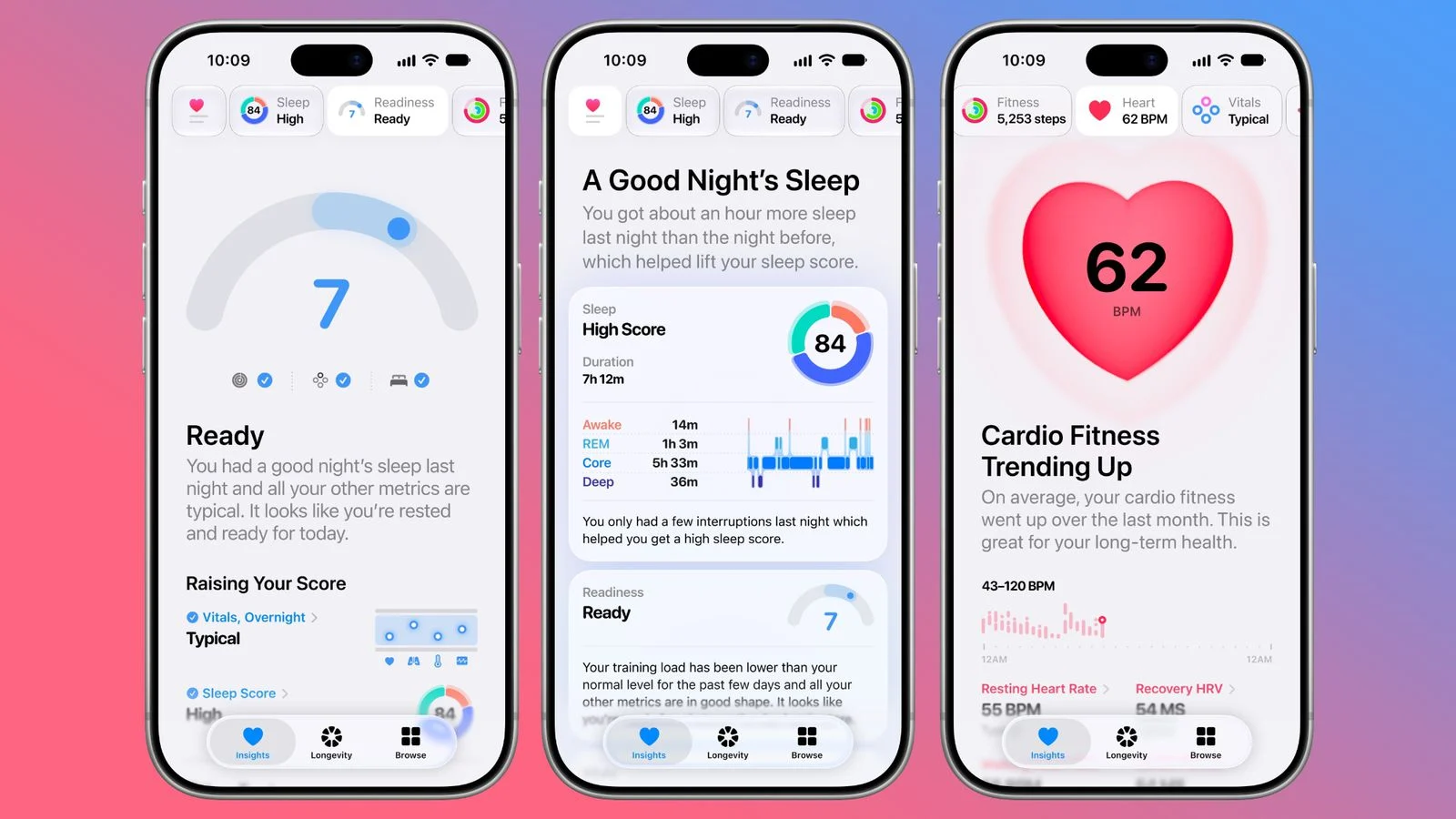
According to Apple, although the new version of the health application has appeared in the beta version of iOS 27.2, it will not be launched with the official version of iOS 27.2, but is planned to be launched later this year. Its core concept is to comprehensively analyze data from Apple Watch, iPhone and other health devices with the help of artificial intelligence to provide users with personalized health guidance.
The most significant change in the new version of the application is the new "Insights" tab. The system will use Apple Intelligence to automatically generate a health summary, showing the most noteworthy recent changes in indicators. For example, sleep quality improves, VO2max reaches new highs, or other physical data show obvious trends. Users can also get exclusive advice around heart health, exercise training, recovery status and more.
Apple said that the new system does not just display data, but attempts to understand users' health goals. For example, when the system discovers that the user is improving their cardiorespiratory capacity, it may suggest adding interval training to a morning run; if the recent recovery is not ideal, it may remind the user to appropriately reduce the training intensity. All recommendations are dynamically adjusted based on individual data, rather than using a uniform template.
When used in conjunction with the new Apple Watch, the system will also introduce a "readiness" scoring mechanism. This function comprehensively analyzes recent activity, vital signs, and sleep data, gives a status score of 0 to 10, and displays corresponding suggestions such as "recovering," "slowing down," "ready," or "go all out." In addition to being displayed on the watch, relevant information will also appear simultaneously in health applications and fitness applications.
In terms of vital signs monitoring, Apple has further expanded its data analysis capabilities. The new version of the app offers a new day and night view and puts heart rate variability (HRV) into greater focus. The system not only tracks overall HRV levels, but also analyzes recovery HRV changes to help users better understand stress management and physical recovery.
Another important change in this upgrade is the addition of the "Longevity" module. Apple hopes to assess users' overall health status from a longer-term perspective. The system will integrate data from iPhone and Apple Watch to establish a long-term health portrait from multiple dimensions such as cardiovascular health, sleep quality, mental health, physical activity, metabolic status, hearing level, and nutritional intake.
The "Health Age" function has also been added to the "Longevity" tab. This function combines indicators such as maximum oxygen uptake, resting heart rate, heart rate variability, sleep status, and blood test biomarkers to analyze the relationship between the user's physical condition and actual age. The system will help users identify which living habits have the greatest impact on health and provide directions for improvement.
In addition to daily monitoring functions, Apple also plans to add a series of home health assessment tools. In the future, users can use the iPhone camera to complete the maximum oxygen uptake test under the guidance of the system. The application will use the visual recognition model to analyze human movements and combine it with Apple Watch heart rate data to complete the evaluation.
At the same time, Apple is also preparing to launch in-depth physical assessment capabilities for flexibility, strength, balance, and body movement mechanisms. These tests will further expand the positioning of health applications from mere data recording tools to digital health advisors.
This reconstruction of the Health application marks a new stage in Apple’s health strategy. In the past, Apple focused more on collecting and displaying health data, but the new system began to use generative artificial intelligence to proactively interpret data and provide suggestions. As Apple Intelligence gradually integrates into the health ecosystem, Apple is trying to transform health applications from a "data warehouse" into a health management platform with truly personalized guidance capabilities.
Comments