
Abstract:
As Apple M6 Mac mini is about to be officially launched, the first Geekbench 7 running score has appeared in the database. Judging from the test results currently exposed, the processor performance of the M6 Mac mini has been significantly improved compared to the previous generation M4 model, especially in terms of multi-core performance, which has been improved by 48%.
The device model that appeared in the Geekbench 7 database this time is "Mac18, 5", equipped with Apple M6 chip, with a 12-core CPU and a base frequency of 4.78GHz. For comparison, the base frequency of the M4 Mac mini is 4.4GHz, while the base frequency of the original Mac mini equipped with the M1 chip is only 3.2GHz.
Currently there is only one CPU test record for Mac 18.5 in the Geekbench database, and there is no GPU or AI performance test yet, so it is not possible to fully judge the overall performance of the M6 Mac mini at this stage. However, judging from the published CPU results, this result is basically consistent with Apple’s previously announced M6 specifications and performance positioning, so it has high credibility. As consumers continue to receive products, more test results are expected to emerge.
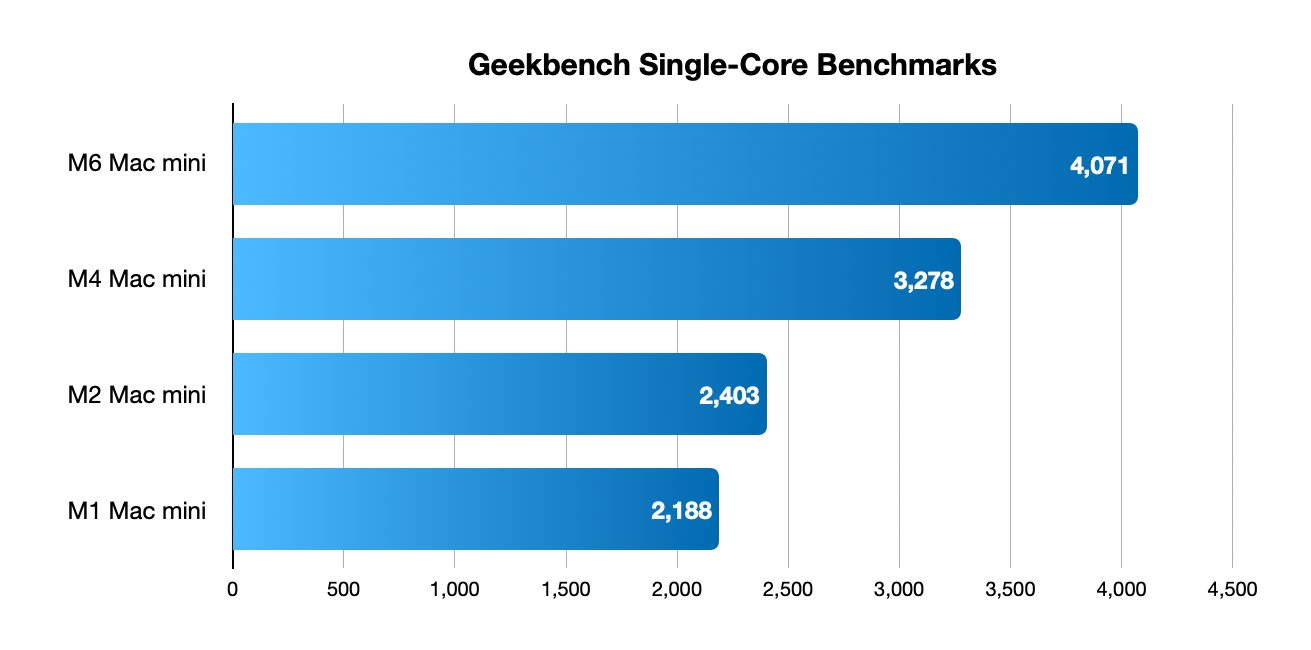
In the Geekbench 7 single-core test, the M6 Mac mini scored 4071 points. Compared with the performance of the previous generation M4 Mac mini, the improvement is approximately 24%. If compared with the M2 Mac mini, the performance improvement reaches 69%; compared with the M1 Mac mini, it has almost doubled, with an improvement of approximately 89%.
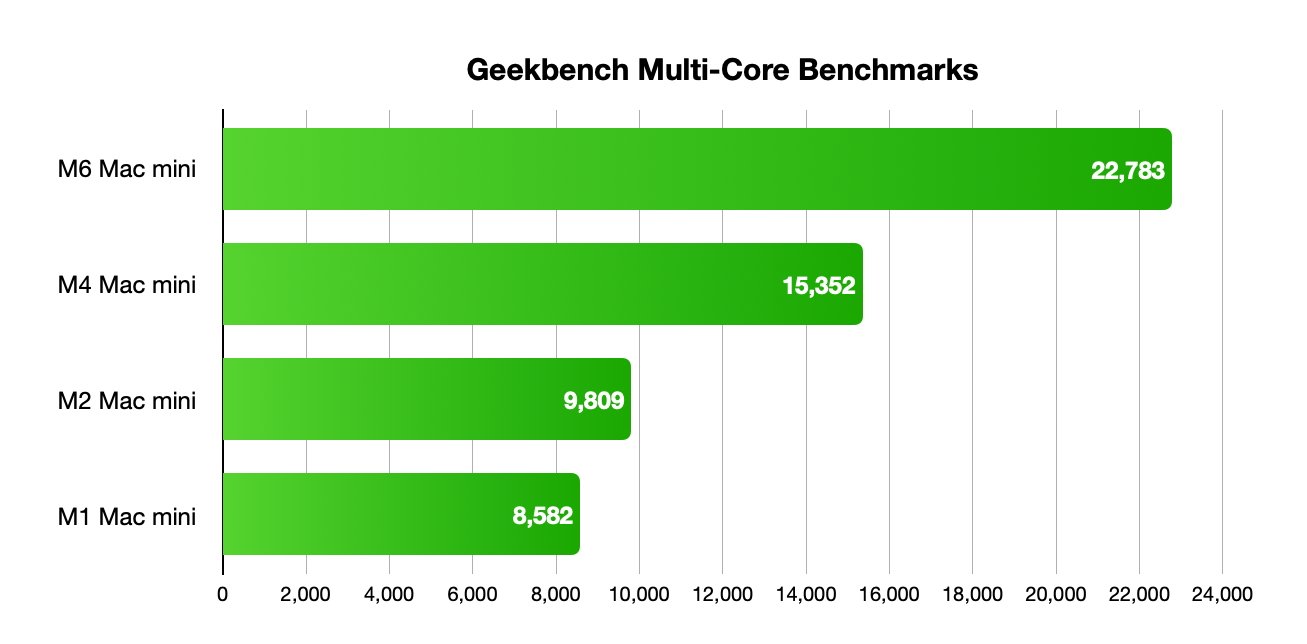
In terms of multi-core performance, the M6 Mac mini performed even more outstandingly, scoring 22,783 points, about 48% higher than the M4 Mac mini. Compared with the M2 Mac mini, the improvement reached 132%, and compared with the M1 Mac mini, it increased by 165%.
From the perspective of actual use, this improvement is enough to be clearly perceived by ordinary users. Normally, if the processor performance improvement reaches or exceeds about 15%, users may feel a significant difference in actual applications. Therefore, if the current running scores are finally verified by more test results, the performance improvement of the M6 Mac mini compared to the M4 or even earlier generations of products will be very obvious.
The M6 Mac mini itself is also a very special product upgrade from Apple. Apple did not continue to use M5 in Mac mini according to the previous rhythm of M1, M2, M3, M4, and M5, but directly upgraded it to M6. The M6 uses a 2nm manufacturing process and has a 12-core CPU, including two Super Cores, four performance cores and six energy efficiency cores.
In terms of GPU, the M6 Mac mini is equipped with a 12-core GPU, and each GPU core is added with a neural accelerator. This allows the new chip to not only provide higher graphics performance, but also further strengthen local AI computing capabilities. Apple previously stated that the GPU graphics performance of the M6 Mac mini can be up to twice that of the M4, and the AI computing power can be up to four times that of the M4.
M6 is also equipped with dual 16-core neural engines and increases unified memory bandwidth to up to 170GB/s. For users running large local AI models, higher memory bandwidth and the neural accelerator in the GPU can reduce the data transfer bottleneck between the processor, GPU and neural engine, thereby improving local inference speed.
Apple also previously claimed that the M6 Mac mini’s large language model prompt word processing speed in LM Studio can be up to 4.8 times that of the M4. If this performance improvement can be verified in actual tests, the M6 Mac mini will not only be a small desktop computer in the traditional sense, but also become a very competitive local AI computing device.
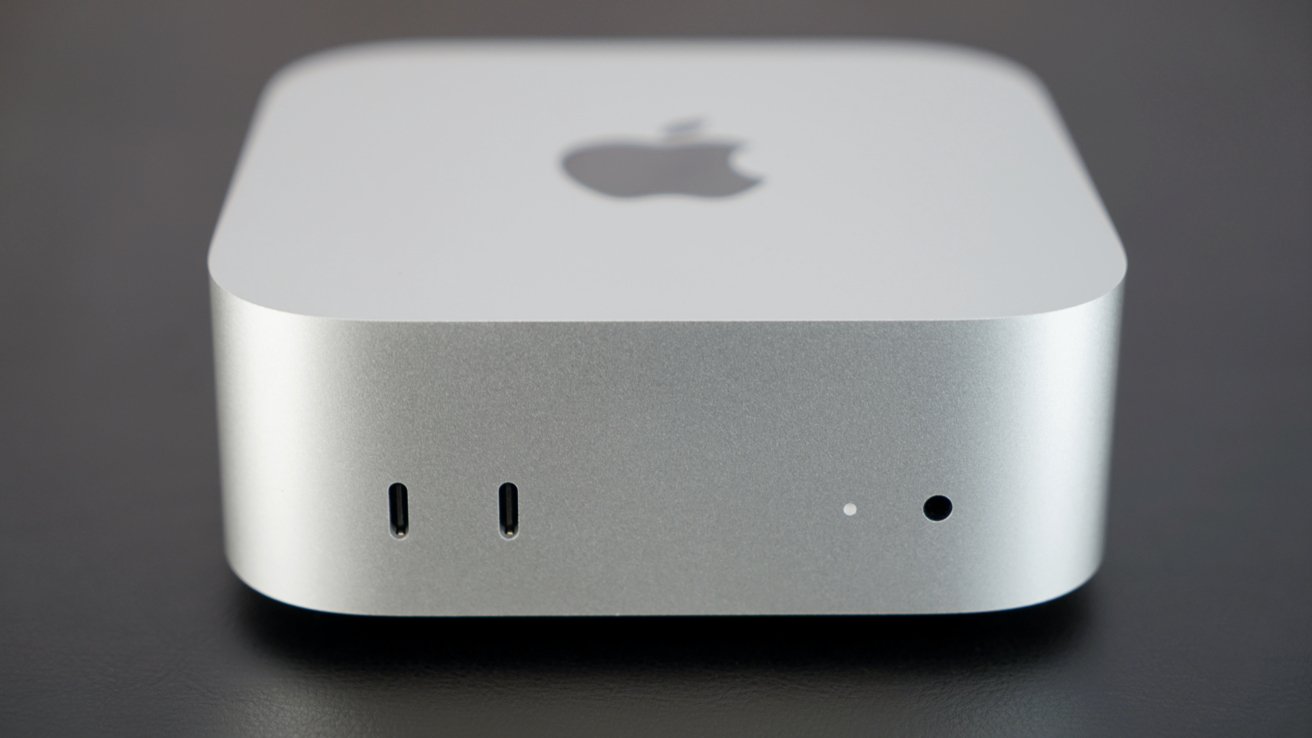
In terms of hardware specifications, the M6 Mac mini continues to use the small body of the current generation Mac mini, measuring 5×5 inches and weighing about 1.5 pounds. The appearance is basically the same as the M4 Mac mini, so this upgrade mainly focuses on the internal hardware. The machine is equipped with 16GB, 24GB and 32GB unified memory, and the storage capacity starts from 256GB, with up to 2TB options.
In terms of interfaces, the new Mac mini is equipped with three Thunderbolt 4 interfaces, two USB-C interfaces on the front of the fuselage, an HDMI interface, a 3.5mm headphone jack and 2.5Gbps Ethernet, and can be upgraded to an additional 10Gbps Ethernet. Wireless connections have been upgraded to Wi-Fi 7 and Bluetooth 6.
The display output capability has also been further enhanced, allowing up to three external monitors to be connected, and supporting a variety of combinations including 6K, 5K and 4K high refresh rate display devices.
The M6 Mac mini starts at US$899, which is US$300 higher than the US$599 starting price of the M4 Mac mini when it was launched. Basic configuration includes M6 chip, 16GB unified memory, 256GB storage and 2.5Gbps Ethernet. Upgrading the memory to 24GB or 32GB each costs an additional $200, and upgrading the storage from 256GB to 512GB costs an additional $200. Upgrades to the 1TB and 2TB configurations cost even more.
Although the price has increased significantly, judging from the current first Geekbench results, the processor performance improvement of the M6 Mac mini is also considerable. Especially for users who still use M1 or even earlier generation Mac mini, the new product not only provides stronger CPU and GPU performance, but also achieves comprehensive upgrades in AI acceleration, memory bandwidth, wireless networks and high-speed interfaces.
Currently, the M6 Mac mini will be officially launched on September 22. Until more Geekbench scores and GPU and AI test results appear, the first test results still cannot fully represent the actual performance of all retail products. However, if subsequent tests can maintain the current performance level, the M6 Mac mini will become one of Apple's most obvious Mac mini replacements with improved performance in recent years.
Comments