
Abstract:
Meta is advancing the artificial intelligence assistant from "can chat" to "can do things" to a new stage. The company recently announced that its AI agent product Muse has officially launched on the Mac platform. This means that Muse no longer just answers questions or generates content, but can perform actual operations directly on the user's computer to help complete various daily work tasks.
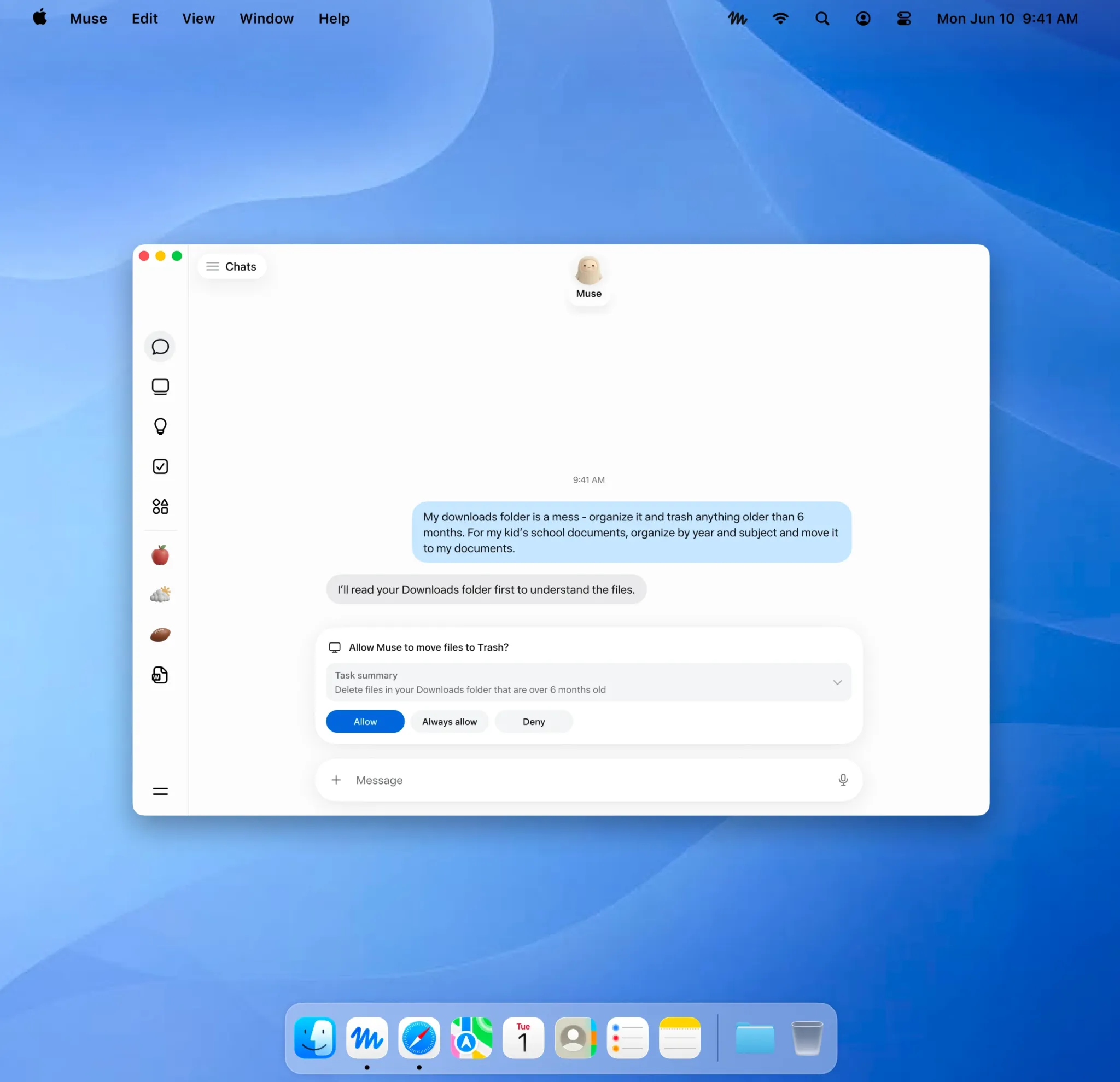
The launch of the Mac version is regarded as an important step towards Meta's universal AI agent. Unlike traditional chatbots, Muse can access computer interfaces and applications after obtaining user authorization, and complete a series of operations according to instructions. For example, organize files, process emails, query information, manage calendars, fill out forms, and perform cross-application tasks.
Meta said that users will not need to guide each operation step by step in the future, but can directly tell Muse the final goal. The system then plans the steps autonomously and completes the task by physically controlling the computer interface. It's akin to having a digital assistant sit in front of your computer and do the work for you, rather than just giving advice.
According to reports, Muse can observe the current screen content, understand the work the user is doing, and decide the next action based on accessible information. It can also perform continuous tasks across multiple applications when users make complex requests, rather than being limited to a single software environment.
In actual demonstrations, Muse can help users organize meeting arrangements, retrieve relevant information, update document content, handle email exchanges, and switch between multiple windows to complete the workflow. Unlike traditional automation scripts, this kind of AI agent does not need to write rules in advance, but relies on the large model's ability to understand the interface to complete operations.
Meta emphasizes that users always retain control. Muse will request authorization before performing key operations and will not automatically perform actions involving privacy, security or financial risks. Users can pause, take over or terminate the task process at any time.
In terms of positioning, Muse has gone beyond the traditional AI chat tool and is closer to the "Computer Use Agent" that has been hotly discussed in the industry in recent years. The goal of such systems is not to answer questions but to get the job done directly, like a real assistant.
Industry insiders pointed out that in the past year, more and more technology companies have begun to shift their competitive focus from chatbots to AI agents that can act autonomously. OpenAI, Anthropic, Google and Microsoft are all investing resources in this direction, and Meta's introduction of Muse to the Mac platform this time also means that a new round of competition among large technology companies is underway.
Meta believes that the way users interact with computers will change in the future. Rather than clicking menus, opening software and performing operations one by one, people will increasingly describe their needs through natural language, and AI will be responsible for the specific execution process.
Currently, the Muse Mac version has begun to be open to some users. In the future, Meta also plans to connect the system with more of its products and services to form a unified AI agent system covering work, life and Internet services.
As artificial intelligence gradually moves from content generation to task execution, computers are transforming from passive tools to active collaborators. The launch of Muse on Mac also marks the official entry of AI agents into the core productivity scenario of personal computers.
Comments