
Abstract:
With the increasing popularity of smart home devices, more and more home appliances are beginning to be equipped with Wi-Fi connections and mobile application support. From light bulbs, doorbells, and door locks to televisions, lawn mowers, and robot vacuum cleaners, even coffee machines are now among the connected devices. However, a bizarre incident once again drew attention to the network and security risks that IoT devices may bring.
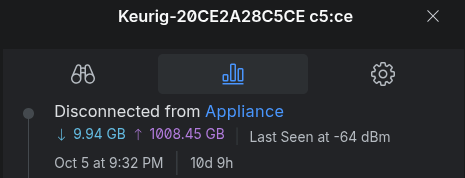
Recently, when a user with an IT background was checking the network conditions at his parents' home, he accidentally discovered that a Keurig smart coffee machine had uploaded more than 1TB of data in just 10 days. This abnormal behavior once caused the home wireless access point to be close to saturation.
According to the information released by it, this coffee machine uploaded a total of about 1TB of data in 10 days and downloaded nearly 10GB of data traffic. After discovering the abnormality, the user said that he immediately disconnected the power supply of the coffee machine and prepared to replace it with a new device for his parents.
The incident was initially discovered while reviewing home network management system UniFi. Data showed that the network activity generated by this coffee machine far exceeded the level of ordinary home appliances, and even occupied the resources of a wireless access point. For a device whose main function is simply to brew coffee, such a staggering flow rate is quite unusual.
However, further investigation revealed that much of the traffic did not actually leave the home network but was instead traveling within the LAN. Since no in-depth packet capture analysis was performed, the specific content of this traffic is not yet known. Relevant people believe that the most likely explanation is a malfunction in the device software, and a simple restart may be able to solve the problem.
Despite this, the user did not intend to pursue the source of the problem. He decided that the risk of letting his parents continue to use such a connected device was not worth the risk, so he decided to simply replace the coffee machine.
As for the question raised by many people about "why coffee machines need to be connected to the Internet", Keurig's smart products do provide some network-dependent functions. For example, users can remotely start brewing, purchase coffee capsules online, and set up regular delivery services through mobile applications. However, these features obviously cannot explain why the device generates such huge data traffic.
The user also half-jokingly speculated that in the future, manufacturers may even restrict users to only use designated brands of coffee capsules through digital rights management (DRM) mechanisms, similar to how some printer manufacturers restrict third-party consumables through chips and authentication systems.
Although the incident looks more like a software bug, it also reflects the real challenges faced by the smart home ecosystem. As more and more common household appliances are connected to the Internet, the probability of problems such as network failures, abnormal traffic, and out-of-control equipment is also increasing.
Security experts have long warned that many IoT devices lack adequate security protection designs, with manufacturers often focusing more on functional development than long-term security maintenance. Once there are vulnerabilities in the device, hackers may use these terminals as attack entrances to launch intrusions into the home network.
In addition, smart devices face another long-term risk. When manufacturers cease operations, terminate software support, or reduce maintenance teams, some smart devices that rely on online services may lose critical functions or even become completely unusable.
The report pointed out that some smart devices are particularly worthy of vigilance. For example, a connected lawn mowing robot will not only record working videos, but may also save residential layout information and Wi-Fi network-related data. Research this year has revealed that robot lawn mowers produced by two manufacturers have been found to have security flaws, and attackers can even remotely monitor the equipment and obtain user data.
Although similar risks continue to attract attention, large technology companies and home appliance manufacturers are still expanding their smart home layout. Although this coffee machine incident is likely to be just an isolated software anomaly, it reminds consumers once again: when more and more seemingly ordinary home appliances are given Internet capabilities, convenience also means more complex network management and security challenges.
Comments