
Abstract:
“
Dear Prime Minister Ambani, please forgive my ignorance for not realizing that you are the real person in power in India.
"
On October 10, Musk, the world’s richest man, posted such a post on his social platform X.The tone is respectful and the content is spicy.
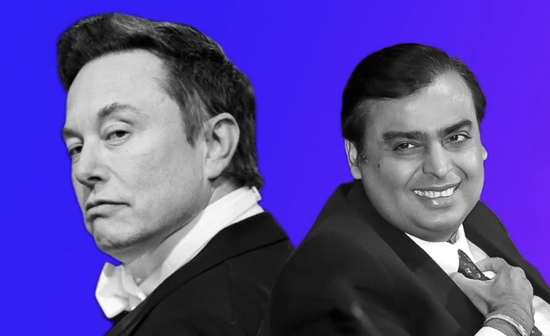
He went on to write:
“
Presumably you prefer to maintain the monopoly exploitation of the Indian people, but can you consider allowing Starlink to participate in market competition? ”
You know, the Prime Minister of India is named Modi, not Ambani.
Musk deliberately called Reliance Industries Chairman Mukesh Ambani "Prime Minister", which is equivalent to pointing at his nose and saying:
You are the one who really has the final say in India.
This air-to-wire confrontation alarmed the Indian government and brought to the table an issue that had long been covered up:
Why has the world's largest satellite Internet company been unable to knock on the door of India for five years?
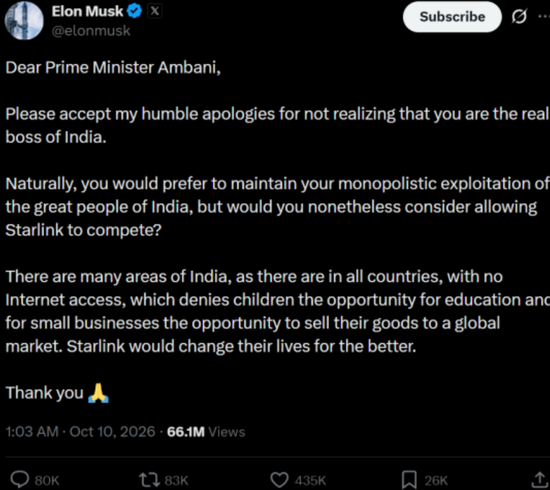
Full translation:
Dear Prime Minister Ambani:
Forgive me for not realizing that you are the real leader of India. I would like to sincerely apologize.
You naturally want to maintain your monopoly over the vast majority of Indian people. Even so, would you like to consider allowing Starlink to compete in the market?
Like all countries in the world, there are still many areas in India without Internet access. As a result, local children lose the opportunity to receive education, and small and micro enterprises are unable to sell their products to the global market. Starlink may improve their lives.
Thank you.
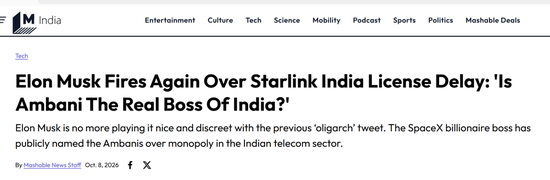
Elon Musk no longer remains polite and low-key about his previous "oligarch" tweets. The billionaire head of SpaceX has publicly named the Ambani family, accusing it of monopolistic behavior in India's telecom industry.
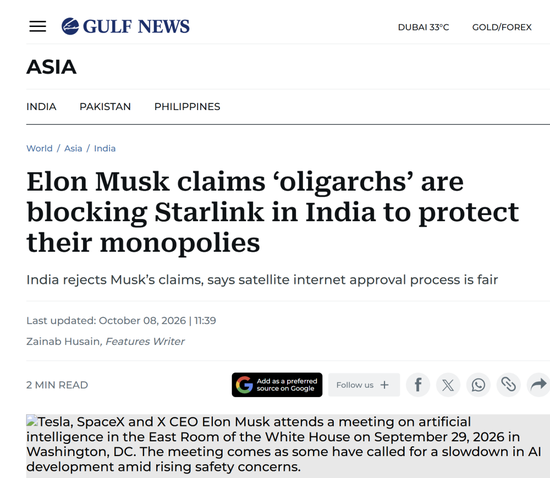
Elon Musk said that "oligarchs" are blocking the implementation of Starlink in India in order to protect their own monopoly interests.
Three posts in five days, the world's richest man publicly "sweared"
Things will start on October 8th.
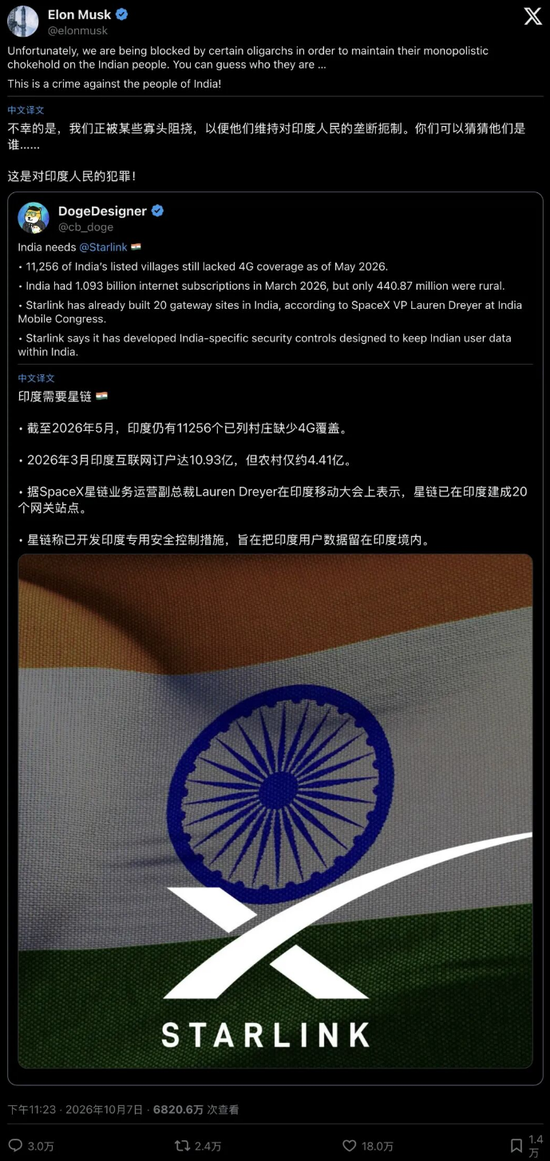
Musk forwarded a message that day "
More than 11,000 villages in India still have no mobile network coverage
"
's post with the text:
“
Unfortunately, we are being blocked by certain oligarchs,
The purpose is to maintain their monopolistic suppression of the Indian people.
You can guess who it is. This is a crime against the people of India
!
"
No names, no evidence, but everyone knows who he is talking about.
The Indian telecommunications and Internet markets are dominated by two major families:
Ambani’s Reliance Jio
and
Mittal's Bharti Airtel.
Ministry of Communications of India
The next day, a rare public statement was issued in response, saying that the claim that the regulatory framework was "unfair and discriminatory" was baseless and was a misunderstanding.
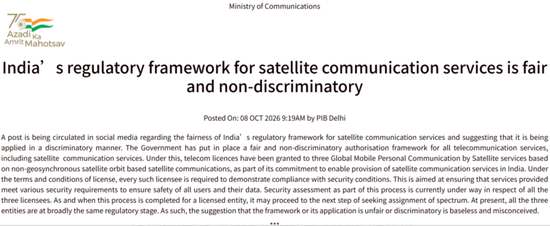
The statement failed to put out the fire.
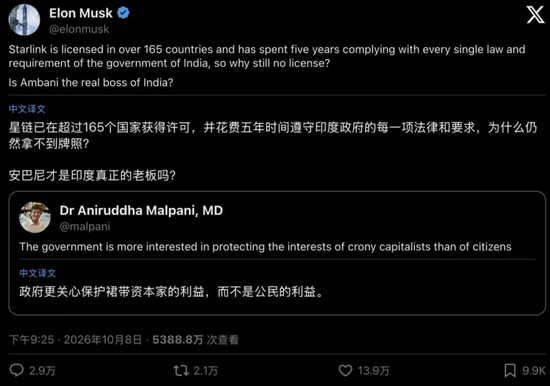
Musk directly named him on October 9:
"Starlink has been licensed in more than 165 countries and has complied with every law and requirement of the Indian government for five years. Why is there still no license? Is Ambani the real boss of India?
"
What followed was the famous "apology letter" on October 10th.
The capital market took action upon hearing this.
On Thursday, Bharti Airtel's share price fell about 1% intraday, and Reliance Industries fell about 1.1%.
Why is Musk so anxious
Musk’s anger is supported by real costs.
SpaceX has been working hard for five years to enter the Indian market.
As early as 2021, Starlink tried to accept reservations in India. As a result, it was characterized by the Indian government as "launching services without obtaining necessary permissions" and was forced to refund all pre-order payments.
In March 2025, SpaceX lowered its arrogance and signed distribution agreements with Jio and Airtel respectively, which was equivalent to agreeing to use the stores of the two oligarchs to sell its own terminals.
In mid-2025, Starlink finally obtained a satellite communications license issued by the Indian telecommunications department. Lauren Dreyer, Starlink's vice president of business operations, disclosed at the India Mobile Conference this week that the company has deployed more than 20 gateway ground stations and hundreds of ground antennas in India. User data is stored in India, and its operating methods have been adjusted in accordance with India's security standards and data sovereignty regulations.
The form was handed in, the seal was affixed, and the local big brother's hand was held, but the business just couldn't get started.
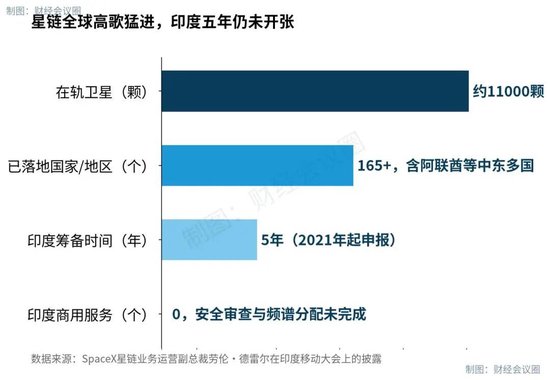
Starlink’s global scale and India’s progress
Horizontal contrast is even more dazzling.
Starlink currently has approximately 11,000 satellites in orbit, with services covering more than 165 countries and regions. Even the United Arab Emirates will officially launch services in September 2026. It is blooming all over the world, but India, the most populous country in the world, has not sold a single commercial terminal in five years.
80% of the market and two local licenses
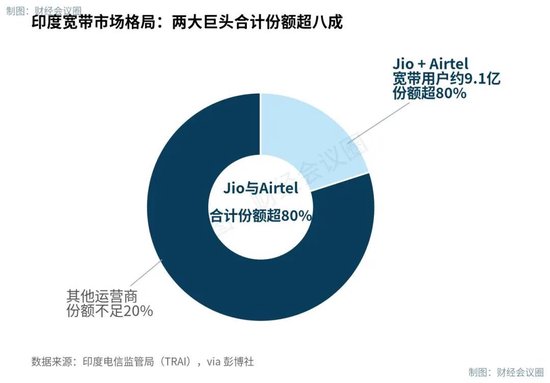
Indian broadband market share
Is Musk’s accusation of “oligarchy obstruction” groundless? Let’s look at the market structure first.
According to data from the Telecom Regulatory Authority of India, Jio and Airtel together serve approximately 910 million broadband users, with a market share of over 80%. In recent years, the two companies have spent hundreds of billions of dollars laying out 4G and 5G base stations and optical fibers.
If Starlink is successfully launched, rural users can buy a terminal and pay a monthly fee to access the Internet without having to wait for the base station to enter the mountains. This will be a direct dimensionality reduction blow to the income of the two giants in remote areas.
Look at the order in which licenses are issued to get a better idea of the flavor.
The Indian government has issued a total of three satellite communication licenses:
One was given to Jio Satellite, Ambani's own company;
One was given to Eutelsat OneWeb, whose major shareholder is the Bharti Group behind Airtel;
The third one is Star Chain, and it is the last one to get among the three.
They say they treat everyone equally, but in fact the two major local families have already secured their admission tickets.
Local players are not idle either.
In June this year, Jio announced that it was evaluating the construction of India's own low-orbit satellite constellation and was cooperating with European satellite operator SES to develop satellite broadband. Neil Shah, a partner at the research firm Counterpoint Research, believes that Starlink may have to wait until local Indian companies have built their own satellite Internet services before it is expected to be approved. Otherwise, if Starlink comes in without a "level playing field", it will directly dominate the entire market.
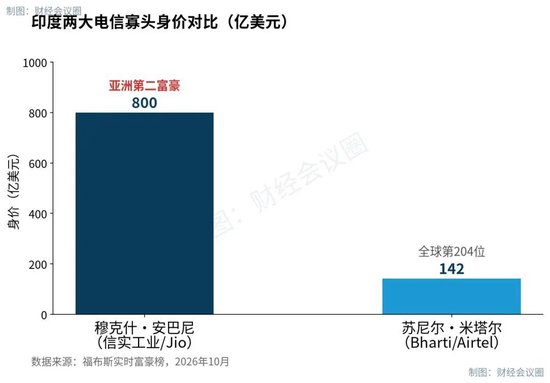
Comparison of the worth of Indian telecom oligarchs
Forbes real-time rich list display,
Ambani is worth approximately US$80 billion, ranking the second richest man in Asia;
Mittal is worth US$14.2 billion and ranks 204th in the world.
Musk is declaring war on two of India’s top tycoons at the same time.
India’s red line is not just business
However, it is unfair to blame the oligarchs entirely.
What the Indian government is really worried about is the nature of the Starlink network.
Several local conflicts in the past few years have clearly illuminated the background of Starlink:
It is a global communications network that is independent of any local telecommunications system and privately controlled by an American company.
Starlink terminals are still used during conflicts in the Middle East, and that service apparently does not have permission from the Iranian government. This scene deepens New Delhi's concerns: In the event of geopolitical tensions, when "other governments" make conflicting demands,
How can SpaceX ensure that it meets India's safety standards?
In June this year, media quoted people familiar with the matter as saying that the Indian government had actually suspended the process of approving Starlink’s commercial operations.
India’s conditions are also very specific:
The government has ordered that Starlink must be able to disconnect from the Internet in specific areas. User data is stored in India. How to implement geofencing must be made clear. Each one of them makes sense alone, but when put together it is a conspiracy: if you agree to install the "Indian-controlled switch", Starlink will no longer be a global network that is not controlled by any government;
If you don’t agree, you will never open the business.
At the same time, Indian netizens did not give Musk face.
The comment section of his post was flooded with criticism. A message with 25,000 likes read:
India is a sovereign country, not Musk's personal business project. Starlink is under the banner of helping the poor, but the service fee is quite expensive, and it is not a charity product.
Some netizens ridiculed Musk as the "President of the United States",
I advise him to first reflect on why the United States does not allow Chinese new energy vehicles to enter the U.S. market.
Some people asked Grok, a subsidiary of Musk's xAI, to explain the risks of Starlink to India. Grok actually listed four:
National security, data sovereignty, costs and market impact
.
The most damaging joke is:
A wise man once said that you should never attack Russia in winter and never provoke India on Twitter.
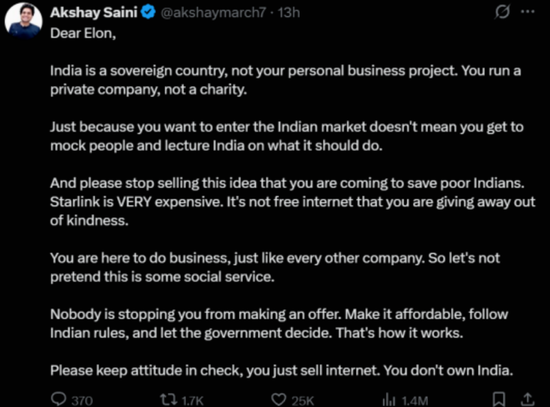
An Indian netizen who received 25,000 likes wrote that India is a sovereign country and not Musk’s personal business project. The message also said that Musk was promoting "Starlink" to India under the banner of helping the poor, but the service fee of "Starlink" is quite expensive and it is not a free charity product for the poor.
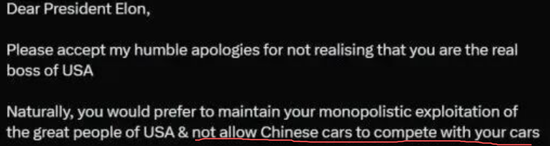
Some Indian netizens imitated Musk's satire on Ambani, calling Musk the "President of the United States" and believed that instead of interfering in India's affairs, he should first reflect on why the United States does not allow Chinese new energy vehicles to enter the U.S. market.
Swearing is false, negotiating is true
Anyone who understands Musk knows that swearing is never his emotion, but his negotiation tool.
In 2018, he criticized California's policies and turned around to get the Shanghai Gigafactory;
In 2022, we will challenge the US Securities Regulatory Commission and push the Twitter acquisition to the end.
The label of "oligarchic obstruction" this time is essentially to put the Indian government on the fire of "protecting monopoly and opposing universal benefits" and using public opinion to exchange for approval progress.
But this time he most likely hit the wall.
The more openly he exerts pressure, the less the Indian government can relent: A foreign richest man will change the rules after just two posts. Modi cannot explain himself in front of domestic voters. How will he control other companies in the future?
The louder the curse, the tighter the door may be closed.
Not to mention a ridiculous detail:
The "oligarch" that Musk railed against on X is precisely the only channel he can count on. Jio has millions of retail outlets in rural India, and it is simply unrealistic for Starlink to build its own channels from scratch. So there was a funny scene: while he was scolding Ambani for obstructing him, his goods had to be sold from Ambani's store in order to enter India.
When this chess game ends, it does not depend on who has the strongest technology or who has the loudest voice, but on when Musk is willing to put the "technical switch" and profit distribution on the negotiation table.
Before that, no matter how loudly he cursed on X, the satellite would not land on the rooftops of rural India by itself.
Comments