
Abstract:
On the 10th, four departments including the Ministry of Industry and Information Technology publicly released a notice (Draft for Comment) on further strengthening the management of innovative design and R&D testing and verification of automotive products. The Technical Guidelines for Automotive Product Innovation Design put forward specific testing and verification requirements around virtual controls, door handles, new human-computer interaction systems, and high-angle seats. The industry generally believes that the new regulations issued by the four departments are a sign of saying no to "quick cars"!
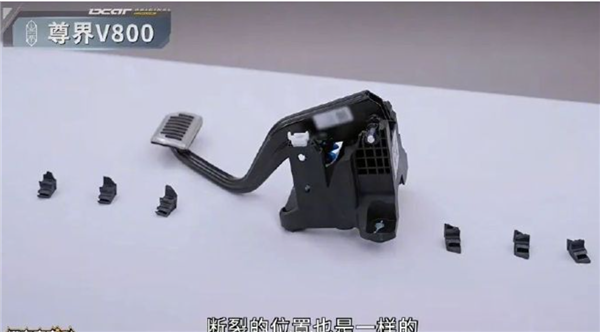
In the past few days, public opinion has been widely concerned about the breakage of the Zunjie V800 brake pedal bracket. The focus of discussion is the safety issues of cars, especially "quick" new energy vehicles. Although the incident awaits an authoritative investigation conclusion, one thing is beyond doubt: a car's brake pedal should never "break" while driving!
What is a "crash car"? This is actually a general term for those models launched by excessively compressing the research and development cycle and deleting the actual vehicle verification process in order to seize market share. "In order to pursue speed to market, some brands have not done many experiments that should be done, and consumers have become 'test drivers.'" Li Fenggang, general manager of Beijing Hyundai, once said bluntly at the 2026 China Automobile Forum.
"Express cars" seize the market with "quickness", but they have hidden dangers in "lack", which exposes the lack of process and shrinking verification.
A test engineer from a car company explained: "A new model often needs to complete basic parameter tests such as braking, steering, handling stability, ride comfort, power, and economy during the test process alone. In addition, high temperature, plateau, extreme cold calibration and environmental adaptability mileage tests are also essential."
Completing these tests naturally requires a corresponding amount of time. Zhu Xichan, a professor at the School of Automotive and Energy at Tongji University, said in an interview: "In the entire development cycle of a new model, vehicle road testing requires two winters and two summers. Even for small modifications, one winter and one summer, 30,000 kilometers of real road testing is necessary." Professor Zhu also gave an example: There are many complaints about "quick-start cars" being prone to rust, among which humidity, heat and lack of corrosion testing are one of the important causes.
One case is that a new energy vehicle company tested new car door handles for a total of 10,000 times, of which only 2,000 were physical tests and the remaining 8,000 were all completed by simulation. Some car companies only do 20% of real testing, and the remaining 80% of testing relies on simulation testing.
The "crash car" is an opportunistic way of replacing real road tests with simulation tests. It is a significant reduction in extreme engineering testing, a cutting of corners by deleting verification subjects and skipping verification processes. However, consumers will ultimately pay for these.
This summer, Chongqing continued to experience extreme weather above 40 degrees Celsius. Many owners of new energy vehicles of a certain brand found that the air springs leaked and one side of the vehicle body collapsed while driving, making the vehicle unable to continue driving. When the temperature is high, people gather together to lie down, which inevitably makes people question: Are the extreme heat tests before going on the market adequate?
Competition in my country's automobile market is fierce. Some car companies do not focus on quality but speed. In the end, it was proved that this road is dead. "Quick cars" that pursue the speed of "updating to new technologies" cannot go far or run stably in the market competition.
In July this year, the National Technical Committee for Automobile Standardization publicly solicited opinions and planned to raise the total mileage of reliability driving tests of the three types of new energy vehicles to no less than 30,000 kilometers, in line with the standards for fuel vehicles.
Cui Dongshu, head of the China Automobile Dealers Association's Passenger Alliance Branch, likens this measure to an "coming-of-age ceremony" for new energy vehicles. Cui Dongshu said: "The introduction of the standard aims to curb the trend of rapid shortening of the development cycle and make the testing of new models more standardized. It marks that China's new energy vehicle industry officially bids farewell to the policy 'infancy' and shifts from 'cultivation first' to 'standardization first'."
Although reaching the "30,000 kilometers" standard cannot be directly equated with vehicle safety, the signal light for rectification of "quick vehicles" has been turned on - car companies' "upgrading to new" relies on improving technical levels and production efficiency, rather than doing less testing that should be done; car companies cannot improve development efficiency at the expense of reduced quality and lack of safety guarantees.
In August this year, the Ministry of Industry and Information Technology and other departments jointly issued a notice to launch a one-year special campaign to improve the production consistency and quality of road motor vehicle products across the country, focusing on four aspects of road motor vehicle product production consistency, reliability, durability, and new technology testing and verification.
What are the four aspects looking for?
Check the consistency and be careful not to "send one set for inspection and another for mass production"; check the reliability and check whether the vehicle can run stably without failure in daily use; check the durability, not only focus on the design service life of the new car, but also pay attention to the research and development cycle before production; check the new technology test verification, check whether the risk assessment of innovative design is sufficient, and whether new materials and new structures have product defects, fatigue failure and other potential risks.
As for the problems of individual companies that unilaterally pursue cost reduction and ignore product quality requirements, and for the application of technologies or designs that have not been fully tested and verified into vehicles, causing product quality and safety hazards, the regulatory authorities launched a heavy blow on October 10, which is to correct the deviation from the source of automotive product innovation design verification and testing.
Safety is an insurmountable red line in the automobile industry, and ensuring safety is the most important function of Chinese automobiles. For consumers, a vehicle does not need to have top acceleration performance or intelligent configurations, but it must not "drop the chain" on the most basic safety issues at critical moments.
"Stable" is a more lasting "fast". In recent years, my country's automobile industry, especially the new energy automobile industry, has achieved leapfrog development. The hard-won industrial ecology, social trust, and consumer reputation need to be jointly maintained by all parties in the industry. The pace of innovation will not slow down due to the pursuit of excellence. Safety is the basis for Chinese cars to run more steadily.
Comments