
Abstract:
The intersection of astronomy and particle physics has recently achieved important results. An international research team composed of astrophysicists has obtained the latest measurement data of the abundance of primordial helium (Helium-4) in the early universe through high-precision spectroscopic observations of extremely low metallicity dwarf galaxies.
This data, which is accurate to the third decimal place, not only provides more stringent observational constraints for understanding the nucleosynthesis process in the first five minutes after the Big Bang, but also provides an extremely critical verification of the traditional standard cosmological model and the hypothesis of elementary particle physics.
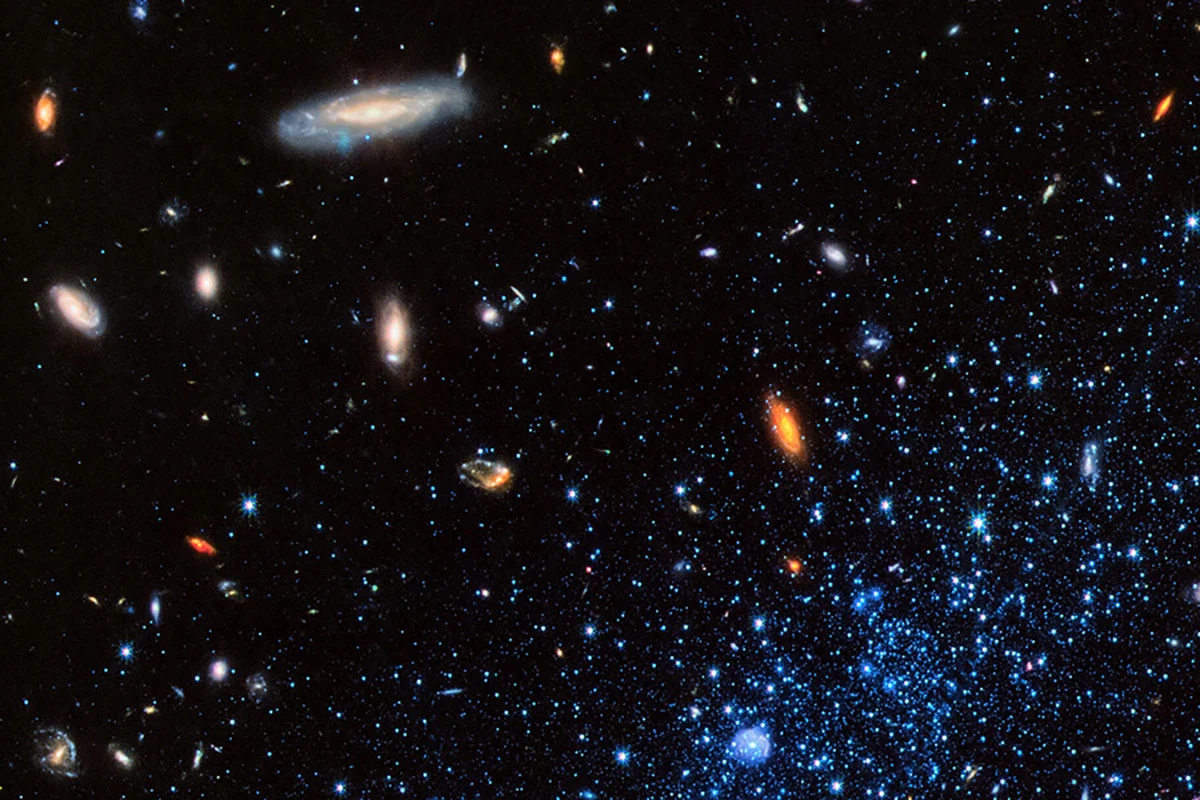
According to the standard Big Bang Nucleosynthesis (BBN) theory, within the first three to five minutes after the birth of the universe, as the temperature and density dropped due to violent expansion, protons and neutrons combined to form the earliest light elements in the universe, most of which were hydrogen and helium-4, with very small amounts of deuterium and lithium. Since stars will continue to produce additional helium through nuclear fusion during the subsequent billions of years of evolution, to explore the true chemical composition of the universe at the beginning, astronomers must look for primordial gas clouds and metal-poor dwarf galaxies that are almost uncontaminated by the evolution of subsequent stars for spectral analysis.
Using a large optical telescope in Hawaii and an advanced high-resolution Echelle spectrometer, the research team conducted long-term, deep exposures and observations of several extremely metal-poor dwarf galaxies hundreds of millions of light-years away from Earth. By accurately calculating the fluorescence radiation intensity emitted by ionized helium and hydrogen gas in the galaxy, and strictly deducting systematic errors such as interstellar dust extinction and stellar wind interference, the researchers successfully locked the mass fraction of the original helium element accurately within an unprecedented narrow range.
This high-precision raw helium abundance measurement is in good agreement with standard values predicted from observations of the Cosmic Microwave Background (CMB) by the European Space Agency's Planck satellite. This high degree of consistency between observational data spanning different evolutionary eras and based on completely different physical mechanisms once again strongly confirms the correctness of the Big Bang Standard Model and proves that mankind's current understanding of the extreme physical conditions of the early universe is accurate as a whole.
However, the researchers also pointed out that extremely small measurement deviations still leave room for potential exploration of new physics. By substituting this precise measurement into the thermodynamic equations of the early universe, the research team was able to set more stringent upper limits on the number of neutrino species in the early universe, neutrino asymmetry, and the presence of unknown lightweight hidden particles such as sterile neutrinos or dark radiation. Industry experts commented that with the next generation of 30-meter giant optical telescopes put into use in the future, the measurement accuracy of original element abundances will be further improved, and it is expected to become a key fulcrum for humans to leverage new physical laws beyond the standard model.
Comments