
Abstract:
On October 30, SanDisk (SNDK.US) announced its first quarter results for fiscal year 2027. The company's revenue for the quarter was US$11.03 billion, a year-on-year increase of 378%, a month-on-month increase of 23%, exceeding market expectations of US$10.68 billion; GAAP net profit was US$8.1 billion, a month-on-month increase of 17%; non-GAAP diluted net profit per share was US$49.51, higher than market expectations of US$46.27.
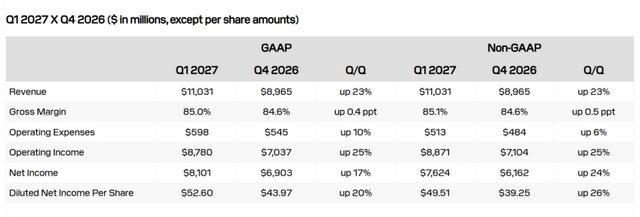
Driven by the tight supply of storage products, the company has raised prices significantly. The adjusted gross profit margin in Q1 reached 85.1%, which was higher than the 84.6% in the previous quarter and 29.8% in the same period last year. Management said on the call that about 60% of this quarter's revenue growth came from sales growth and 40% from price increases.
In terms of performance guidance, SanDisk expects revenue in the second quarter of fiscal 2027 to be US$12.2 billion to US$12.6 billion, higher than analysts’ expectations of US$12.1 billion; the adjusted gross profit margin is expected to be 84.5% to 85.5%. The company is committed to returning 100% of surplus cash to shareholders and has spent $5 billion on stock repurchases this quarter.
SanDisk Chairman and CEO David Goeckeler said that the data center business has grown from about 20% of the industry's total volume ten years ago to nearly half today. It is expected to occupy more than 55% of the market share in 2027, with bidding demand increasing by about 40% year-on-year. He predicts that by the end of this decade, key-value cache (KV Cache) will account for about one-third of the AI data center flash memory market. Currently, about 50% of SanDisk's production capacity in fiscal year 2027 has been locked in new business module projects, and this proportion will rise to about two-thirds in 2028.
In addition, SanDisk's first high-bandwidth flash (HBF) memory chip has completed tape-out. This architecture has a read bandwidth equivalent to HBM but has a larger capacity. The first batch of samples is expected to be delivered to customers next year. Management also pointed out that the current two quarters are the low sales period of the PC market. It is expected that PC sales may still decline by single digits next year, but PC storage capacity (in EB) will grow. All segments of the NAND flash memory market will show positive growth next year; automotive electronics is regarded as one of the largest market segments in the future edge computing field.
Comments