
Abstract:
The earth is about 4.5 billion years old, but there is a puzzling time gap in the rock formations in many parts of the world: hundreds of millions of years, or even more than a billion years, of geological records are missing between some ancient rocks and the younger sedimentary rocks above them.
Scientists call this phenomenon the "Great Unconformity." Recently, a research team from the University of Wollongong in Australia proposed a new explanation: the slowly flowing mantle material deep in the earth may have promoted large-scale uplift of ancient continents, causing rocks to be exposed and eroded for a long time; then the continents gradually sank, and oceans and sediments covered these eroded surfaces, thus preserving this geological discontinuity to this day.
The Great Unconformity is one of the most famous unsolved mysteries in geology. Normally, rock layers accumulate over time, with younger sediments covering older rocks, creating a continuous record that traces Earth's history. However, where the Great Unconformity occurs, sedimentary rocks formed in the early Cambrian period about 540 million years ago often directly cover ancient crystalline rocks that are more than 1 billion years old.
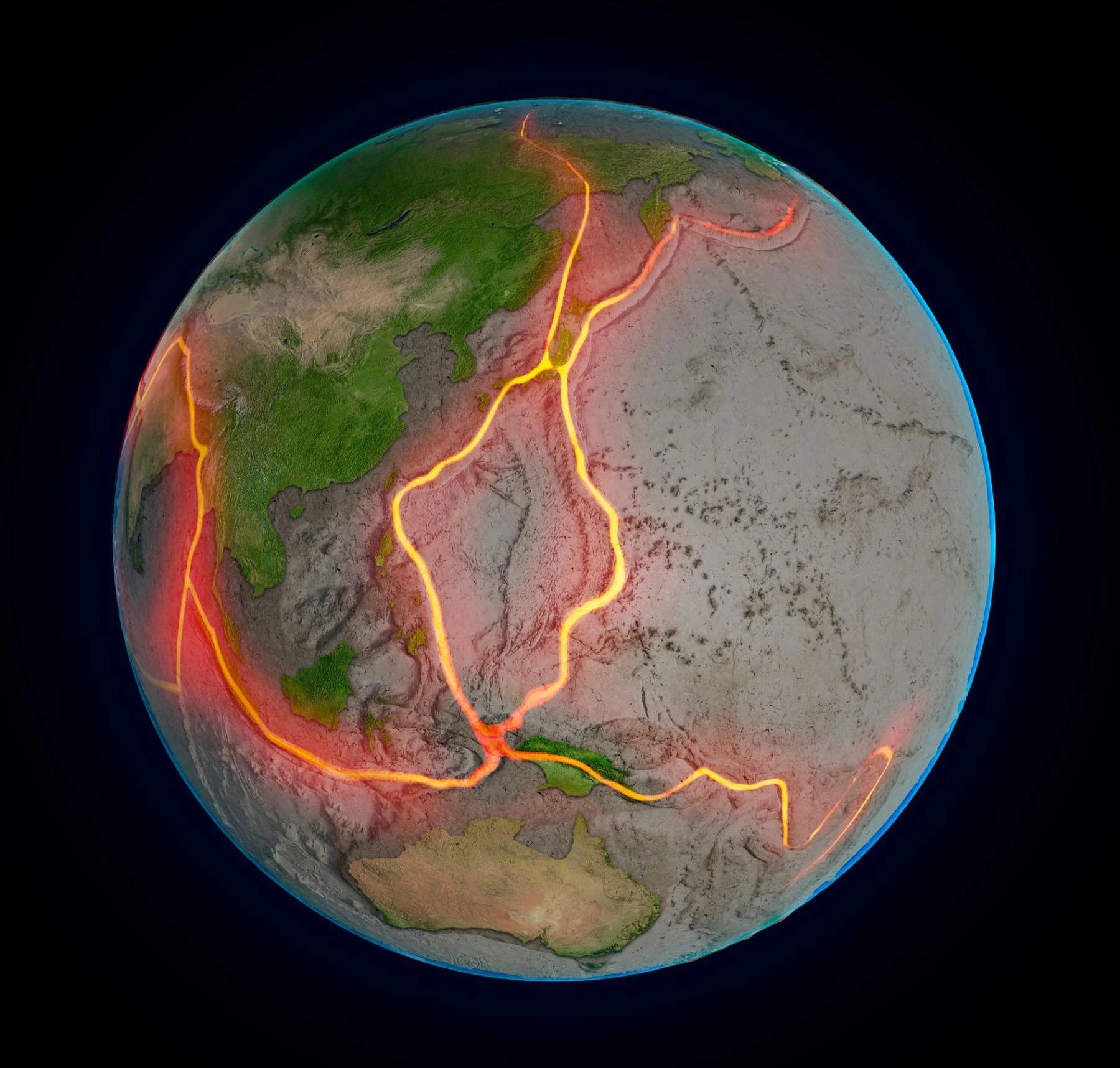
This huge time gap between rock layers means that rocks formed during the long intervening period have disappeared or have never been preserved locally.
The Grand Canyon is one of the most famous places to observe this phenomenon. On the canyon walls, Tapeats Sandstone, formed about 540 million years ago, directly covers ancient basement rocks such as Vishnu Schist that are far more than 1 billion years old. There is a geological time gap of hundreds of millions of years between the two.
Similar phenomena are not limited to North America; related geological boundaries can also be found in Europe, Australia, Africa and Asia. However, the missing time spans in different areas vary, some are about 200 million years old, and some are more than 1 billion years old.
In the past, scientists have proposed a variety of explanations, including global erosion, ancient glacial activity and changes in plate tectonics. In particular, the global glacial events that occurred in the late Neoproterozoic were once thought to have caused large-scale rock erosion. But these theories cannot fully explain why the Great Unconformity can form on distant continents, nor why erosional interfaces in some areas can be preserved for such a long time.
This time the research team turned their attention to the movement of the mantle deep in the Earth.
The mantle is located beneath the earth's crust and is composed of high-temperature solid rock. Although it does not flow as quickly as a liquid, mantle material is capable of slow convective motions on time scales of millions to hundreds of millions of years. These deep movements can change the height of the Earth's surface, causing large continental areas to gradually rise or sink.
Research leader Santosh Dhungana, a doctoral candidate at the University of Wollongong, and his supervisor, Associate Professor Nicolas Flament, used computer models to simulate the relationship between mantle convection and vertical movement of continents over hundreds of millions of years.
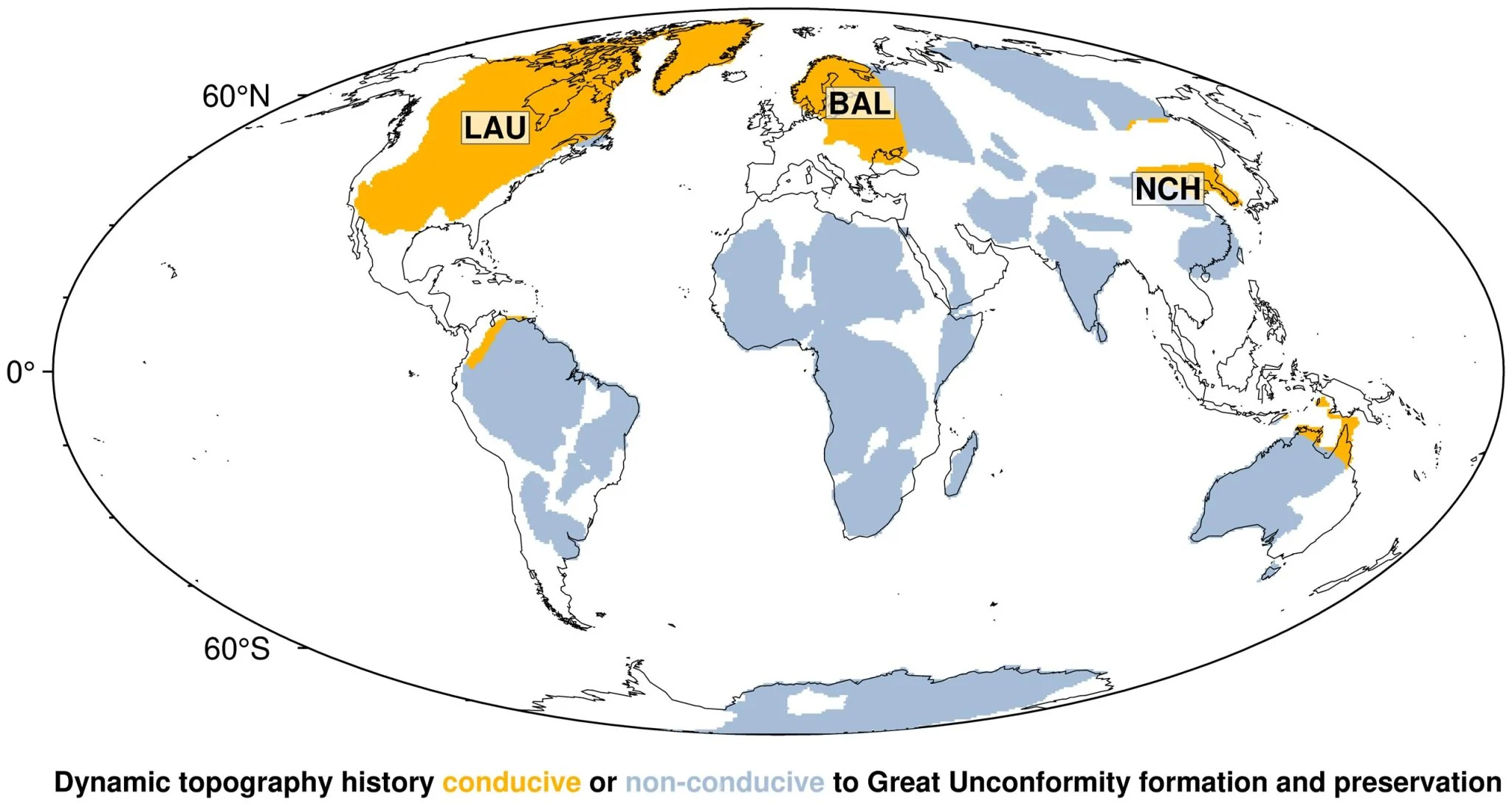
Models show that during the Neoproterozoic period about 1 billion to 540 million years ago, the flow of hot material inside the mantle may have pushed the ancient continental cores of Laurentia, Baltica, and North China to gradually uplift.
Laurentia is the predecessor of the core of the ancient continent of North America, and the Baltic Continent forms an important geological foundation for today's Nordic region. The researchers found that these areas experienced a long-lasting process of surface uplift, gradually exposing ancient rocks that were originally buried underground.

As rocks are exposed for longer periods of time, weathering, river washouts, and other erosional processes can continually remove the upper layers of rock and sediment. After hundreds of millions of years of erosion, a large number of rock formations that could have recorded the history of the Earth were completely removed, leaving only the surface of ancient crystalline rock.
But it's not enough to explain why the rocks disappeared. Another puzzling question about the Great Unconformity is why the eroded surface was preserved over time rather than continuing to be completely destroyed.
The key, researchers believe, is the subsequent sinking of the continent.
Entering the Phanerozoic, a geological period about 540 million years ago, the mantle movement pattern changed, and the previously uplifted continental core gradually sank. As the surface level decreases, seawater begins to re-cover these long-eroded areas, and new sediments accumulate, separating the older rocks from the younger geological record.
In other words, previous continental uplift was responsible for removing large amounts of rock, while subsequent continental subsidence helped preserve the geological interface created by erosion. Two deep Earth processes that lasted for hundreds of millions of years worked together to create the Great Unconformity seen today.
The researchers found that the uplift and subsidence areas predicted by the computer model are highly consistent with the actual distribution of large unconformity surfaces in areas with obvious distribution, including North America, Northern Europe and North China. This geographical correspondence provides important support for the involvement of mantle motion in the formation of the Great Unconformity.
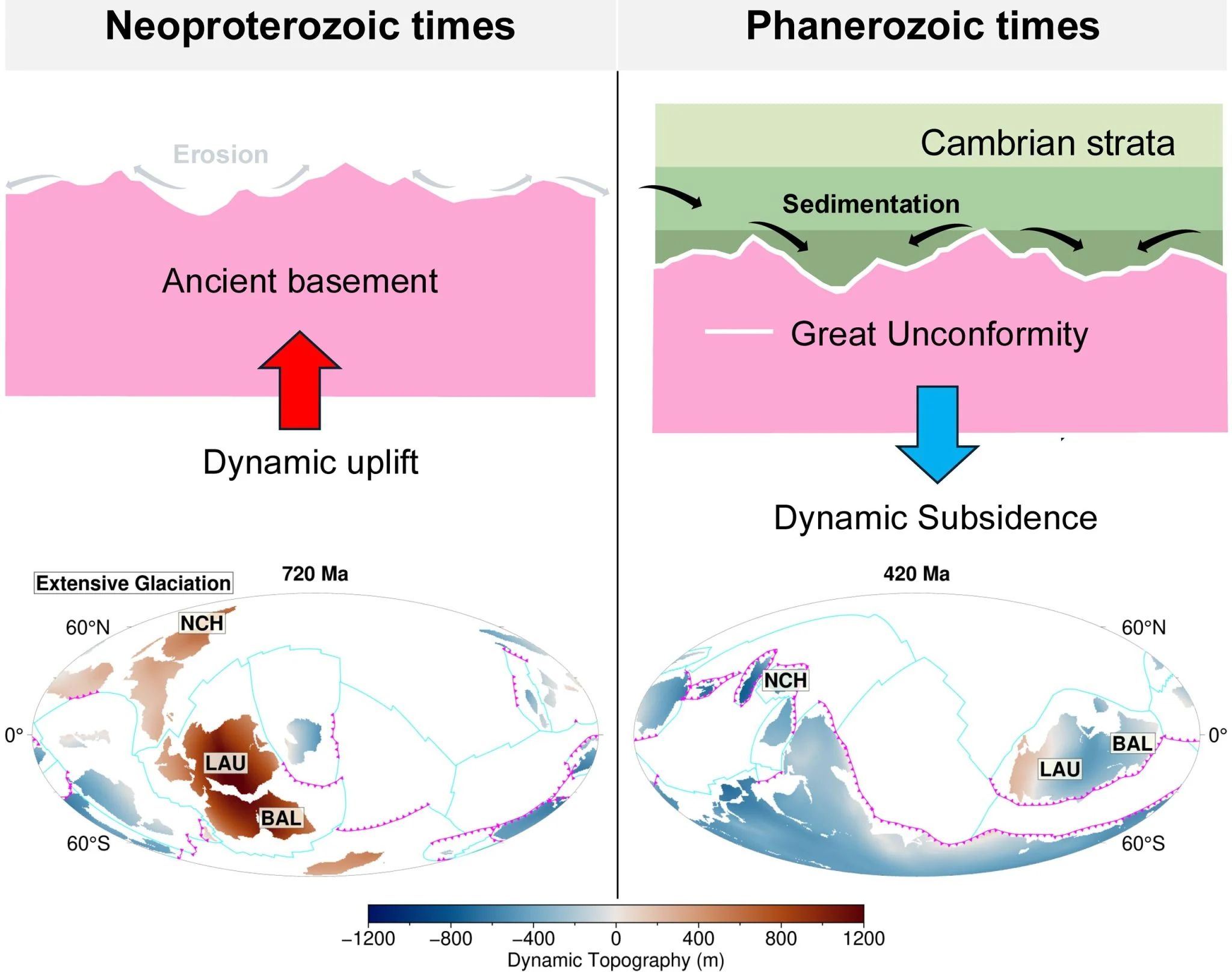
Nicolas Flament said that long-term uplift followed by long-term subsidence created the ideal conditions to remove large amounts of rock and preserve the eroded surface. While many past explanations have not fully incorporated actual movements in the deep Earth over long geological timescales, this study attempts to link mantle dynamics to the surface geological record.
The research also has broader geological implications. It illustrates that the rock formations seen on the Earth's surface are not only affected by external forces such as rainfall, rivers, glaciers and oceans, but may also be controlled by long-term mantle movements thousands of kilometers deep. Slow changes in the Earth's interior can leave clearly identifiable geological traces hundreds of millions of years later through processes such as continental uplift, erosion and sedimentation.
The research paper is titled "The deep Earth origin of the Great Unconformity" and was co-authored by Santosh Dhungana and Nicolas Flament. It was published in Nature on November 4, 2026. The research was funded by the Australian Research Council.
Of course, this study does not mean that the Great Unconformity is formed by exactly the same process in all regions. Different continents have different geological evolutionary histories, and the missing time spans also vary. The mantle dynamics model proposed by the research team mainly explains the formation and preservation mechanism of the large unconformity in several important areas.
The most interesting aspect of this discovery is that seemingly lost chapters of Earth's history may not have been lost by accident. Their disappearance itself just records the large-scale changes that have occurred in the earth's interior. By studying these missing rock layers, scientists may be able to further reconstruct the movements deep within the Earth hundreds of millions of years ago, and how ancient continents rose, fell, and reshaped themselves over time.
Comments