
Abstract:
Over the past two decades, the Antarctic ice sheet has continued to melt and lose at an average annual rate of about 140.5 billion tons, which is one of the major uncertainties in future global sea level rise. However, the latest satellite observation data reveals an unexpected turn: In just two years from 2021 to 2023, the Antarctic ice sheet has a net increase in mass of approximately 695 billion tons, the largest increase in the history of the GRACE gravity satellite.

A latest study published in the top international academic journal "Nature" reveals the driving force behind this rare phenomenon. An international scientific research team led by the Institute of Oceanography, Chinese Academy of Sciences, successfully deciphered the climate linkage mechanism between the tropical ocean thousands of miles away and the Antarctic ice sheet through comprehensive analysis of gravity satellite data, ice core snow accumulation records, water vapor tracking, and atmospheric circulation model simulations.
Research shows that between 2021 and 2023, the "tropical warm pool" area located at the intersection of the western Pacific and the eastern Indian Ocean has experienced abnormal and sustained seawater warming. This continued warming stimulates large-scale atmospheric Rossby wave trains in high latitudes of the Southern Hemisphere, completely reshaping the atmospheric circulation pattern over East Antarctica. Under the enhancement and maintenance of the vortex mean flow feedback, low pressure anomalies formed in the waters south of Australia, and high pressure anomalies appeared along the coast of East Antarctica. The two formed a significant "north-south dipole" circulation pattern.
This dipole circulation is like a huge water pump, continuously transporting large amounts of moist water vapor from the mid-latitudes of the Indian Ocean to the Antarctic, significantly increasing the number of "atmospheric rivers" reaching the Antarctic continent. The large amount of moisture eventually transformed into continuous heavy snowfall in areas such as Queen Mary Land and Wilkes Land in East Antarctica, which directly promoted the short-term explosive growth of local ice sheet mass.
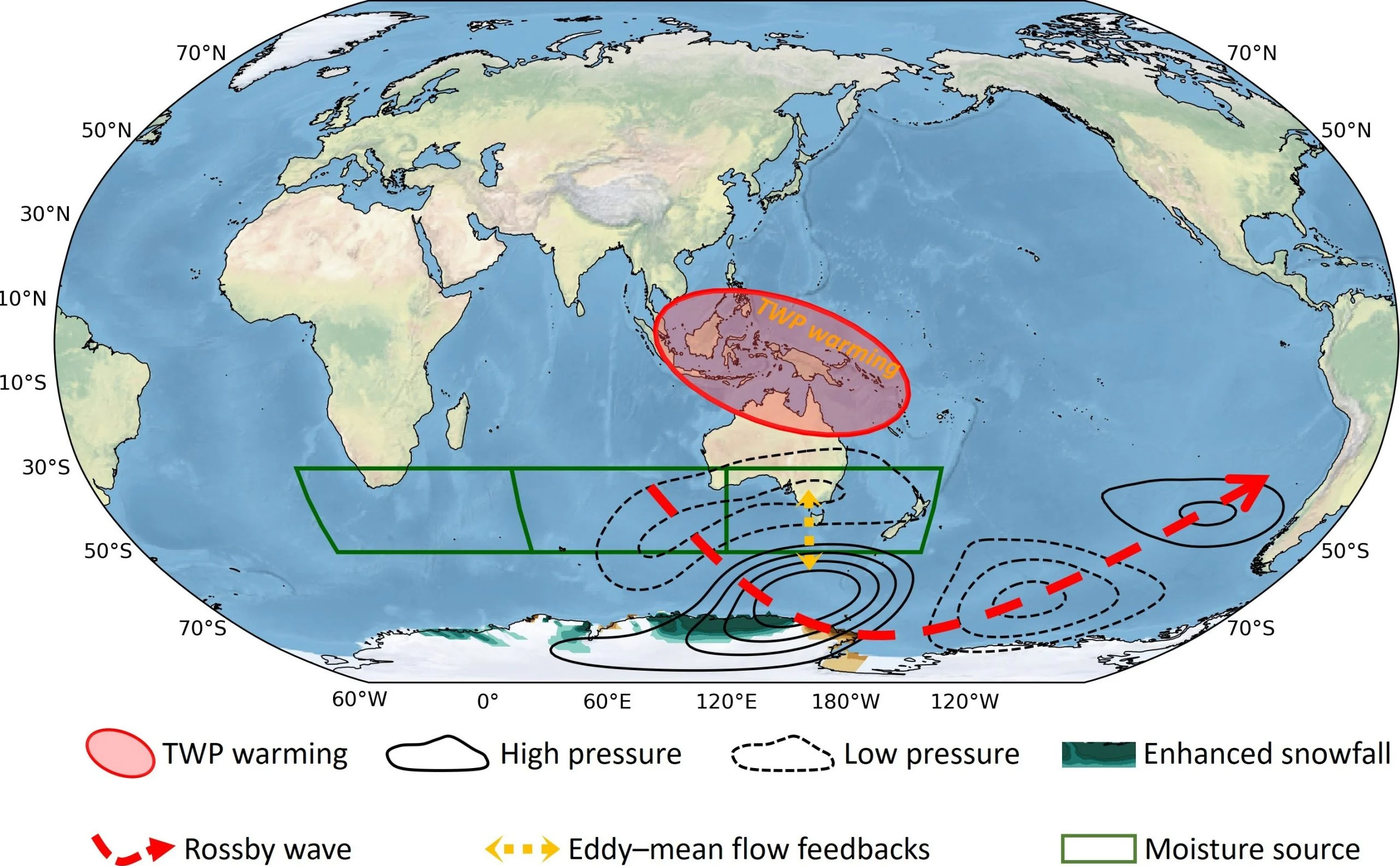
Numerical simulation experiments further confirmed that the abnormal warming of the tropical warm pool is the direct cause of this circulation and the sharp increase in snowfall. It is worth noting that the analysis shows that climate warming caused by human activities only accounted for about 9% of the snowfall anomaly, indicating that the event was mainly caused by natural interdecadal fluctuations within the earth's climate system, rather than direct atmospheric humidification driven by greenhouse gases. Similar tropical warm pool sustained warming events occur approximately once every ten years. It is like a natural remote "regulator" that dominates the multi-cyclical oscillations of East Antarctic ice and snow accumulation.
Although the ice sheet has recorded a staggering increase in two years, researchers have made it clear that this does not mean that the long-term trend of Antarctic ice melt has been reversed. In the long term, the West Antarctic ice sheet will continue to melt, and some outflow glaciers in East Antarctica are also facing the threat of melting at the bottom of the ice shelf and accelerating ice flow caused by warm ocean water.
This study establishes for the first time the long-range connection path between the "tropical warm pool-East Antarctic Ice Sheet". It provides a key answer to the puzzle that has long puzzled the scientific community as to why the mass of the Antarctic ice sheet fluctuates violently in the short term. It also lays an important theoretical foundation for more accurate predictions of polar climate change and global sea level dynamics in the future.
Comments