
Abstract:
Recently, Mercedes-Benz CTO Jörg Bolzer admitted at a media roundtable that
The L3 level autonomous driving launched by the brand in its early years has limited practicality. Mercedes-Benz has adjusted its technical route and prioritized high-end L2 assisted driving. In the future, it plans to skip L3 and directly sprint towards L4. He said bluntly, "Being the first to launch new technologies does not mean that they will be able to meet the actual needs of consumers."
It is reported that Mercedes-Benz’s Drive Pilot was once the leader in the global autonomous driving circle. At the end of 2021, it was approved by the German Federal Transport Administration and became the world’s first mass-produced L3 system that can be legally put on the road. In 2023, it landed in Nevada and California in the United States, and it became a hit.
When the system is activated, the driver can watch videos or play games with his or her hands or eyes free, and Mercedes-Benz will be fully responsible for an accident.
But behind the seemingly close-to-autonomous driving experience are harsh usage conditions. The system's maximum speed is only 64km/h, and it can only be activated on congested highway sections, during the day with fine weather, and in areas covered by high-precision maps.
In other words, the best scenario for this system is crawling in traffic jams, but it won’t be able to help when it’s really on the highway.
Although the experience is average, the optional price of Drive Pilot in Germany is as high as 5,000 to 9,000 euros, and in the U.S. market, an annual subscription fee of $2,500 is required.
Due to low demand and low frequency of use, the new S-Class released in January this year no longer provides Drive Pilot, and the facelifted EQS has also removed it.
The successor is MB.DRIVE ASSIST PRO. This L2++ level system supports full driving assistance from the starting point to the end. It can complete operations such as lane changes, intersections, turns, and recognition and response to traffic lights on highways and urban roads. The new S-Class is equipped with up to 27 sensors (10 cameras, 5 millimeter wave radars, 12 ultrasonic radars), and a computing power platform of 254 TOPS.
However, since it is L2 assisted driving, the driver still needs to hold the steering wheel and look at the road, and the responsibility still lies with the driver. The system has been first launched in the Chinese market, and was subsequently introduced to the United States and Europe.
As for further planning, Mercedes-Benz chose to directly cross the L3 hurdle.
Currently, Mercedes-Benz is cooperating with Momenta to conduct L4-class Robotaxi public road testing in Abu Dhabi with an S-Class prototype.
Bolzer predicts that the L4 model will not be mass-produced until after 2030 and will be gradually promoted.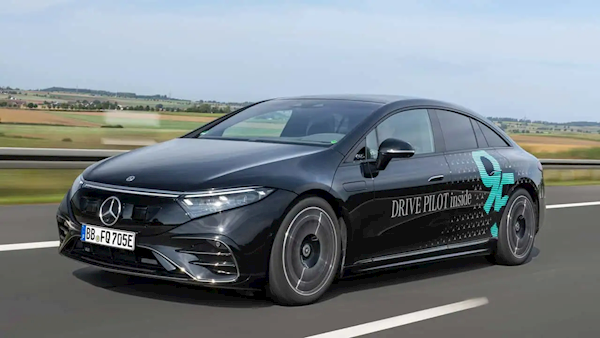
Comments