
Abstract:
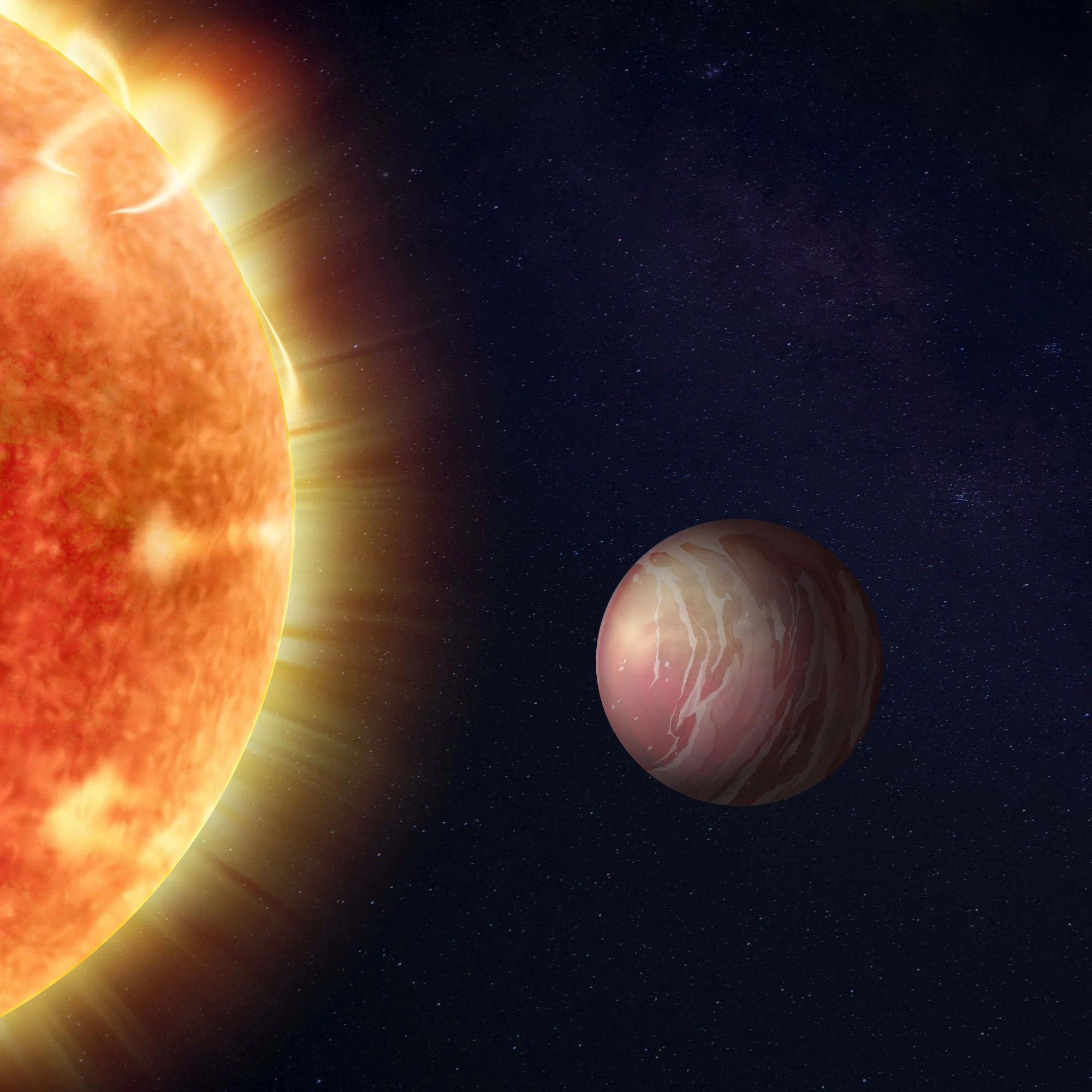
TOI-561 b, a rocky planet about 280 light-years away from Earth, is orbiting its star in a period of about 10.5 hours. It is extremely close to the star and has been subject to intense radiation for a long time. According to current theories, it should have lost most of its atmosphere billions of years ago; but new observations from the Webb Space Telescope show that this hot world may still be surrounded by a significant layer of atmosphere.
The international research team used the Webb Telescope's near-infrared spectrometer to continuously observe TOI-561 b for about 37 hours, recording changes in brightness and thermal radiation during its nearly four revolutions. The side of the planet facing the star is cooler than predicted by models of bare, dark rock; researchers taking the first observations of the night side found that the night side doesn't have enough heat to explain the entire difference. Combining the phase curve and energy model, the team concluded that the planet reflects about three-quarters of the incident starlight, with an albedo similar to Venus. At the same time, the atmosphere may transport some heat from the day side to the night side.
Climate simulations show that mineral clouds such as silica and magnesium silicate may form on the sun's surface near the junction of day and night, reflecting starlight and reducing surface heat absorption. The effect is similar to a planetary-scale "sunscreen layer." However, Webb's observations did not directly image the clouds or determine their composition; silicate clouds are currently the result of a model that can explain the high reflectivity.
What exactly the atmosphere is made of is still an open question. Possibilities suggested by the researchers include a hot carbon dioxide atmosphere, or an atmosphere rich in the volcanic gas sulfur dioxide. The surface of TOI-561 b is thought to be covered by a global magma ocean. The molten interior continuously releases gases and replenishes volatiles taken away by stellar radiation. This may explain why the atmosphere exists for a long time; another possibility is that the planet originally had unusually rich gas reserves.
The research, published in the Astronomical Journal, builds on previous evidence that TOI-561 b may have a thick atmosphere. The team plans to use Webb to continue observing at longer wavelengths to distinguish different atmospheric models and understand how this extremely hot planet maintains its atmosphere; the researchers emphasize that the environment here is far from suitable for known life.
Comments