
Abstract:
The Vera Rubin Observatory, funded by the National Science Foundation and the Department of Energy, discovered the outer solar system object 2026 ED138. It is located beyond the orbit of Neptune, with a preliminary estimate of a diameter of about 600 to 1,500 kilometers. It may be one of the larger dwarf planet candidates discovered so far; however, it has not been officially confirmed as a dwarf planet, and it only has a temporary number for the time being.
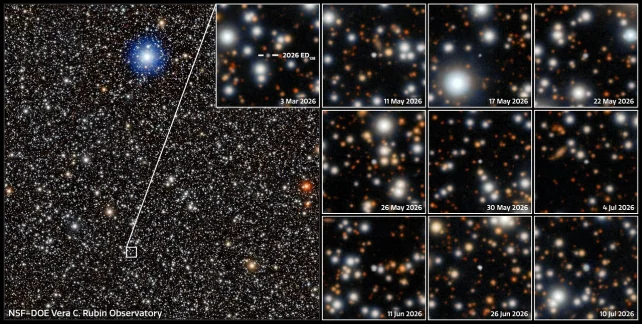
The discoverer, Matthew Holman, an astronomer at the Harvard-Smithsonian Center for Astrophysics, noticed this moving object when analyzing observation data from the Rubin Observatory on October 13. The research team then confirmed 30 observations in the Rubin Observatory's data from March 4 to July 11, 2026, distributed over 20 nights; after consulting the archives, they also found the records it left as early as 2016 from the dark energy camera images of the Inter-American Observatory in Tololo Mountain, Chile, as well as observations in 2017, 2018, 2019 and 2023. Combining this data allowed astronomers to track its movement for up to ten years.
According to the Minor Planet Center, ED138 is currently about 46 astronomical units from the sun and takes about 281 years to orbit the sun. Its perihelion is about 36.86 AU, its aphelion is about 49.04 AU, and its orbital inclination is about 24.5 degrees. In comparison, Pluto is approximately 29.6 to 49.08 AU from the Sun, so ED138 always falls within Pluto's distance from the Sun, but its orbital plane is much tilted.
The object has not been discovered before, in part because of its position in the sky close to the plane of the Milky Way, where a dense background of stars makes the faint moving point of light difficult to discern. The Rubin Observatory is designed to conduct large-area and repeated sky surveys. Researchers used algorithms to track position changes in a large number of images to identify ED138 from the crowded star field. The diameter of the celestial body is still not accurately measured: scientists estimate based on brightness and distance that if the surface is darker, it may be larger; if the surface ice layer is highly reflective, the actual size may be smaller, so a wide range of 600 to 1,500 kilometers is given.
The determination of a dwarf planet requires confirmation that the celestial body is massive enough to form an approximately spherical shape by its own gravity. The research team believes that if ED138 is close to the larger end of the estimated range, it may meet this condition, but infrared observations are needed to further constrain its size and properties. If confirmed, it would join the five known dwarf planets: Pluto, Ceres, Eris, Haumea and Makemake.
The Rubin Observatory will launch a ten-year Southern Hemisphere sky survey mission in June 2026. The research team expects that this continuous and repeated observation will help discover thousands of objects in the outer reaches of the solar system and study the formation and evolution of the solar system by tracking their orbits. Rubin's data may also provide more clues to the "Planet Nine" hypothesis, but ED138 itself does not prove the existence of Planet Nine.
Comments