
Abstract:
According to a latest study published in Nature on the 19th, astronomers used the James Webb Space Telescope to directly track for the first time the process of stars "eating" similar species: two stars spiraled into a shared envelope stage, and then violently exploded. This event, named AT 2025abao, provides an important basis for understanding the formation of compact star systems and other energetic astronomical events.
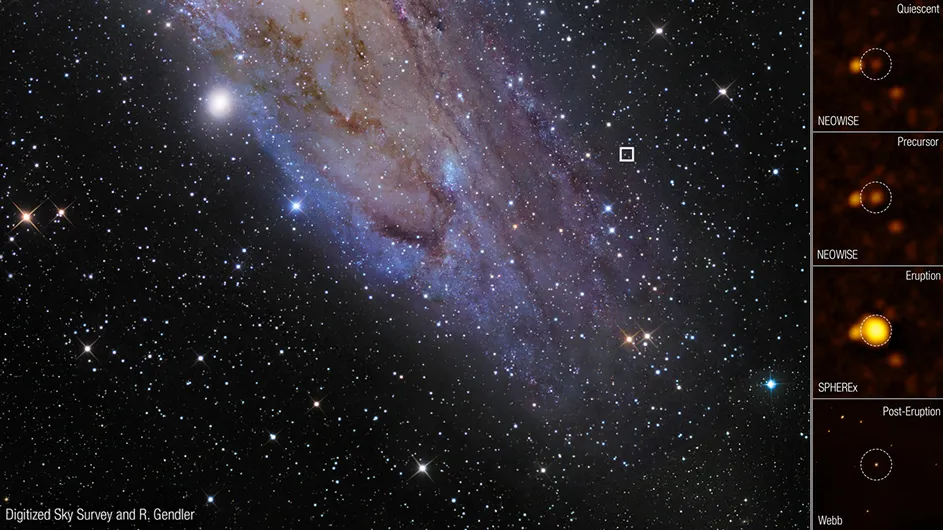
When a star evolves to the end of its life, its volume will expand rapidly and may swallow any celestial body in nearby orbit. In a binary star system, this is called the "shared envelope stage." However, it is still difficult for humans to track astronomical events in which stars engulf similar species, mainly because envelope obscuration is difficult to detect and the evolution process is too rapid. Previously, most people have only seen the aftermath of the explosion.
In fact, this is a thrilling process. In a binary star system, the outer layer of the first star wraps its core with the second star. The second star continuously loses orbital energy and angular momentum, and the energy released can heat and eject the envelope. The system either leaves a tight binary, or the two stars merge completely. Therefore, this process is closely related to the formation of compact systems such as X-ray binaries.
Astronomers from Columbia University in the United States analyzed the multi-stage observation data of AT 2025abao. The event manifested itself as an explosive spot of light in the Andromeda Galaxy. Research shows that its predecessor was a binary star system: the first star (primary star) has a mass of about 7 times that of the sun, a radius of about 350 times that of the sun, and a luminosity of about 18,000 times that of the sun; the second star (companion star) has a mass of about 0.7 times that of the sun. In 2018, the companion star entered the outer layer of the main star and continued to spin inward for about seven years. This process only experienced about seven orbital movements.
In 2023, the research team discovered the abnormal brightness of the system from a large amount of data and continued to monitor it. In October 2025, the system exploded violently, ejecting about 0.1-0.2 solar masses of material. NASA's Webb Space Telescope then carried out observations about 47 days after the peak of the explosion, helping the research team analyze the state of the system before, during and after the explosion. Combining these data, they believe that the companion star may have merged with the main star.
The observations also suggest that today's Standard Model may not fully describe how energy was redistributed in this event, particularly how orbital energy was transferred to the envelope and drove the ejection of material. Long-term infrared observations are still needed in the future to determine the final outcome of such astronomical events.
Comments