
Abstract:
Scientists have recently clarified the timeline of three giant impacts that reshaped the moon, bringing humans one step closer to solving a long-standing mystery: why the side of the moon facing the Earth is so different from the side facing away from the Earth.
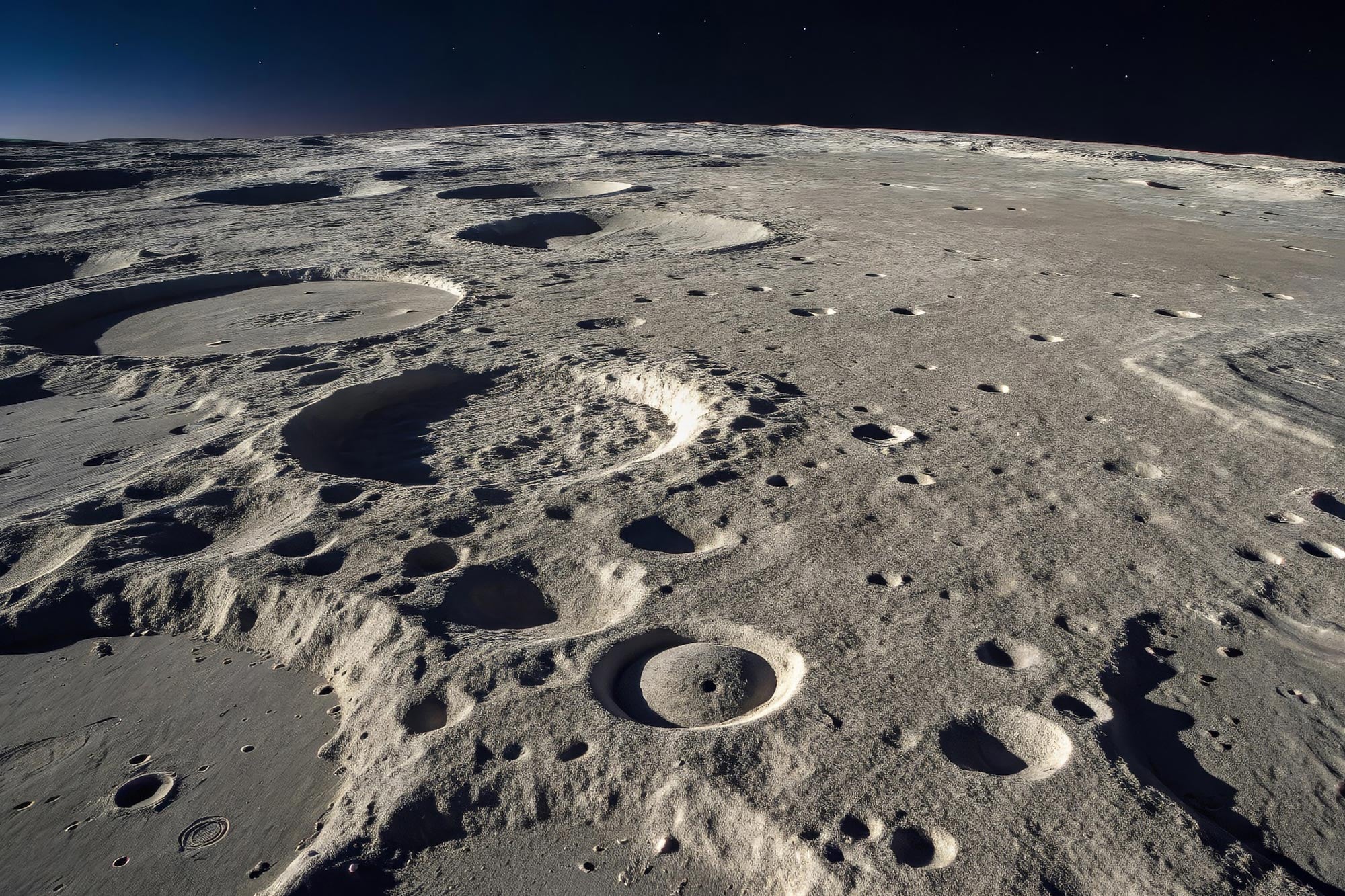
Billions of years ago, an impact powerful enough to melt a large amount of lunar rock formed the largest impact basin on the moon. Subsequent impacts have continued to fragment and scatter these ancient materials, leaving a geological record on the lunar surface that scientists can trace.
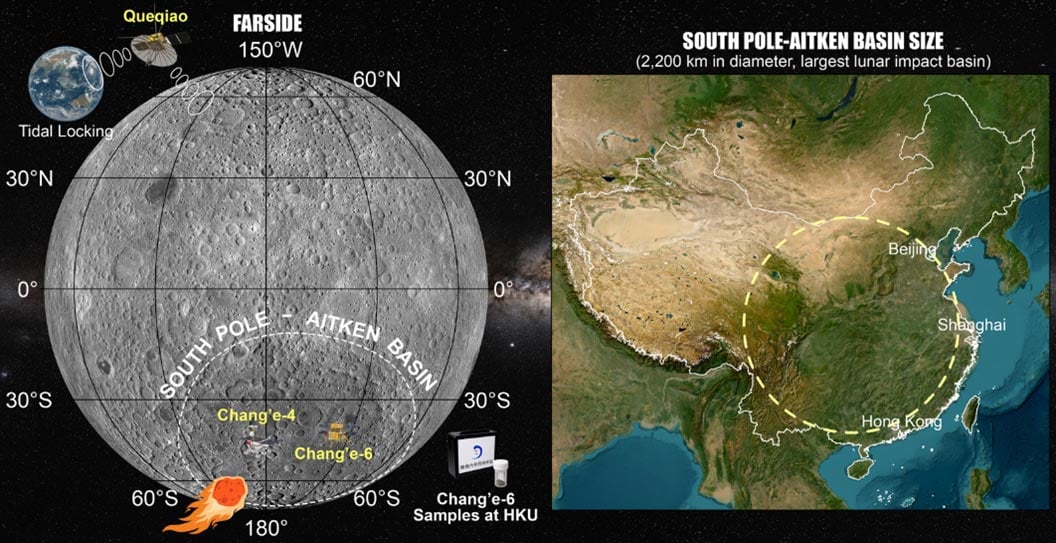
The South Pole-Aitken Basin, located on the far side of the moon, is one of the oldest and largest impact structures in the solar system. Understanding its history helps explain why the moon's front and back are so different, what lies beneath its surface, and when major impacts occurred in the moon's early evolution.
According to the research team of the University of Hong Kong, an international research team led by Zhao Guochun, professor of the Department of Earth and Planetary Sciences of the University of Hong Kong, and Dr. Qian Yuqi, the first author of the paper, identified two types of magnesium-rich rocks with completely different sources, and further clarified the timeline of the main impacts that shaped the region. Relevant results have been published in the journal Science Advances.
Over the past few decades, the Antarctic-Aitken Basin has been poorly explored. In 2019, Chang'e-4 completed humanity's first soft landing on the back of the moon; in 2024, Chang'e-6 brought rock samples from this area back to Earth for the first time.
Using Chang'e-6 samples assigned to the University of Hong Kong, as well as surface sounding data from the Chang'e-4 and Chang'e-6 landing areas, the researchers obtained for the first time direct geological evidence from the two landing sites to reconstruct the basin's impact history. Satellite observations and numerical modeling helped the team track the origin of rocks within the wider basin.
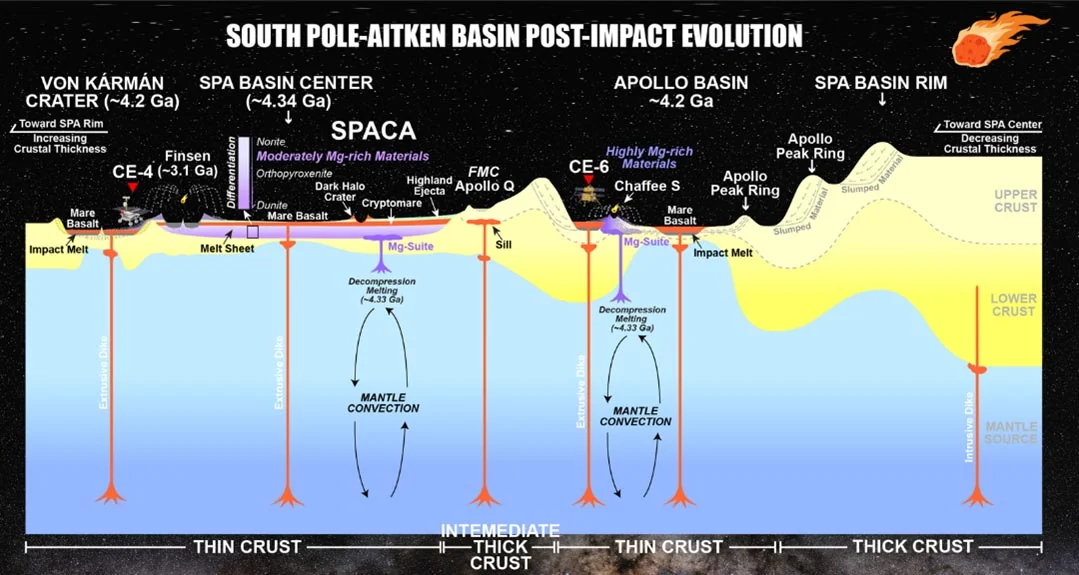
One type of rock is called a moderately magnesium-rich nodite, which formed after the initial impact in the Antarctic-Aitken basin. That impact created thick layers of molten rock, and as the magma cooled, different minerals crystallized in different stages. Later impacts exposed these ancient rocks on the central peak of the large crater, and some of them were thrown into Von Kármán Crater, where Chang'e 4 landed, by the impact that formed the Finsen meteorite.
Another type of rock has a much higher magnesium content and may have originated from a separate process known as "magnesian magmatism", which is related to the original impact of the Antarctic-Aitken basin. These rocks were originally exposed on the ring peaks on the west side of the Apollo Basin. Later, the Shafi S impact threw some of the rocks towards the Chang'e-6 landing area.
Previously, the Hong Kong University team had also discovered long-lasting volcanic activity in the area, as well as previously unrecognized magmatic activity. Those studies also suggested that ilmenite-rich deposits underground may help explain the contrasting volcanic histories on each side of the moon.
The latest research believes that the Antarctic-Aitken Basin was formed about 4.34 billion years ago; another large impact formed the Apollo Basin about 4.2 billion years ago; and then the Vostok Basin was formed about 3.87 billion years ago. Together, the three events reveal how successive impacts reshaped the Moon's largest impact basin over hundreds of millions of years.
Comments