
Abstract:
Researchers from the School of Engineering at the University of Nottingham in the UK have developed a new sound effect technology that gives listeners the impression that sound is moving by controlling the interaction of sound waves generated by multiple speakers in space. Unlike traditional mechanical rotary speakers, this system does not have motors, belts or any rotating parts, but it is able to reproduce some of the unique sound effects of classic rotary speakers.
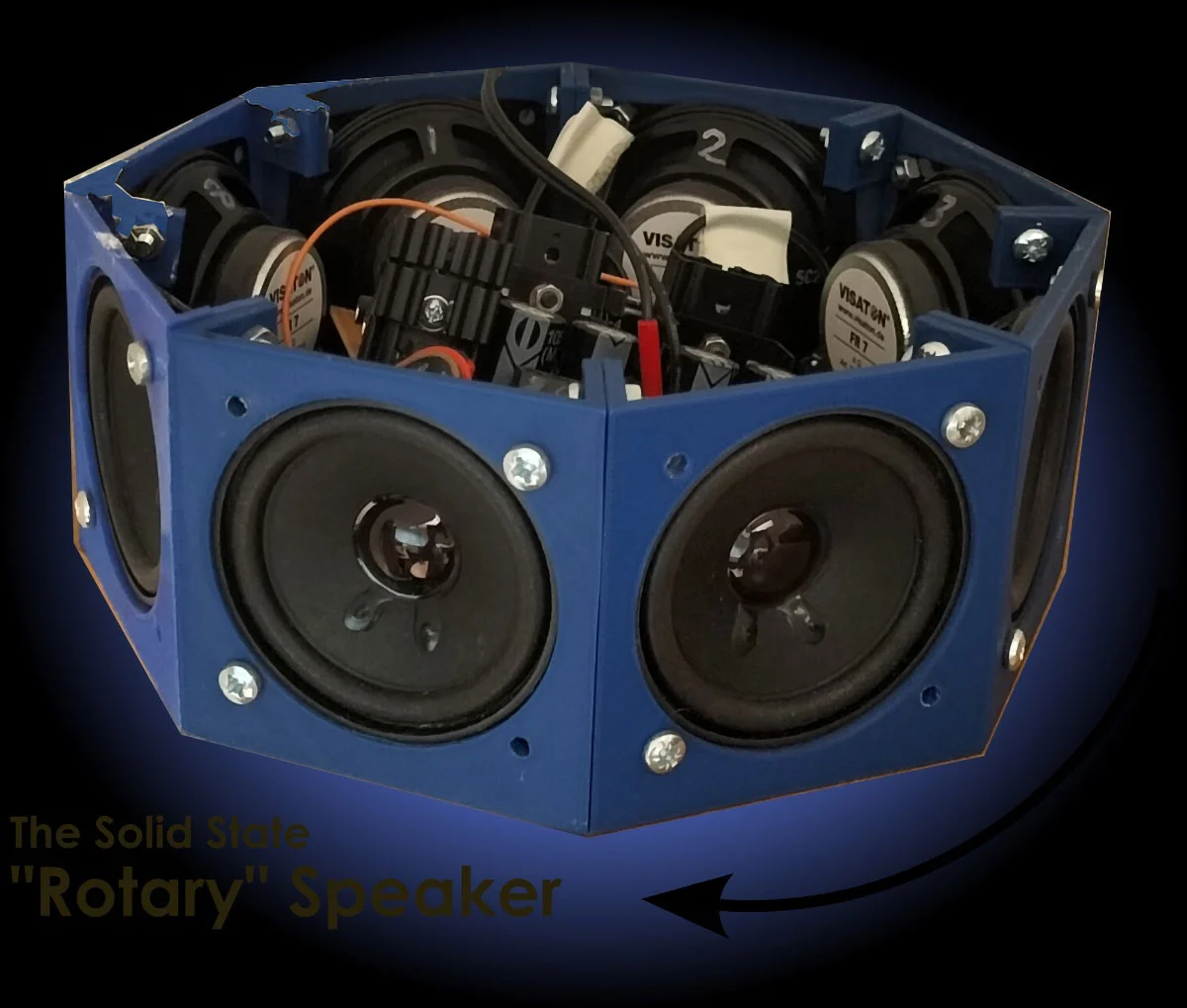
At the heart of this research is not simply changing the audio signal, but directly manipulating the way sound physically travels when it reaches the listener. The researchers created a circular array composed of multiple speakers and electronically moved the audio signal along the speaker array, so that the resulting sound waves produced an effect similar to the rotation of the sound source in space.
Traditional sound equipment usually processes electronic signals before the sound enters the speakers. For example, effects such as chorus, flanger, and phaser all create special listening sensations by changing the phase, time, or frequency characteristics of audio signals. But the University of Nottingham's solution is closer to a true "moving sound source" because the changes occur as the sound waves have already left the speaker and propagated towards the listener.
This technology was inspired by the Leslie rotary speakers that appeared in the 1930s. The Leslie speaker was originally used in electronic organs. Its unique feature is that it uses a motor and a belt to drive the speaker horn or baffle to rotate, so that the sound continuously reaches the listener from different directions, thus producing a sound with a distinct sense of space and periodic changes.
Leslie speakers later became the most representative sound effects equipment in the history of music. Many electronic music devices, digital effects, and software plug-ins attempt to emulate this sound, including various phasers and chorus effects. However, these digital simulations mainly change the electronic signal and cannot completely replicate the acoustic changes caused by a real sound source moving in space.
It is this problem that researchers at the University of Nottingham hope to solve. The "solid-state rotary speaker" they designed does not have any mechanical moving parts. Instead, it uses a fixedly installed speaker array to control the output timing and phase of different speakers to allow the sound wave itself to produce a spatial propagation effect similar to that of a rotating sound source.
Therefore, this system is somewhere between traditional mechanical sound effects and purely digital sound effects. It does not have the complex mechanical structure of traditional rotating speakers. At the same time, it not only simulates the rotation effect at the audio signal level, but directly uses the propagation and interference of physical sound waves in space to produce sound changes.
Fernando Perez-Cota, assistant professor at the Department of Electrical and Electronic Engineering at the University of Nottingham, said that current music sound modulation can be roughly divided into two categories. One is the acoustic mechanical method used by the original Leslie speaker, and the other is modern electronic and digital processing methods. This research attempts to establish a new technical route between the two.
The researchers believe that the value of this approach may be far greater than rebuilding a Leslie speaker without mechanical parts. Because the speaker array can be controlled by software, it can theoretically create sound movement patterns that cannot be easily achieved with traditional rotating speakers.
For example, by changing the signal relationship between different speakers, the sound can produce different directions, different speeds, or even more complex spatial movements. Compared with mechanical rotating devices, electronic control does not require waiting for physical components to accelerate or decelerate, and is not limited by motors, belts and mechanical structures.
This also means that future music producers may have access to a new sound design tool. Traditional sound effects mainly create effects by changing the frequency, phase and dynamic characteristics of the sound itself, and this technology can further incorporate "where the sound comes from and where it moves" as part of the sound creation.
The researchers emphasized that this is not simply using multiple speakers to play the same sound at the same time. What really matters is the signal relationship between the speaker arrays and the resulting changes in sound wave interference and propagation. By precisely controlling these factors, the listener can experience the sound source moving through space.
At present, this system is still an experimental prototype, but the research team believes that it has the potential to become a new sound effects platform. In the future, it can be used not only for music production and live performances, but also for immersive audio, spatial audio, and other scenarios that require precise control of the spatial position of sound.
This research has been published in the "Audio Engineering Society Journal", the title of the paper is "The Solid-State "Rotary" Speaker", the researchers are Nicholas Wolstenholme and Fernando Perez-Cota.
Compared with traditional rotary speakers, solid-state solutions also have an obvious advantage, that is, the mechanical structure is simpler. Traditional Leslie speakers require motors, transmission structures and rotating parts to work for a long time. They are not only larger in size, but also produce mechanical noise and wear. Fixed speaker arrays can complete sound modulation through electronic control, so in theory it is easier to achieve digital control and automation.
The research team said they hope this concept can be applied to music creation at a more accessible cost and scale in the future. In other words, this technology is not just about replacing expensive classic rotary speakers, but it hopes to allow more music producers to achieve spatial sound effects that previously required specialized mechanical equipment.
If developed further, this technology may even change people's understanding of "sound effects". In the past, effectors mainly processed sounds at the electronic signal level; in the future, sound effects equipment may directly control the way sound waves propagate in real space, making the sound itself an object that can be "programmed to move."
This research by the University of Nottingham thus provides a new route between mechanical acoustics and digital signal processing. It does not allow the speaker to actually rotate, but uses electronic control to allow the sound waves to exhibit spatial characteristics similar to those of a rotating sound source. For music production and spatial audio, this idea of "moving sound rather than just changing sound signals" may open up a new field beyond traditional sound effects technology.
Comments