
Abstract:
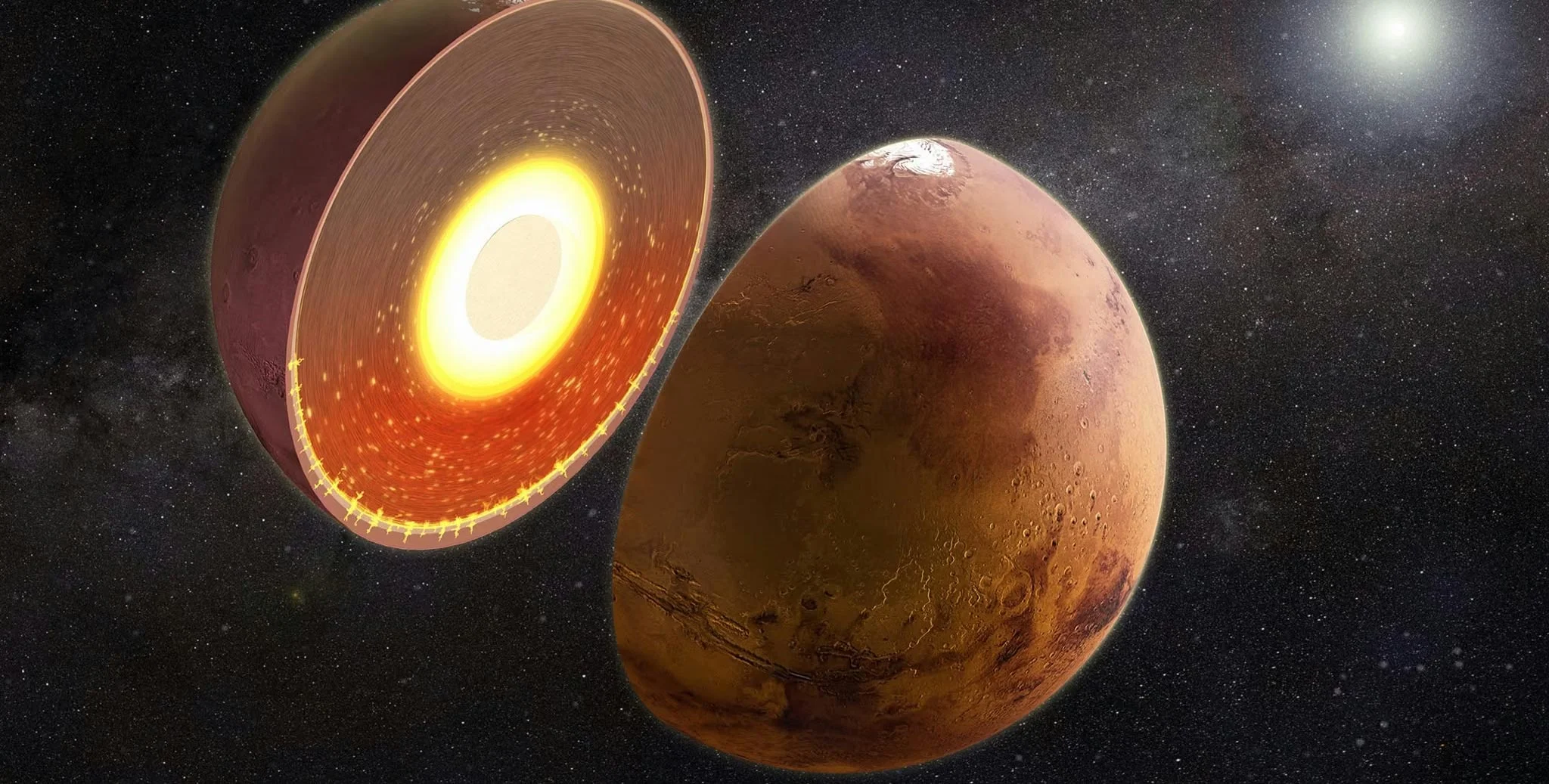
Scientists have discovered that there may be a huge temperature difference inside Mars that has not been recognized before: the temperature deep underground in the southern hemisphere may be 200 to 400 degrees Celsius higher than in the northern hemisphere, and part of the mantle in the southern hemisphere may be in a partially molten state. This discovery not only provides new clues to explain the long-standing huge geological differences between the northern and southern hemispheres on the surface of Mars, but may also help scientists re-understand the early magnetic field, water cycle and geological evolution history of Mars.
The research was led by Caltech alumnus Alexander Byrne. Byrne, who developed a method to use small changes in a planet's gravity to infer its internal structure as a doctoral student at Caltech, has moved on to a postdoctoral fellowship at the University of Arizona. The research results were published in the magazine "Nature" on August 26, 2026.
One of the most striking features of Mars is the extremely obvious differences between the northern and southern hemispheres. The southern hemisphere is dominated by plateaus, mountains, and dense ancient impact craters, and the overall surface elevation is higher; the northern hemisphere is mainly composed of low-lying, flat, and relatively young plains. Scientists have long known about this phenomenon, known as "crustal dichotomy," but how exactly this huge difference is formed has never been satisfactorily explained.
Latest research shows that this north-south difference may not stop at the surface of Mars, but extends to the depths of Mars. Through the analysis of gravitational changes in the interior of Mars, researchers found that the internal structure of the underground in the southern hemisphere is also significantly different in thermal properties from that in the northern hemisphere, and its temperature may be 200 to 400 degrees Celsius higher.
To obtain this result, the researchers did not rely on traditional Mars seismic observations, but used a method called "tidal tomography." The basic idea is similar to a medical CT scan, but the scan object is not the human body, but the entire Mars.
The sun's gravity will continue to act on Mars. Because Mars' orbit is slightly elliptical and its axis of rotation is tilted, the tidal effect exerted by the sun on Mars changes over time. Although Mars does not have liquid water that can undulate significantly like Earth's oceans, the entire planet will still be subject to extremely slight stretching and deformation.
The temperature and state of matter inside Mars will affect this deformation. Cool, hard rocks are less susceptible to deformation, while hot, soft or even partially molten rocks are more susceptible to change by tidal forces. Therefore, as long as we can accurately measure the tiny response of Mars under the action of tides, we can in turn infer the state and temperature of its underground materials.
The problem is that this deformation is too small to be directly observed. But when Mars deforms, its gravitational field will also produce extremely weak changes, and a detector orbiting Mars can indirectly record this gravitational difference through subtle changes in its own speed.
The research team therefore retrieved radio tracking data accumulated by multiple Mars orbiters over decades, including the Mars Global Surveyor launched in 1996, the Mars Odyssey launched in 2001, and the Mars Reconnaissance Orbiter launched in 2005. By analyzing the small gravitational perturbations in the speed of these probes during their long-term operation, the researchers reconstructed the changes in Mars' gravitational field over time.
After conducting "tidal tomography" analysis on these data, the researchers finally obtained a model of the three-dimensional structure of Mars' interior and found that there are significant thermal asymmetries in the underground of the northern and southern hemispheres.
The discovery may also explain two other long-standing mysteries of Mars.
The first mystery is related to the magnetic field of Mars. Today's Mars no longer has a strong global magnetic field like the Earth, but very strong local magnetization traces are preserved in the ancient crust of the southern hemisphere of Mars. These magnetic anomalies are believed to be relics of the early existence of a global magnetic field on Mars, and also mean that Mars once had a generator mechanism capable of generating a global magnetic field.
Mars’s southern hemisphere has an abundance of such magnetized crust, while its northern hemisphere is conspicuously devoid of similar structures, a difference that has long been puzzling. If the mantle in Mars' southern hemisphere has a completely different thermal history, it could help explain why Mars' ancient magnetic record shows such an asymmetric distribution between the north and south sides.
The second mystery comes from the NASA InSight mission. The seismometer carried by InSight has continuously observed the interior of Mars. Researchers have found that when seismic waves propagate in the southern region of Mars, the energy loss rate is significantly higher than in the northern region.
High-temperature rocks are generally softer than low-temperature rocks and more likely to absorb seismic wave energy. If there is indeed a high-temperature or even partially molten mantle underground in the southern hemisphere, then this environment can explain the abnormal attenuation of seismic waves previously observed by InSight.
This means that several previously seemingly unrelated mysteries of Mars—the geological differences between the northern and southern hemispheres, the anomalous magnetization of the southern hemisphere, and the faster attenuation of seismic waves in the south—may now all point to the same hidden factor: a hotter, softer interior beneath Mars' southern hemisphere.
The researchers also believe that this result may be related to Mars' past water environment. The huge topographic differences between Mars' northern and southern hemispheres not only determine today's surface landscape, but may also influence the formation of ancient basins and how water flows and collects on the Martian surface. Understanding this north-south difference will help scientists further track where Mars' past water came from, where it flowed, and which areas may have had liquid water for a long time.
This is also meaningful for finding whether Mars had an environment suitable for life in the past. Mars may have had a thicker atmosphere, a warmer climate, and a large amount of surface water in its early days, and these conditions are closely related to the geological activities inside Mars. If the time and cause of the formation of underground thermal structures in the northern and southern hemispheres can be determined, it may be possible to further reconstruct the process of Mars' gradual evolution from a more active and potentially habitable young planet to the cold and dry world it is today.
However, researchers are still unable to answer the most critical question: What makes the interior of Mars' southern hemisphere so hot?
There are at least several possible explanations. One possibility is that a massive impact event occurred in the early days of Mars. A giant object impacting Mars could have altered its internal thermal structure and created a massive lowland basin in the northern hemisphere, causing the differences seen today between the northern and southern hemispheres.
Another possibility is that asymmetric internal convection once occurred in the Martian mantle. Hot material inside the planet will rise and cooled material will sink. This convection process does not always maintain perfect symmetry. If the mantle in the southern hemisphere of Mars maintains a special convection structure for a long time, it may cause more heat to continue to accumulate there.
The third possibility is related to the composition of underground materials. If geological structures rich in radioactive elements exist deep in the Southern Hemisphere, these elements would continue to release heat during their long-term decay and could keep underground regions unusually hot. At the same time, if there are thick geological structures above that prevent the release of heat, the heat may be trapped underground for a long time.
No explanation has yet received conclusive evidence. The researchers said that the next step is to combine more seismic, gravity and Martian surface geological data to further determine at what stage in Mars history this thermal anomaly was formed, and whether it appeared at the same time as the north-south topography dichotomy.
This study also demonstrates the value of long-term accumulation of detection data. The Mars Global Surveyor was launched as early as 1996 and ended its mission in 2006, but the data it collected that year can still be used to solve cutting-edge questions about the internal structure of Mars. By reanalyzing observations from decades ago, researchers have obtained new scientific results that may not have been anticipated during the mission design phase.
If it can be further confirmed in the future that there are large-scale high-temperature or even partially molten areas underground in the southern hemisphere of Mars, it will mean that the interior of Mars is far more uneven than previously thought. For this seemingly "dead" planet, there may still be huge thermodynamic differences hidden in its depths, and this temperature mystery of 200 to 400 degrees Celsius may be an important key to understanding the formation, evolution and ancient habitable environment of Mars.
Comments