
Abstract:
On the evening of October 15th, Beijing time, the media obtained a list that disclosed all major donors to President Trump’s White House Ballroom Project, including donors that had not been disclosed to the public before. Many of these donors benefited from regulatory approvals, government contracts and, in one case, a relative received an amnesty.
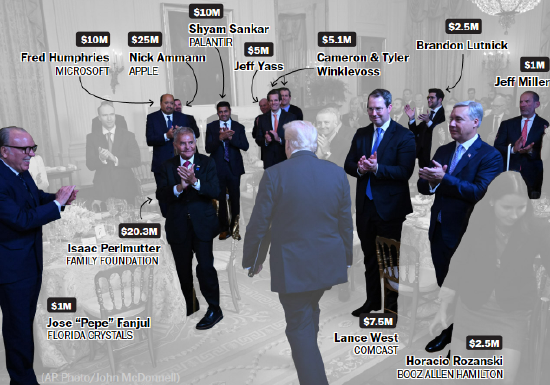
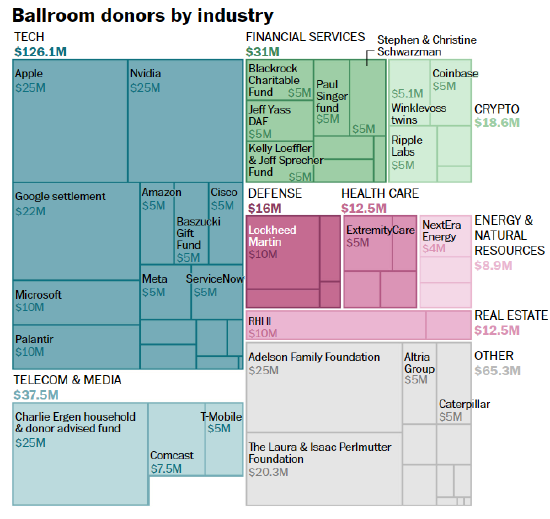
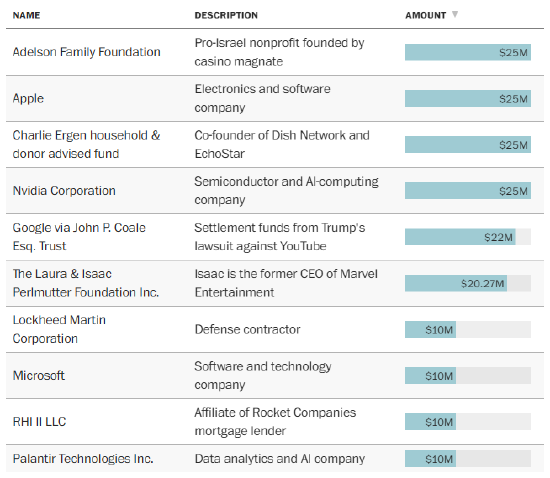
The list shows that technology giants Nvidia and Apple have each pledged to donate US$25 million, the highest single donation.
The Adelson family, the top Republican donor family, and billionaire Charles Ergen, co-founder and chairman of telecommunications company Dish Network, have also pledged to donate this amount.Trump himself did not appear on the list, although he claimed to have funded the project
. A few days after the demolition of the old east wing building started last year, he once said: "100% of the project funds were borne by me and some friends."The White House announced a list of 37 individual, corporate and foundation donors in October last year, but did not disclose the amount of each donation.
The internal spreadsheet obtained by the media is a record file used to track fundraising. It records a total of 67 donations of more than US$10,000 as of late last month, including the source of funds, donation date and amount. Data show that private donations totaled $333 million, consistent with the government's public statements.
Other internal fundraising documents further disclosed donation details, showing that at least $77 million came from donors who requested anonymity.
This list and supporting documents paint a complete picture of this fundraising campaign: both the scale of the fundraising and the degree of opacity of its operations are extremely rare. Regular political donations are subject to public disclosure and are subject to campaign finance regulations. Donations for the banquet hall project are received by a non-profit organization, then transferred to a government account, and deposited into a White House account under the direct control of the president.
Independent experts and scholars have expressed concerns about this, believing that this arrangement carries potential risks of power-for-money transactions and forced donations.
Supporting documents show that some donors on the list wrote large checks in one go, while others paid in installments, and the payments are still being made. This list does not include in-kind donations.
Media reports have not confirmed a link between donation pledges and favorable decisions made by the Trump administration. But documents show that the vast majority of fundraising funds come from companies and wealthy individuals with business demands at the federal level.
Media statistics show that donations from companies or business executives who received federal government contracts during Trump’s second term accounted for about half of the total amount.
After reviewing the list obtained by The Post, White House spokesman Davis Ingle declined to discuss individual donations, saying only that the ballroom donors were "many outstanding American businesses and generous individuals, all of whom are donating to make the White House (the People's House) a better place for future generations."
He said: "Critics who claim false conflicts of interest will be equally critical if American taxpayers are left to bear the burden of this long-overdue renovation." He added that the government will "fully pursue those responsible for this malicious leak while continuing to protect all donors."
The media will announce the names of 57 donors who have pledged donations of US$100,000 or more. Donor intention documents show that at least nine people requested anonymity.
The Post attempted to contact all donors listed in the report, but most did not respond or declined to comment. Donors who were willing to respond stated that there was no connection between donations and any favorable government policies.
NVIDIA, the world's most valuable listed company, became the top donor of the banquet hall project in October 2025.
Nvidia CEO Jensen Huang told the media at the time that the company would donate a "small amount" to the Trump Ballroom project, but did not disclose the specific amount. The documents show that Nvidia asked that its $25 million donation remain anonymous.
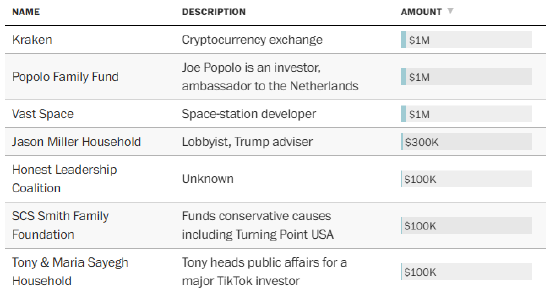
Records show that Joseph Popolo Jr., a large Republican donor and Trump’s ambassador to the Netherlands, and his wife donated $1 million through the family foundation in late 2025 to support the banquet hall project. This donation has not been exposed before. The donation comes two months after Popolo was appointed ambassador.
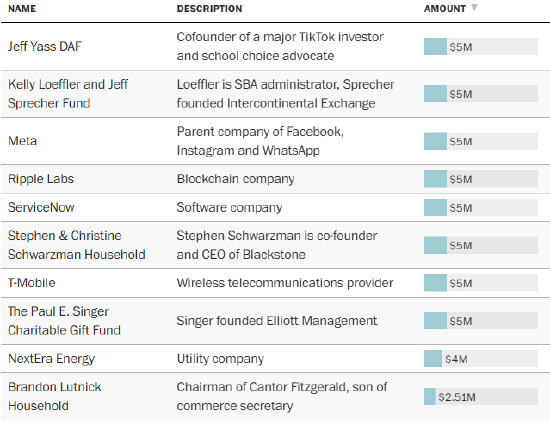
The list shows that Kelly Loeffler, a Trump cabinet member and Small Business Administration official, and her husband, Jeff Sprecher, the former chairman of the New York Stock Exchange, have pledged to donate $5 million to the project. Records show that Brandon Lutnick, chairman of the investment bank Cantor Fitzgerald and the son of Commerce Secretary Howard Lutnick, donated more than $2.5 million worth of stock.
Popolo, Loeffler, Sprecher and the Lutnick family did not respond to requests for interviews.
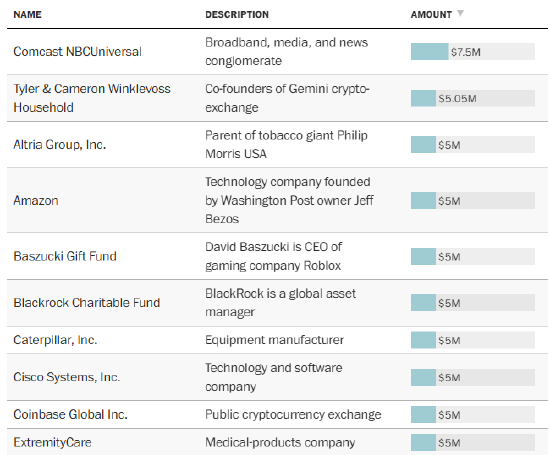
More than three-quarters of the ballroom project's funding came from a single donation commitment of $5 million or more. Top donors include many American blue-chip companies: Amazon, Caterpillar, Comcast, Microsoft, and T-Mobile. (Amazon Executive Chairman Jeff Bezos is the media owner)
Cryptocurrency companies and their investors have collectively pledged to donate more than $18 million after the Trump administration relaxed relevant regulations. The largest amount came from brothers Tyler and Cameron Winklevoss, co-founders of the Gemini crypto exchange, who donated a total of $5,050,018 worth of Bitcoin.
The Winklevoss brothers did not respond to requests for an interview.
The ballroom project also received dozens of small donations, starting as low as $10. The list and supporting documents show that, except for US$24,000, the source of all donations can be traced.
The total amount raised has not yet reached the $400 million fundraising goal set by Trump. The Post previously reported that the estimated cost of the new east wing project, which includes banquet halls, office areas and underground military facilities, has risen to US$600 million in March this year. Records show the White House has used taxpayer funds to cover some of the construction costs.
Donations for the ballroom are channeled through the National Mall Trust, a Washington-based nonprofit whose mission is to restore and preserve the National Mall and the White House campus. Non-profit organizations are generally not required to disclose donor information to the outside world.
The media obtained a copy of the donation pledge document that intended donors will receive to donate to the "Donald J. Trump Ballroom" project. The document lists Meredith O'Rourke, chief fundraiser for Trump's 2024 campaign, as the main contact.
O'Rourke referred inquiries to the White House.
A 12-page agreement signed between the government and the trust fund requires that the trust fund "keep the identities of project donors confidential to the extent permitted by law and may not publicly honor any donor unless expressly authorized in writing by White House residence staff."
Democratic lawmakers denounced the high confidentiality of this fundraising event and potential problems with its transactional nature. They asked the government and trust funds to disclose the details of the donors and the background of the donation, but the relevant requests were rejected.
The trust fund said in a statement: "It is very common for donors in the charity field to request anonymous donations. The trust fund will abide by its commitment and respect the donor's request for anonymity."
The earliest donation pledge for the banquet hall was signed on September 23, 2025. The donor was the daughter of Julio Herrera Verlutini, an international banker with dual nationality of Venezuela and Italy.
In 2022, the U.S. Department of Justice indicted the then 50-year-old Herrera Velutini, accusing him of bribery, saying that he funded the then-Puerto Rico governor’s campaign in exchange for removing regulators who were investigating his bank. The former governor and a political adviser were also indicted.
Herrera Velutini and her lawyers tried unsuccessfully to have the case dropped, arguing that prosecutors would criminalize legitimate political activity.
Campaign finance records show that after Trump won the election, Herrera’s daughter, Isabella Herrera, donated a total of US$3.5 million to Trump’s political action committee MAGA in two installments.
The donation prompted the nonprofit Campaign Legal Center to file a complaint with the Federal Election Commission, accusing Isabella Herrera of acting as a "straw man donor" for her father. According to the agency, she is in her 20s and works as a freelance financial advisor. Her only previous political donation was a $20 donation to 2020 Democratic presidential candidate Pete Buttigieg.
The agency said it had not received a response from the Federal Election Commission, which declined to comment for this story.
In August 2025, Herrera Velutini passed a plea agreement and the charges were downgraded to a misdemeanor.
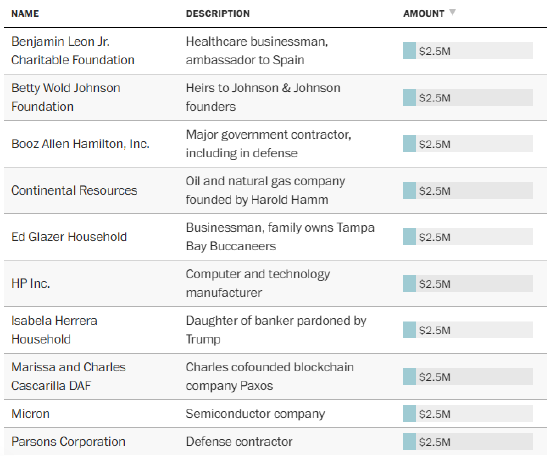
The following month, Isabella Herrera pledged a previously undisclosed donation of $2.5 million to the ballroom project. Records show she paid the first installment of $835,000 on October 14, 2025. Trump pardoned Herrera Velutini in January of the following year. Her second installment is due this month, records show.
The Department of Justice's large-scale public corruption investigation has generally turned to contraction. Against this background, Trump also pardoned the aforementioned former governor of Puerto Rico and political consultants. The White House said the prosecutions were politically motivated.
After the pardon was issued, Herrera Velutini’s lawyer issued a statement, saying that the client was “deeply grateful to President Trump for his generous pardon.”
Neither Herrera Velutini nor her daughter responded to requests for interviews.
An investigation that was dropped
EchoStar, a company owned by telecommunications executive Ergen, came under investigation by Trump administration regulators last year.
Federal Communications Commission Chairman Brendan Carr sent a letter to Ergen in May, informing the agency that it had launched an investigation into EchoStar and threatening to revoke government licenses related to the company's survival, accusing Dish Network parent company EchoStar of failing to fulfill its promise to upgrade the cellular network.
The media quoted sources as reporting that Ergen met behind closed doors with Trump and Kahl the following month to discuss the investigation. According to reports, the meeting on June 11 briefly touched on Ergen’s political donations and whether he has donated to candidates of both parties.
EchoStar mentioned the June 11 meeting with Carr in its regulatory filing, writing that Trump "then encouraged the parties involved to reach an amicable resolution."
Ergen negotiated an agreement in August to sell part of the company's licenses to AT&T. The transaction still needs approval from the Federal Communications Commission and the Department of Justice.
The following month Carr withdrew the investigation and thanked Ergen for the feedback and information he provided.
The donation list shows that in December, while the sale was still pending approval, Ergen pledged to donate $12.5 million to the ballroom project. Records show that he requested that the source of the donation remain anonymous. The donation has not been disclosed before.
The list shows that he once again pledged to donate US$12.5 million in February of the following year.
In May this year, the Federal Communications Commission and the Department of Justice both approved the EchoStar license sale.
Ergen and EchoStar declined to comment through spokespersons; the Federal Communications Commission and Carr did not respond to inquiries, and the Department of Justice did not comment on this report.
There is also an AT&T donation of US$5 million marked as "pledged" in the donation list, which is the only entry in the entire list that uses this mark; all other amounts are marked as "won".
AT&T spokesperson Meghan Catlay said in a reply that the company was most likely mistakenly included on the list. "We are not aware of the list you are referring to and have no plans to donate to the National Mall Trust."
Approval, then donation
Another large donor is a subsidiary of Detroit real estate fintech company Rocket, which was founded by NBA Cleveland Cavaliers owner Daniel Gilbert.
In March 2025, Rocket announced plans to acquire two competitors: real estate search website Redfin and mortgage loan platform Mr. Cooper, the transaction will significantly increase Rocket's share of the real estate market.
The federal agency responsible for antitrust oversight did not file a lawsuit to block the deal, and the merger went ahead. Six Democratic senators sent letters to the Justice Department and the Federal Trade Commission protesting.
In order to complete the interview with Mr. Cooper's acquisition, Gilbert also needs approval from the Federal Housing Finance Agency.
The Federal Housing Finance Agency approved the transaction on August 26, 2025.
Three weeks later, the Rocket subsidiary pledged $10 million to the ballroom project, records show, speaking on condition of anonymity.
A Rocket spokesperson said there is no connection between approvals and donations.
Spokesperson Alan Emerson said: "Rocket and its affiliates have continued to support the National Mall Trust and other nonpartisan organizations in Washington for more than ten years. We are honored to join dozens of companies and individuals in helping to build the capital."
A spokesman for the Federal Trade Commission said Rocket did not receive special treatment, noting that days after the donation, the commission filed an antitrust lawsuit against Redfin.
The Federal Housing Finance Agency and the Justice Department declined to comment.
Software Contract
Salesforce, the leading software manufacturer in the United States, has significantly expanded its government contract business during Trump’s second term.
Salesforce CEO Marc Benioff has attended many high-end dinners and events with Trump, including the state banquet hosted by King Charles III of the United Kingdom at Windsor Castle in September 2025, and the business summit held in Japan the following month. During the Japan summit, Trump thanked Benioff for putting him on the cover of Time magazine (Benioff owns the magazine).
Trump said of the CEO: "Many of the suggestions Mark made are very good."
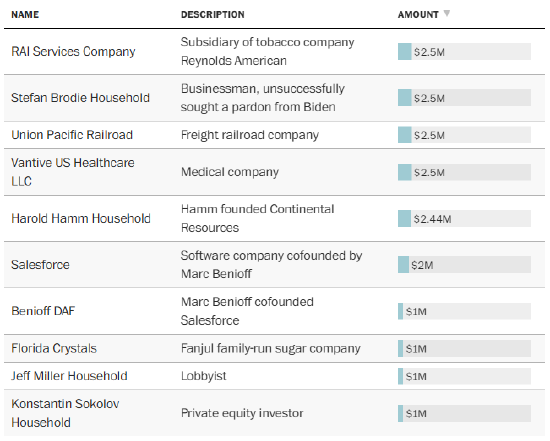
The list shows that Benioff promised to donate US$1 million to the banquet hall project the next day. This donation had not been disclosed before, and Benioff requested anonymity.
The list shows that Salesforce has committed two additional donations of US$1 million, one on Christmas Eve last year and the other on January 29 this year. Both donations have not been made public before.
During this period, the U.S. Army awarded the company a contract that is valid until 2035 and has a maximum value of $5.6 billion. Looking at public contract records, this appears to be the largest government contract in Salesforce's history. When the Pentagon announced the contract, it said: "The project was tendered through the Internet and only one bid was received."
Benioff and Salesforce did not respond to requests for interviews.
A Pentagon official said in a statement: "External affiliations, investors or political connections have no influence on Department of Defense funding approval decisions."
Salesforce competitor ServiceNow also donated money to the ballroom project.
In September last year, the U.S. General Services Administration announced a landmark agreement with ServiceNow, allowing federal agencies to use the company’s AI software at a discount.
ServiceNow CEO Bill McDermott said in the announcement: "President Trump's proposal that the federal government should operate as efficiently as top companies is no empty talk."
The following month, ServiceNow pledged a previously undisclosed donation of $5 million toward the ballroom project.
The U.S. General Services Administration said in a statement that ServiceNow has been a federal supplier for more than a decade, adding that "the company's charitable or political contributions, like those of other businesses, will not affect the General Services Administration's decision to include it in the federal procurement catalog."
ServiceNow stated that relevant cooperation negotiations have been ongoing for a long time, and government business is "independent of any public welfare donations, and the two are not related."
Regarding this donation, the company said: "Many of our partners and peers have participated in donations, and we have chosen to join together."
Venezuela oil-related capital
Two Trump political donors have pledged a combined investment of nearly US$10 million to support the banquet hall project, and both are investing in the Venezuelan oil sector. The Trump administration has gained influence in the Venezuelan oil market since the United States seized assets related to Nicolás Maduro in January.
Billionaire financier Paul Singer pledged to donate US$5 million through his foundation in October 2025. A month later, his hedge fund received court approval to acquire Venezuelan oil giant Citgo for $5.9 billion.
The deal requires approval from multiple federal agencies including the Departments of Commerce, Energy, State, and Treasury. The deal is currently stalled due to ongoing negotiations with Venezuela's U.S.-backed interim government.
Oklahoma oil and gas company Continental Resources and its honorary chairman and Republican large-donor Harold Hamm have pledged a combined donation of nearly US$5 million in October 2025.
This year, in response to the Trump administration’s call to encourage energy companies to invest in Venezuela’s oil industry, Continental Resources reached a preliminary agreement with Venezuela’s state-owned oil company to jointly develop 126,000 acres of undeveloped oil fields.
Singer declined to comment; Hamm and Continental Resources did not respond to inquiries.
Donors not included in the list
In the list of donations made public by the White House, two companies and one individual did not appear on the internal list obtained by The Post.
Two companies: Hard Rock International, a hotel chain owned by the Florida Seminole Tribe, and Tether America, an encryption company; the individual is Paul Tiramani, an executive at a modular housing company, who once told the London Times that he donated shares worth $10 million.
None of the three parties responded to the Post’s questions and did not explain why they were not included in the banquet hall’s fundraising list. The National Mall Trust and the White House also offered no explanation.
This article was co-reported by Kevin Crowe, Samantha Schmidt, Dan Lamott and Alex Horton.
Comments