
Abstract:
An information technology supervisor at a U.S. Customs and Border Protection (CBP) port of entry in Maine was arrested by the FBI. The reason for his arrest was that the supervisor secretly removed high-value hardware from his office computer in the middle of the night and replaced it with old hardware he had prepared in advance. Afterwards, the supervisor sent the disassembled parts to Newegg to pay the price difference and exchange them for new ones, and then resold the new hardware at a profit.
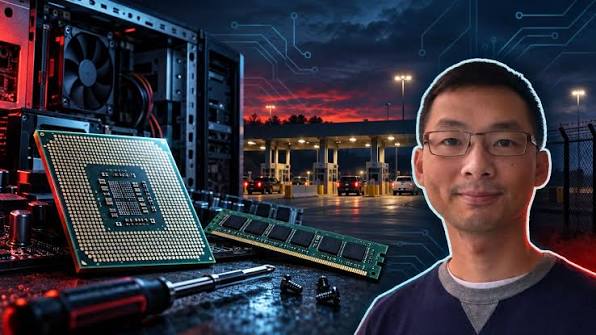
39 units of Department of Homeland Security equipment replaced with parts:
The person involved in the case is named Terry Jiajia Liu. His job is mainly in information technology matters, but he does not have the authority to move or modify computer equipment belonging to the U.S. Department of Homeland Security. However, from May 2025 to July 2026, Liu took away 39 devices without authorization and disassembled the parts. Among them, the processors of 39 computers were replaced, the memory of 6 computers was replaced, the hard drives of 8 computers were replaced, and multiple parts of some equipment were replaced.
These office equipment were originally equipped with 14th generation Intel Core i7 processors. In order to maximize profits, Liu even replaced some of the processors with Pentium series processors. Of course, large-capacity memory and hard drives are also Liu's goals.
The problem is that the office is monitored:
What is incomprehensible is that as an information technology director, Liu should be well aware that the office is monitored: FBI investigation found that Liu moved the computer to the training room during the night shift, then used a screwdriver to remove the processor, clean the silicone grease, and install a spare processor prepared by himself. Surveillance footage also captured Liu putting the removed memory stick into his drawer.
The port supervisor had informed him in advance but Liu ignored it: In March 2025, the port supervisor discovered that Liu had moved these office equipment or replaced parts without authorization. Liu himself did not have the authority to move the computer or replace parts. At this time, Liu's behavior was already in violation, but the port supervisor only reminded him and did not make any other intervention.
Two months later, Liu began to steal computer hardware. After Liu was arrested, he claimed that replacing parts could improve performance. However, after being investigated, Liu admitted that computer performance would indeed decrease after replacing parts. The investigation also revealed that Liu did not install any malware on his computer and that his behavior was purely to make money by replacing high-value parts.
Comments