
Abstract:
An early test of NVIDIA's new generation AI rendering technology DLSS 5 shows that even the flagship GeForce RTX 5090 graphics card may encounter unexpected performance and power supply limitations when facing this technology. The test results show that DLSS 5 not only fails to bring "free performance improvement" in the traditional sense, but will significantly increase the power consumption of the graphics card and expose the potential ceiling of the power supply design of the RTX 5090 public version product.
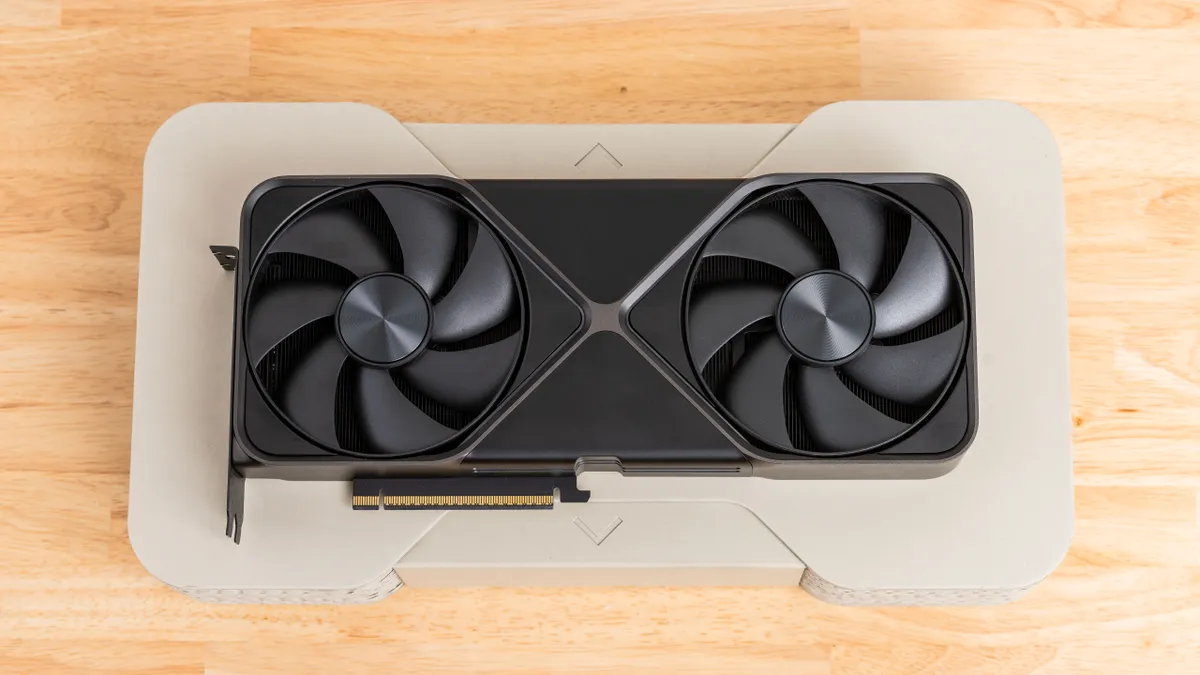
Since the launch of the RTX 40 series, issues such as heating and melting of the 12VHPWR and subsequent 12V-2x6 power supply interfaces have continued to attract players' attention. As the power consumption of high-end graphics cards continues to rise, some users have even developed their own monitoring tools to limit the power output of graphics cards and reduce the risks faced by the power supply interface.
The latest thing to attract attention is the new situation that emerged during the DLSS 5 testing process. DLSS 5 is a new generation of AI graphics technology released by NVIDIA at the GTC 2026 conference. The company describes it as the "GPT moment" in the field of graphics rendering. However, due to its new neural rendering and diffusion model scheme, the gaming community's evaluation of this technology has been controversial.
In order to evaluate the actual performance of DLSS 5, the test media selected the RTX 5090 Founders Edition public version graphics card and MSI RTX 5090 Lightning Z. The latter is a non-public version product with significantly higher specifications. It is equipped with dual 12V-2x6 power supply interfaces and can increase the power consumption limit to 1000 watts through Extreme vBIOS, so it has a power supply margin that far exceeds that of the public version card. The core goal of the test is to verify whether DLSS 5 can utilize these additional power consumption spaces into actual performance advantages.
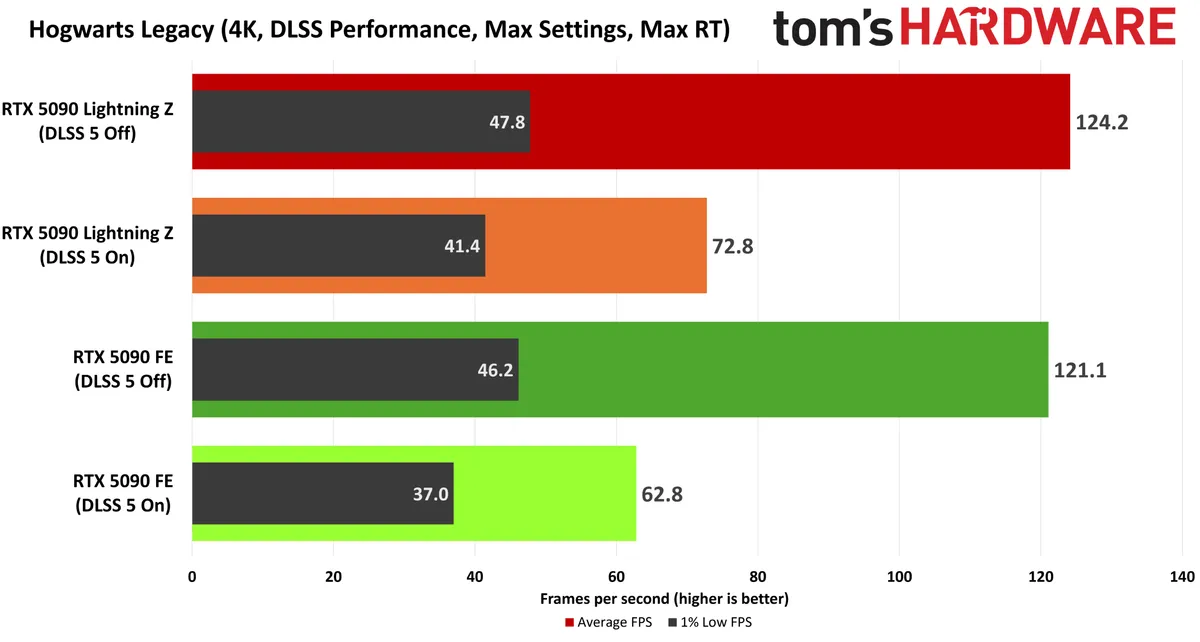
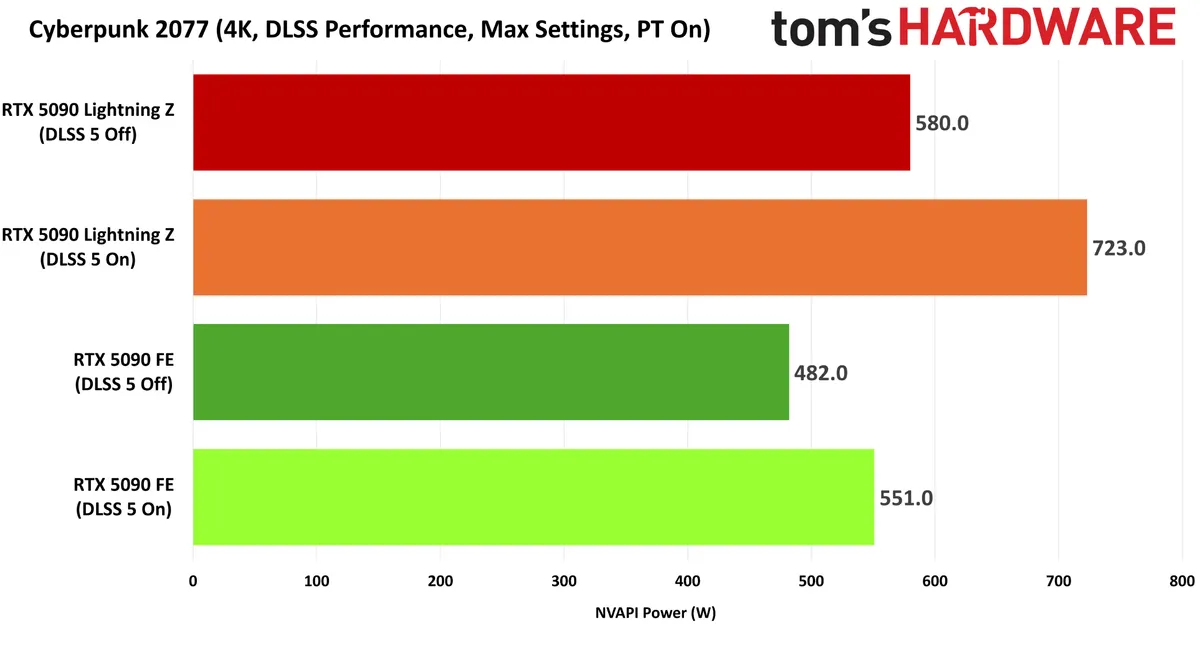
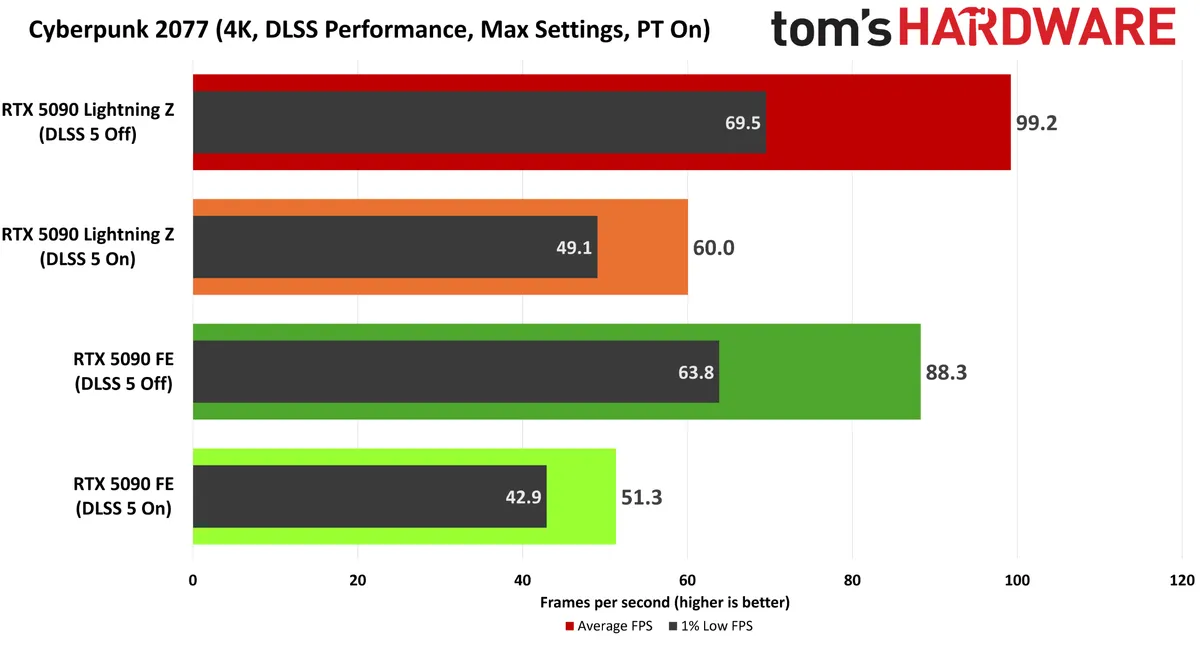
The test was conducted at 4K resolution, with DLSS Performance mode enabled, which means the game is first rendered at 1080p native resolution, and then enlarged to 4K output through AI technology. All games have the highest rasterization and ray tracing settings turned on, and "Cyberpunk 2077" also has path tracing enabled. In order to observe the impact of DLSS 5 itself alone, multi-frame generation technology was not enabled during the test.
The results show that after turning on DLSS 5 in "Cyberpunk 2077", the performance of the RTX 5090 public version graphics card dropped by about 42%, while the performance of MSI Lightning Z dropped by about 39%. Although both products experienced significant performance losses, the MSI graphics card with higher power consumption still maintained a higher frame rate.
Power consumption data sheds further light on the problem. After turning on DLSS 5, the power consumption of Lightning Z increased from approximately 580 watts to 723 watts, an increase of 25%; while the RTX 5090 public version increased from 482 watts to 551 watts, an increase of approximately 14.5%, and is close to its design power limit.
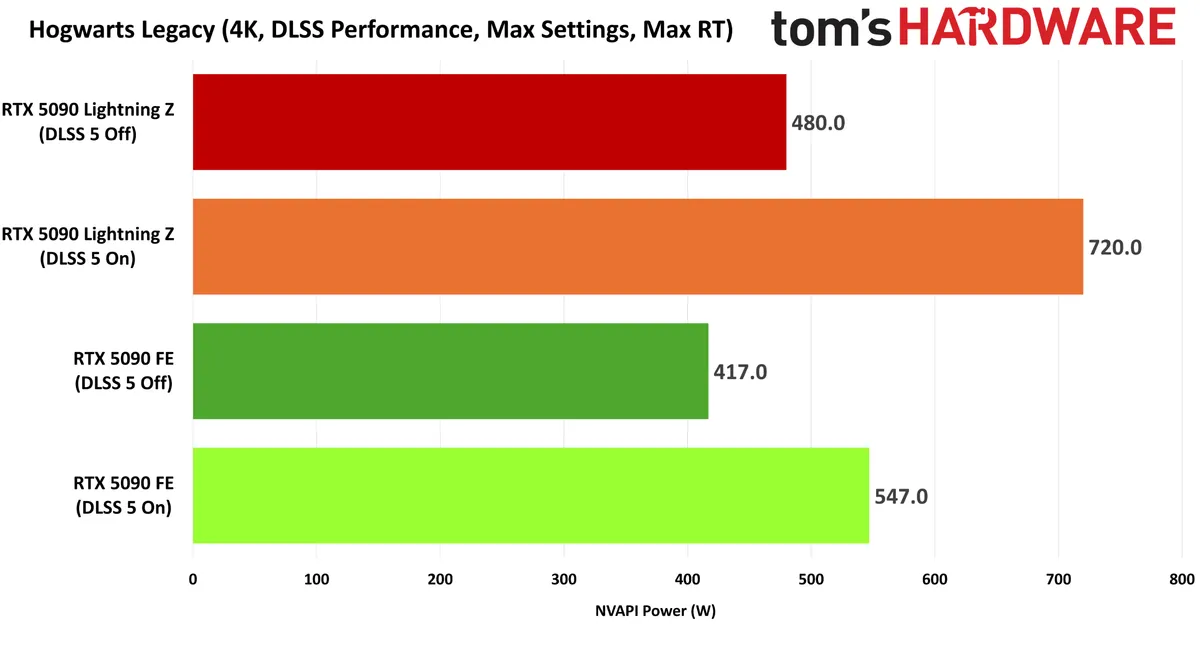
A similar situation occurs in "Hogwarts Legacy". The power consumption of MSI graphics cards increased sharply from about 480 watts to 720 watts, an increase of up to 50%. In terms of performance, Lightning Z dropped by about 42%, while the public version of RTX 5090 dropped by about 49%.
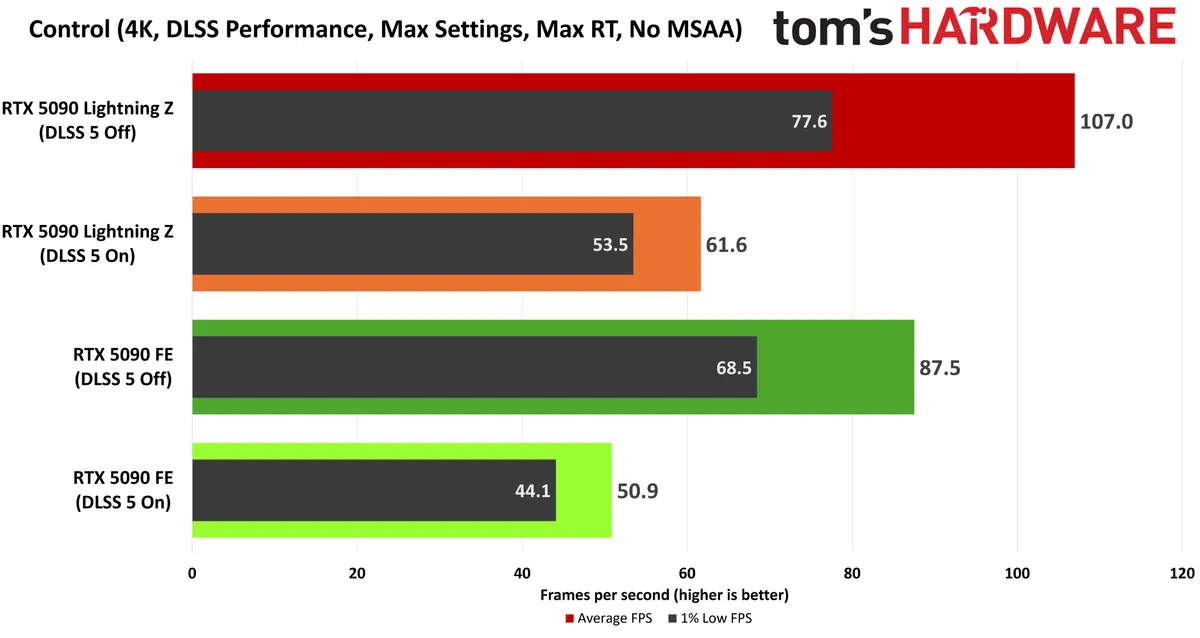
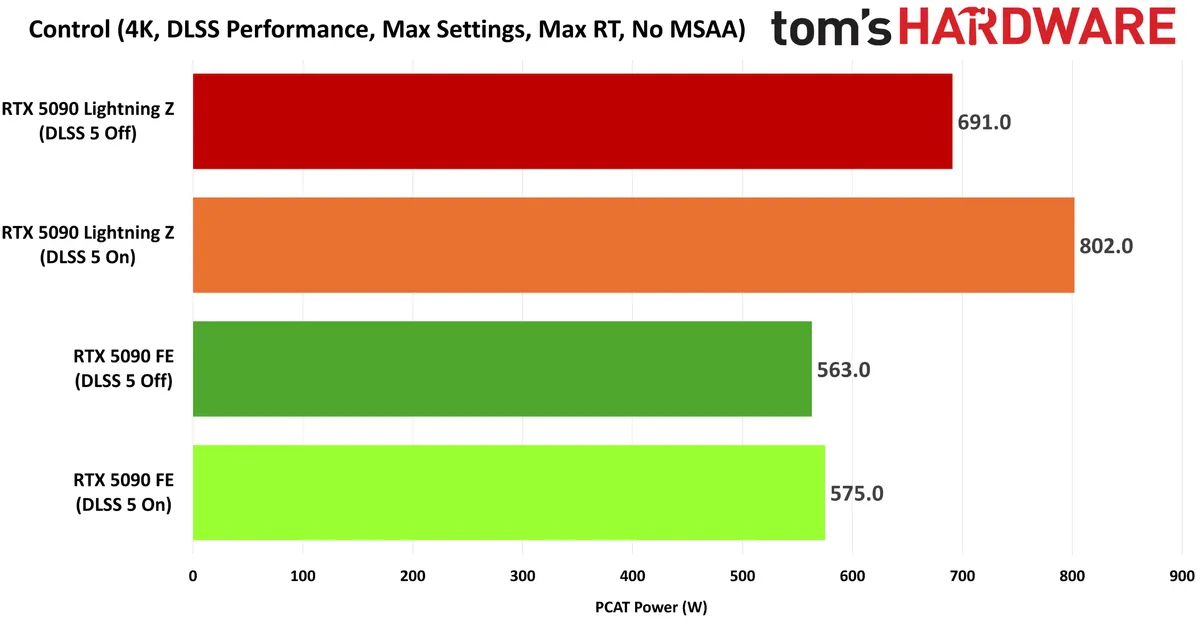
The test results in "Control" are even more obvious. When DLSS 5 is not enabled, Lightning Z power consumption has reached approximately 691 watts; after enabling neural rendering, it further increases to 802 watts. At the same time, the public version of the RTX 5090 once again hit its power consumption limit of about 575 watts. Although the performance of both graphics cards dropped by about 42%, MSI's products still achieved an average frame rate advantage of about 20% due to their higher power supply capabilities.
Testers believe that the real problem is not that the RTX 5090 cannot run DLSS 5, but that the single 12V-2x6 power supply interface of the public version of the graphics card and the established power consumption wall limit its space. DLSS 5 highly relies on Tensor Core for diffusion model calculations. When neural rendering, ray tracing, and path tracing are enabled at the same time, its demand for power resources is far greater than that of previous versions of DLSS.
Test results show that when DLSS 5 is superimposed with heavy light-tracing scenes, the RTX 5090 may actually require a higher power budget than the 575 watts allowed by the public version design to fully exert its performance. This also means that some low-end non-public version RTX 5090 products with more conservative power supply designs may face similar restrictions in the future.
However, it should be pointed out that this test did not use the official version released by NVIDIA, but the community-modified version DLSS 5 that had been leaked before. The official will officially provide this technology through the Streamline framework in the future, so there is still room for change in the final performance. According to data released by the NVIDIA research team, DLSS 5 takes approximately 8 milliseconds of computing time and 731MB of video memory to process one frame of 4K. The data obtained in this test is basically consistent with the official parameters.
Based on the current test results, DLSS 5 is more like an advanced AI rendering technology that requires additional hardware resource support, rather than a performance enhancement function in the traditional sense. In the three test games, the performance loss of the RTX 5090 ranged from 39% to 49%, and with sufficient power margin, the graphics card power consumption may even increase by hundreds of watts. For the public version of RTX 5090, its power supply design and power consumption limit have become important constraints in releasing the full potential of DLSS 5.
Comments