
Abstract:
Affected by the abnormal warming of the ocean caused by climate change, a large number of Portuguese man-of-war jellyfish have recently appeared on the beaches along the Atlantic and Mediterranean coasts of Europe. This species of siphonophore, which usually inhabits tropical waters, is appearing more frequently along European coasts, triggering beach warnings and incidents of stings from tourists.
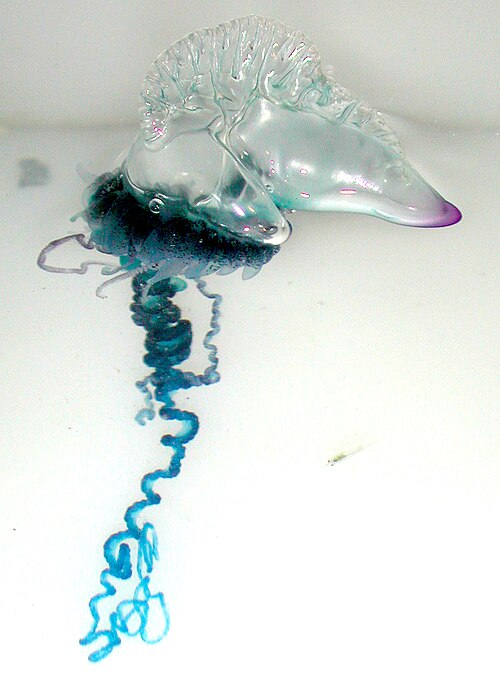
The Portuguese man-of-war jellyfish is known for its translucent blue-purple or pink floating sacs and stinging tentacles up to 30 meters long. Although it is not fatal, about 10% of stings require hospitalization. Arcachon beach on France's Atlantic coast was closed to swimming this month due to the species' presence, and more than a thousand stings were reported on the Basque coast in the past two weeks. Beach warnings have also been issued in San Sebastian in northern Spain and the French Pyrenees-Atlantiques department. According to the French Institute for the Development of the Sea, the Portuguese man-of-war jellyfish has appeared every seven to eight years on France's Atlantic coast, instead of appearing every year. Researchers have expressed "confusion" about this.
A study by scientists from the World Weather Attribution Alliance shows that without global warming, high ocean temperatures in Europe are "almost impossible to occur." Climate change caused by the burning of fossil fuels increased the temperature of the Mediterranean Sea by about 2 degrees Celsius in August, the Bay of Biscay and the surrounding waters of the Iberian Peninsula by about 1.4 degrees Celsius, and the Irish Sea and English Channel by about 1.3 degrees Celsius. John Bruno, a marine ecologist at the University of North Carolina, warned that extreme heat could lead to mass die-offs of fish, seabirds and marine mammals, while jellyfish and related species are more tolerant of warming and will reproduce in large numbers during some ocean heat waves.
Albert Calbet, a researcher at the Barcelona Institute of Marine Sciences, pointed out that the continued proliferation of jellyfish in the context of the decline of marine wildlife has become an issue of "increasing concern" for the marine scientific community. The Mediterranean region is most affected by climate change, warming at about twice the global average.
Global sea surface temperatures hit a monthly record high in July. The National Oceanic and Atmospheric Administration stated that the Pacific El Niño warming phenomenon is expected to continue until May 2027 and may be the strongest since the 1950s, which will further intensify the global warming effect. The Royal Wildlife Trust says the species has been found in Britain as far north as Cumbria in recent years.
Comments