
Abstract:
Waymo, a self-driving travel company, officially announced that it will enter the Singapore market and plans to launch an unmanned taxi service for the public in 2028. This will be Waymo’s first deployment in Southeast Asia and also marks a further acceleration of the company’s international expansion strategy.
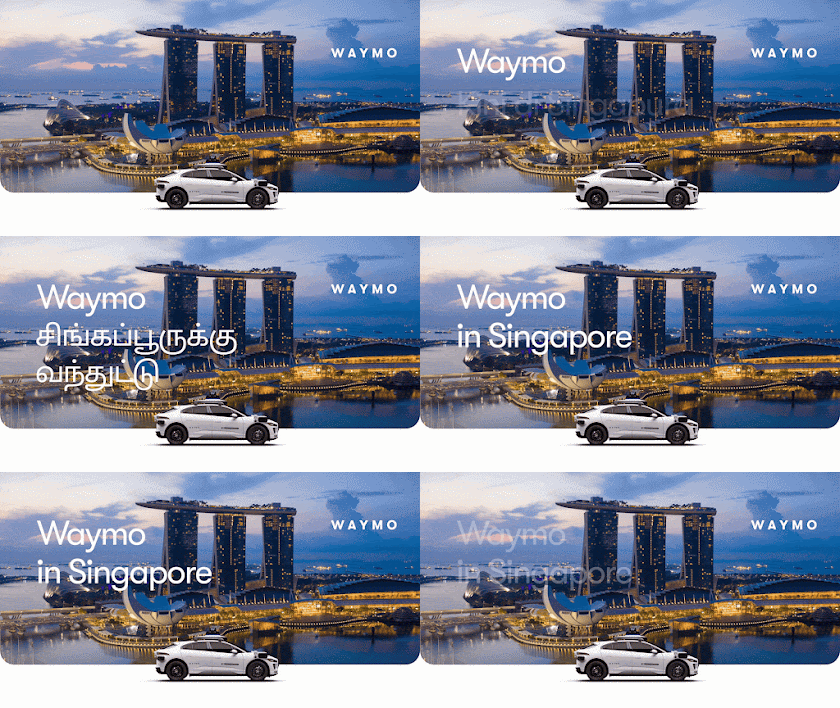
According to the plan announced by Waymo, the first batch of vehicles will arrive in Singapore in the next few months to prepare for subsequent testing. In 2027, the company will launch the mapping and road verification phase, and conduct autonomous driving tests under the supervision of safety drivers to adapt to the local road environment and operating conditions. Subsequently, Waymo plans to open its fully autonomous driverless taxi hailing service to the public in 2028 after completing regulatory approvals.
However, Waymo still needs to obtain approval from the Land Transport Authority of Singapore before officially carrying passengers. In accordance with local regulations, all self-driving vehicles must pass a safety assessment conducted by the Center of Excellence for Testing and Research and meet a series of regulatory requirements set by the government before they can be put into commercial operation on public roads.
In fact, this is not the first time Waymo has established ties with Singapore. The company has established a local legal entity as early as this year and participated in the work of the Singapore Autonomous Vehicle Steering Committee. The Singapore government has continued to promote the development of the autonomous driving industry in recent years and has approved the implementation of projects such as autonomous logistics transport vehicles, road sweepers, and unmanned buses for airport employees.
For Waymo, Singapore is seen as an ideal international expansion target. The company's co-CEO Tekedela Mawakana said that Singapore has one of the safest, most efficient and most forward-looking transportation systems in the world. Its emphasis on reliability, sustainable development and people-centered innovation is highly consistent with Waymo's development philosophy.
According to currently disclosed information, Waymo plans to deploy an all-electric Jaguar I‑PACE self-driving fleet in Singapore. By 2027, relevant vehicles will be manually driven by professional testers to conduct adaptive training on local road layout, traffic habits and tropical monsoon climate environment, thereby optimizing the Waymo Driver autonomous driving system.
The Singaporean government regards Waymo’s participation as an important step in expanding the autonomous driving ecosystem. Officials stated that they hope to provide residents with more travel options by introducing leading international autonomous driving companies, while promoting the development of the local autonomous driving industry and creating new high-skilled jobs. At the same time, the government has also promised to promote the skills transformation of employees in advance to prevent autonomous driving technology from developing faster than society's adaptability.
Currently, Waymo already operates nearly 4,000 self-driving vehicles in about 15 cities in the United States and continues to expand its service scope. Since the beginning of this year, the company has announced its entry into new markets such as Nashville, Denver, San Diego and Las Vegas. At the same time, Waymo is also advancing its international layout, including plans to launch services in London before the end of 2026, enter Tokyo in 2027, and enter Munich, Germany later in 2027 to start its first commercial deployment in the EU.
In the Asian market, Singapore will become an important node for Waymo’s focus after Japan. Industry insiders believe that compared with many cities, Singapore has a smaller area, highly digitalized road management, complete infrastructure and a clear regulatory environment. These factors make it an ideal testing ground to verify the commercial operation capabilities of autonomous driving.
As the global autonomous driving industry gradually moves from the testing stage to the commercial implementation stage, Singapore is becoming an important market for international autonomous driving companies to compete. Waymo's entry into Southeast Asia also means that the global competition for driverless taxis has begun to extend further from the United States to the international market.
Comments