
Abstract:
The latest simulations by MIT physicists and collaborating institutions show that if the primordial black hole formed in the early days of the universe is captured by a sun-like star, it may sneak into the star's interior, gradually swallowing the star's material, and eventually triggering a very spectacular explosion.
Such events are expected to release bursts of radiation that are currently detectable by telescopes, provide new ways to search for black holes that formed shortly after the Big Bang, and may also help scientists study the mysterious dark matter that makes up most of the matter in the universe.
Primordial black holes may have formed in the first less than a second after the Big Bang. At that time, some unusually dense regions of the universe collapsed under the influence of gravity, forming these black holes. The smallest among them have long since evaporated through Hawking radiation, but the larger ones may have survived to this day. Some primordial black holes may have been as small as an atom but as massive as an asteroid, about one millionth the mass of Earth.
The researchers focused on a scenario in which a primordial black hole encounters a sun-like star. The gravity of the star itself alone is not enough to capture a passing black hole, but if there are companion stars or planets around the star, complex gravitational interactions may trap the black hole. The black hole passes through the interior of the star again and again, and its orbital energy gradually decreases. After thousands to millions of years, it finally settles into the core of the star.
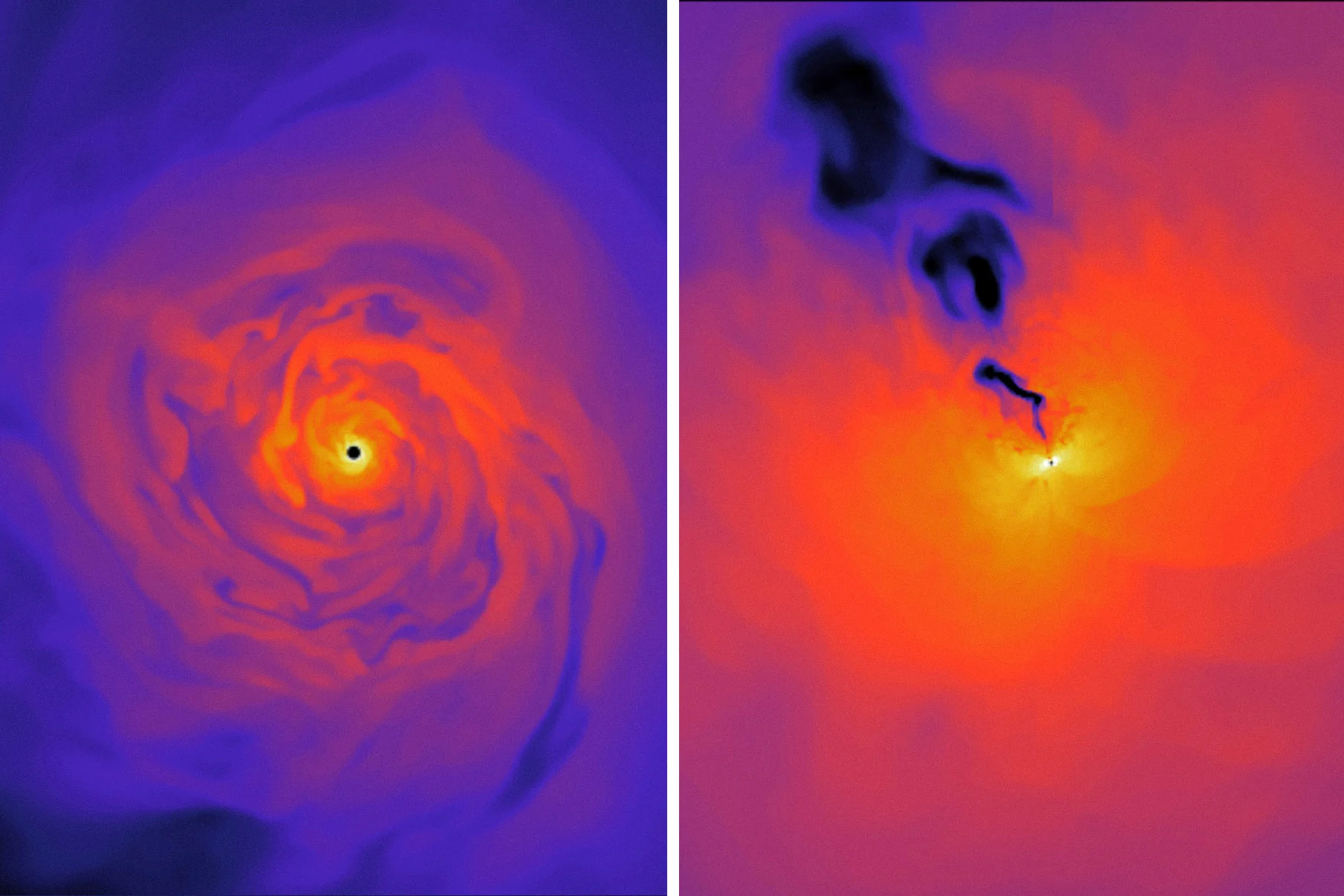
Ole Gottlieb, the first author of the paper and assistant professor of physics at MIT, described that the real "show" starts from this moment. The research team's three-dimensional simulation shows that the trapped black hole will continue to eat star material and gradually grow. Over millions of years, it may absorb about one percent of the star's mass. If the star spins fast enough, the remaining gas forms a rotating accretion disk around the black hole.
Gottlieb said that a black hole with an accretion disk appeared inside the star, and the black hole itself was rotating and distorting the surrounding space-time. As matter spirals toward the black hole, the black hole distorts the magnetic field in the accretion disk, creating powerful jets that can penetrate the star. He bluntly said that once the accretion disk is formed, the star is basically sentenced to death. The twisted magnetic field will drive extremely strong electromagnetic jets from the black hole's poles. These jets will explode the entire star within tens of seconds, and the process is very rapid.
The explosion may have released bright blue and ultraviolet light, along with X-rays and gamma rays. As the event develops, the radiation will gradually shift to other bands of the electromagnetic spectrum. Gottlieb said X-rays and gamma rays may be detected initially, followed by optical and infrared radiation, and then radio radiation. If the event is not too far away from the Earth, existing human equipment has a chance to capture these signals. It may occur in other distant galaxies, not necessarily just in the vicinity of the solar system.
However, other types of cosmic explosions may produce similar signals, so astronomers need more evidence to confirm the existence of primordial black holes. One possible clue is that the exploding star itself should not explode according to conventional theory. Gottlieb explained that if a star's mass is of a type that shouldn't explode, but it explodes, it means that there may be some kind of "parasite" inside the star that is eating it from the inside out.
No primordial black holes have yet been confirmed via this mechanism, but the signals predicted by the researchers could provide direction for future observations. Gottlieb said that humans are expected to detect primordial black holes through the interaction between black holes and stars. Such events should be observable and deserve further study. The broader significance is that scientists can now use astronomical observations to constrain the number of primordial black holes and further assess their contribution to dark matter.
This research, titled "The Life and Death of Stars Capturing Primordial Black Holes," was completed by Ole Gottlieb, Matteo Cantiero, Cameron Norton, Ken Van Tilburg, and Matthew Kleban. It was published in the Astrophysical Journal on November 19, 2026. Research was supported in part by the Advanced Scientific Computing Research Program of the U.S. Department of Energy's Office of Science and the National Science Foundation.
Comments