
Abstract:
Today, AMD's next-generation RDNA 5 GPU IP appears for the first time in a working chip, but its carrier is not a traditional graphics card, but Samsung's mobile platform. SemiAnalysis conducted wafer-level annotation of Samsung's Exynos 2700 SoC and found that the chip is equipped with the Xclipse 970 GPU built with AMD GPU technology.
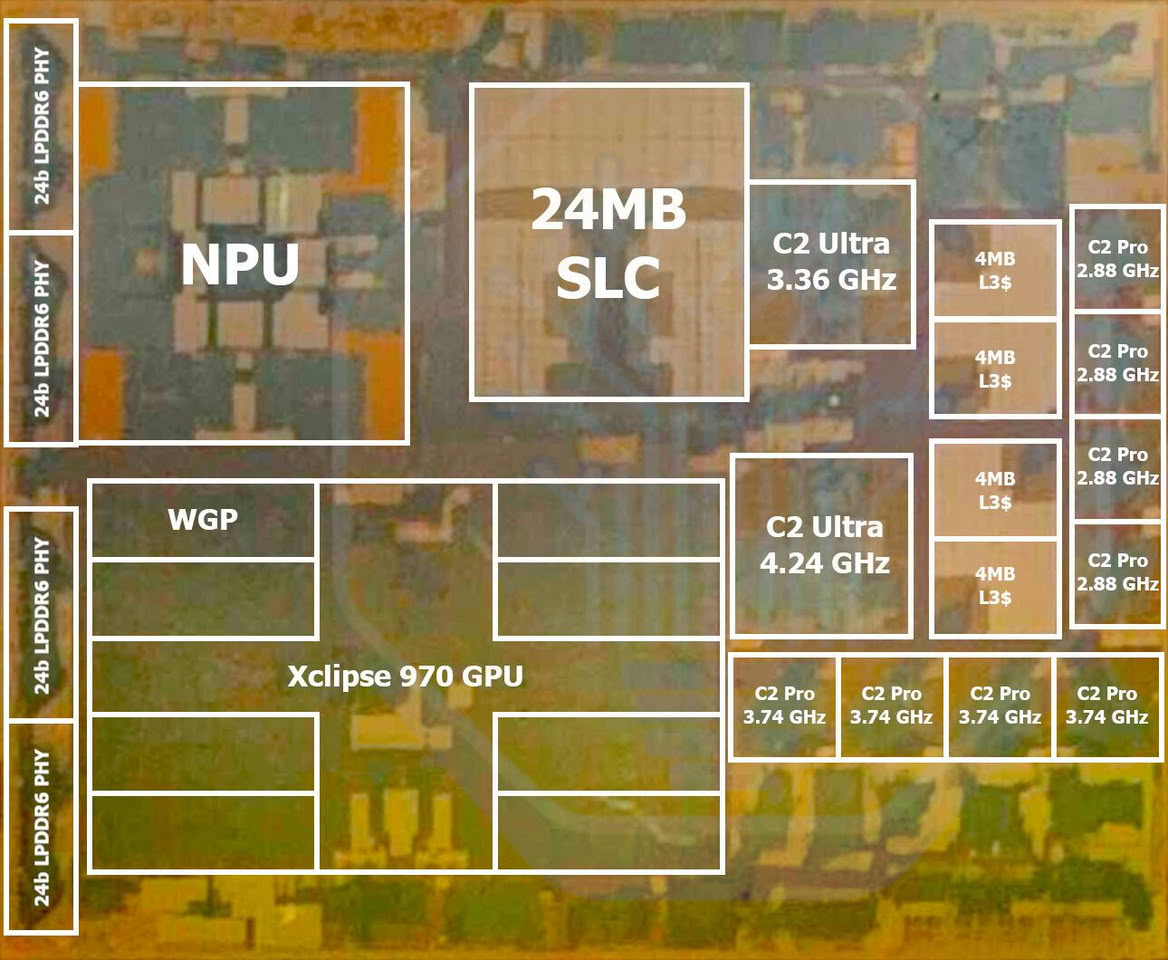
Multiple leaks of information have shown that AMD and Samsung jointly developed Xclipse 970 and adapted AMD's RDNA architecture for mobile platforms. Today, this GPU IP has been upgraded to the latest RDNA 5. Therefore, from a technical perspective, Exynos 2700 will be the first chip equipped with RDNA 5 and officially shipped.
Exynos 2700 is built on Samsung's foundry SF2 process, which is the 2nm node. Samsung designed it with a unique 10-core CPU configuration and high-performance GPU, aiming to compete with Qualcomm's Snapdragon Elite series SoCs.
The CPU part uses Arm’s ready-made CPU core IP, including C2-Ultra and C2-Pro cores. The specific configuration is: 1 large C2-Ultra core clocked at 4.24 GHz, 1 C2-Ultra core clocked at 3.36 GHz, 4 C2-Pro cores clocked at 3.74 GHz, and 4 C2-Pro cores clocked at 2.88 GHz, for a total of 10 CPU cores.
The GPU part is equipped with 8 GPU workgroup processors (WGP), each WGP contains 2 computing units (CU). If AMD maintains the same WGP to CU ratio in RDNA 5 as in RDNA 4, the Xclipse 970 will have a total of 16 compute units.
For Samsung, the release of Exynos 2700 is of great significance. The company is further testing the capabilities of the SF2 2nm process with this highly heterogeneous chip design. This is also an important release for AMD, because the GPU exposed this time does use the RDNA 5 architecture, and the outside world has lacked detailed information about this architecture for some time.
In terms of external connections, Samsung has equipped the Exynos 2700 with a 24-bit LPDDR6 memory interface to provide sufficient memory bandwidth for the CPU and GPU core clusters. The industry is still waiting for the first performance test results of this mobile SoC. Relevant data may be able to demonstrate in advance the possible future performance levels of AMD's desktop RDNA 5 architecture.
Comments