
Abstract:
Caltech researchers shined a laser on a crystal and observed billions of atoms emitting pulses of microwave and infrared light in uniform order. The research reveals how atoms synchronize through a quantum phenomenon called superradiation, creating a frequency comb that can output both microwave and light signals.
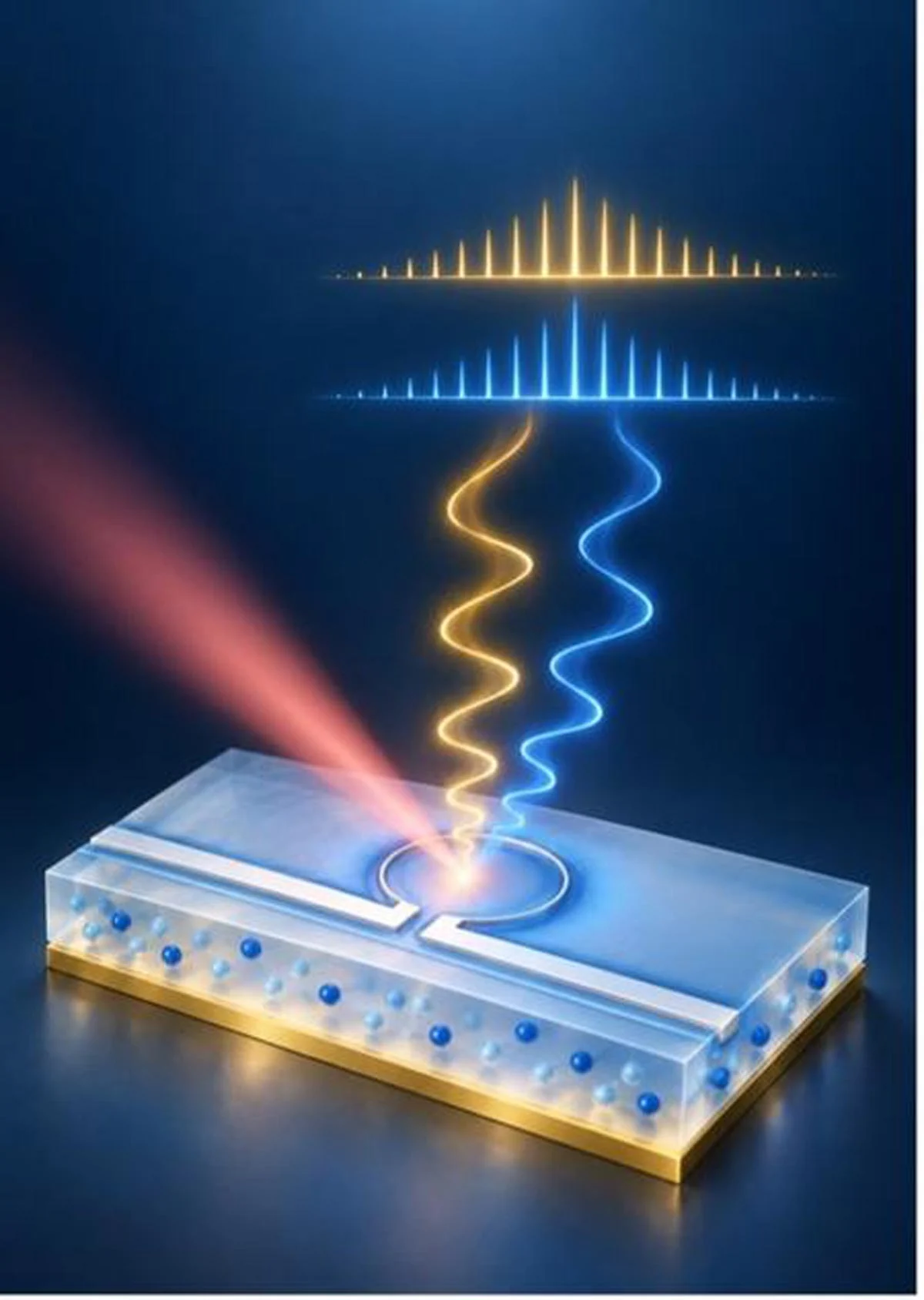
As early as early 2024, researchers from Andre Faraon's laboratory at the California Institute of Technology discovered that lasers can cause billions of atoms in a crystal to emit light pulses regularly. A tiny superconducting circuit binds the microwaves emitted by the atoms, creating a shared field that keeps the atoms in sync.
What's amazing is that these atoms flash in two completely different lights, microwave and infrared light, at the same time, in perfect synchrony with each other, a phenomenon that has never been observed before, Faraon said. Faraon is the William L. Valentine Professor of Applied Physics and Electrical Engineering at Caltech and the Fletcher Jones Endowed Director of the Kavli Institute for Nanoscience.
The Faraon team, working with researchers led by Joonhee Choi at Stanford University, traced this rhythm to a quantum phenomenon called superradiance. They exploited this phenomenon to create frequency combs. A frequency comb is a light source with equally spaced frequencies, like the scales on a ruler. Frequency combs help atomic clocks keep precise time, allowing scientists to measure distances, track ultrafast events, and identify chemicals by the light they absorb. The new frequency comb generates microwave and optical signals simultaneously, a combination that could help connect quantum devices.
The research team embedded billions of ytterbium ions into yttrium vanadate crystals, which were covered with a thin layer of superconducting material to capture microwaves. The laser energizes the ions, and the microwave fields generated by the ions allow them to interact and synchronize with each other. At first, they emitted microwaves steadily. When the laser power exceeds a certain threshold, the steady emission transforms into regularly spaced pulses.

Scientists have known about the phenomenon of superradiation for more than 50 years. In the process, the shared electromagnetic field synchronizes the atoms so they emit light together. Previous experiments produced single flashes or steady beams of light. In this crystal, the ions enter a certain rhythm and flash repeatedly.
Imagine a group of people suddenly starting clapping in perfect rhythm without anyone directing them, Choi said. That's basically what these atoms are doing when they create repetitive flashes of light. It's remarkable how they can organize themselves in this way. Choi is an assistant professor at Stanford University and a former postdoctoral scholar at Caltech.
In a conventional laser, light bounces back and forth between mirrors, causing excited atoms to release energy in sync with the passing light. The spacing between the mirrors helps set the frequency, so even small changes can change the frequency. With superradiation, the atoms themselves can set the emission frequency.
Tian Xie, the first author of this "Nature" paper, said that other mode-locked frequency combs rely on light being reflected by mirrors in the cavity, and the length of the cavity may fluctuate due to factors such as temperature. Because superradiation comes from interference between atoms, it is absolutely stable in frequency and therefore could in principle become a better platform than previous frequency combs. Tian Xie completed this work while a graduate student in Faraon's lab and is now a postdoctoral researcher at Stanford University.
The team hopes to use laser control of ion pulses to make atoms a programmable light source. Faraon said being able to adjust the intensity, pulse spacing and firing pattern of each shot would be useful for different specific applications.
Superconducting quantum computers use microwave signals, which can easily lose quantum information outside ultra-low temperatures close to absolute zero. Infrared light can transmit information over long distances through fiber optic cables. For a superconducting circuit to take advantage of this connection, its microwave signals need to be converted into optical signals.
Ytterbium ions can interact with both. Each ion has three experimentally relevant energy levels. The smaller gap between a pair of energy levels matches the energy of a microwave photon, while the larger gap matches the energy of an infrared photon.
Tian Xie said that whenever these ions generate a microwave field, there is a process that naturally generates a corresponding light field at the same time. That's why in experiments, when you pump atoms with a laser, you see two distinct frequencies of emitted light. This paired emission suggests that these ions may one day connect superconducting circuits with optical fibers.
This research is titled "Observation of Tunable Superradiant Frequency Combs" and was published in the journal "Nature" on November 18, 2026. The research was funded primarily by the U.S. Office of Naval Research, with additional support from the Institute for Quantum Information and Matter, the U.S. Department of Energy, the Quantum Advantage Co-Design Center, and the Gordon and Betty Moore Foundation Experimental Physics Fellows Program. Individual researchers have also received support from the U.S. Air Force Office of Scientific Research, Stanford Terman Faculty Fellowships, Quad Fellowships, and Edelman Fellowships.
Comments