
Abstract:
For the first time, physicists from the University of Queensland in Australia used changes in the gravitational field to encode and transmit a piece of information through a partition wall, successfully spelling out the English word "Gravity". The experiment demonstrates that tiny changes in gravity caused by a moving mass can carry information like a binary signal, providing an empirical basis for a form of communication that theoretically cannot be shielded by ordinary materials.
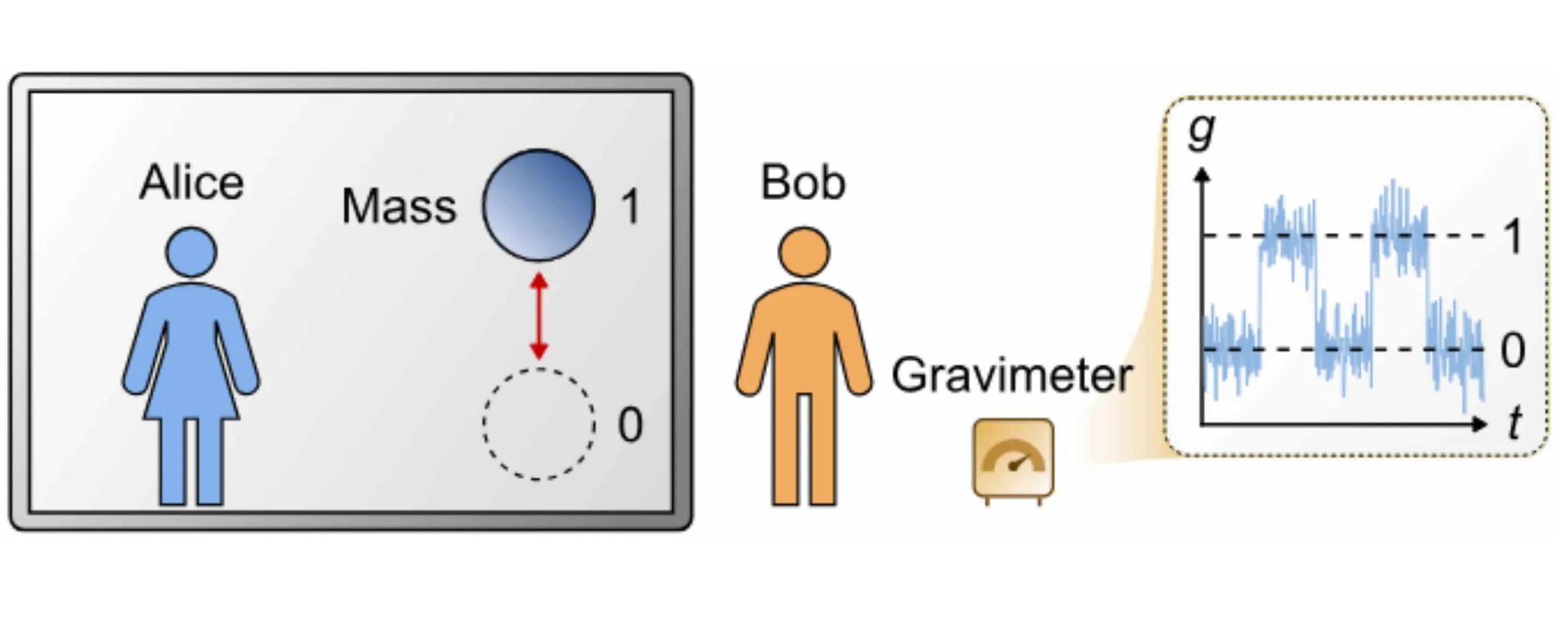
In modern wireless communications, although electromagnetic signals can penetrate brick walls, they can be shielded by materials such as metal mesh; in a vacuum environment, traditional Morse code cannot be transmitted. Gravity is different: there is a gravitational effect between any two objects with mass, and this effect will not disappear no matter how many bricks or iron plates are separated between them. The research team pointed out that no ordinary material has been found that can shield gravitational signals the way a "Faraday cage" shields electromagnetic waves.
In the experiment, the researchers set the elevator's counterweight weighing approximately 1,815 kilograms at two different positions, representing "0" and "1" in binary respectively. On the other side of the partition, a commercial gravimeter uses a spring-suspended mass to detect subtle changes in gravity in the vertical direction. As the weight moved, the instrument measured an acceleration change of about 50 nanometers per second, which is only about one-fifth billionth of Earth's normal gravity.
To improve reliability, each binary bit took up a full minute: the researchers spent 25 seconds moving the weight, then 10 seconds waiting for the system to stabilize, and finally 25 seconds to average the readings. After correcting for the effects of Earth's tides and instrument drift, the team completely recovered all 49 bits of information, as well as the short sequences used to mark the beginning and end of the information. The entire transfer process took 63 minutes.
The initial goals of this study were modest. The research team had hoped to find a way to weigh trucks without having to drive them onto a weighbridge. After verifying that this idea worked, they realized that the same physical principles could also be used to encode and transmit information. Once the idea proved to work, the team realized it could be used to encode and transmit information, said physicist Andrew Grozek, lead author of the study.
Measuring the gravity of tiny objects dates back to 1798. The British physicist Henry Cavendish used the gravitational effect of a large lead ball on a small hanging ball to twist the hanging wire, and calculated the density of the earth based on this. This experiment advances this ancient principle into the field of information transmission.
The researchers estimate that using more sensitive gravimeters and equipped with faster elevators, the system's transmission capacity could be increased to about 15 bits per minute. In another theoretical calculation, using a more sensitive detector, a well-positioned 75-metric-ton weight, and accepting higher noise levels, the transmission distance could reach about 500 meters.
Although this speed is far from enough to transfer large amounts of data or even download a TV series in the foreseeable future, the researchers emphasize that its value lies in providing an experimentally proven path to help. The paper writes that if someone is trapped in a soundproof elevator that is equivalent to a Faraday cage and the mobile phone happens to be malfunctioning, this method can be a feasible means of sending a distress signal.
Scientists have previously used other particles that are difficult to shield to transmit information. In 2012, a team from Fermilab in the United States used a neutrino beam to send signals through a soil layer of about 240 meters, with a transmission speed of 6 bits per minute. But that experiment required a particle accelerator and equipment designed to detect extremely difficult-to-trap particles; this gravity-encoding experiment only requires a well-placed elevator and a commercial sensor.
In recent years, gravity measurement technology has also continued to advance. In 2022, researchers used cold atom clouds to detect the gravitational characteristics of a tunnel about 1 meter underground; earlier this year, another research team proposed a method of measuring gravitational changes using optical fibers. These developments indicate that once imperceptible gravitational signals are gradually becoming identifiable and exploitable.
However, this technology is still a long way from practical application. Even with more sensitive instruments, gravitational interference from environmental vibrations or other moving objects can still drown out the signal. The researchers believe that a lot of further work will be needed to make the system truly practical.
But the research team pointed out that being disturbed by noise and being completely blocked by walls are two different things. With the completion of this proof-of-concept experiment, it may be possible to use moving mass to knock out a message that truly "shakes the universe" in the future. The research results have been published in the journal Science Advances.
Comments