
Abstract:
NVIDIA's latest DLSS 5 technology was recently tested on Apple's M5 Pro chip under an unofficial experimental program. The results show that its neural rendering capabilities can significantly improve image quality, but at the cost of frame rates falling to single digits and input lag soaring to ten times that of the desktop RTX 5050.
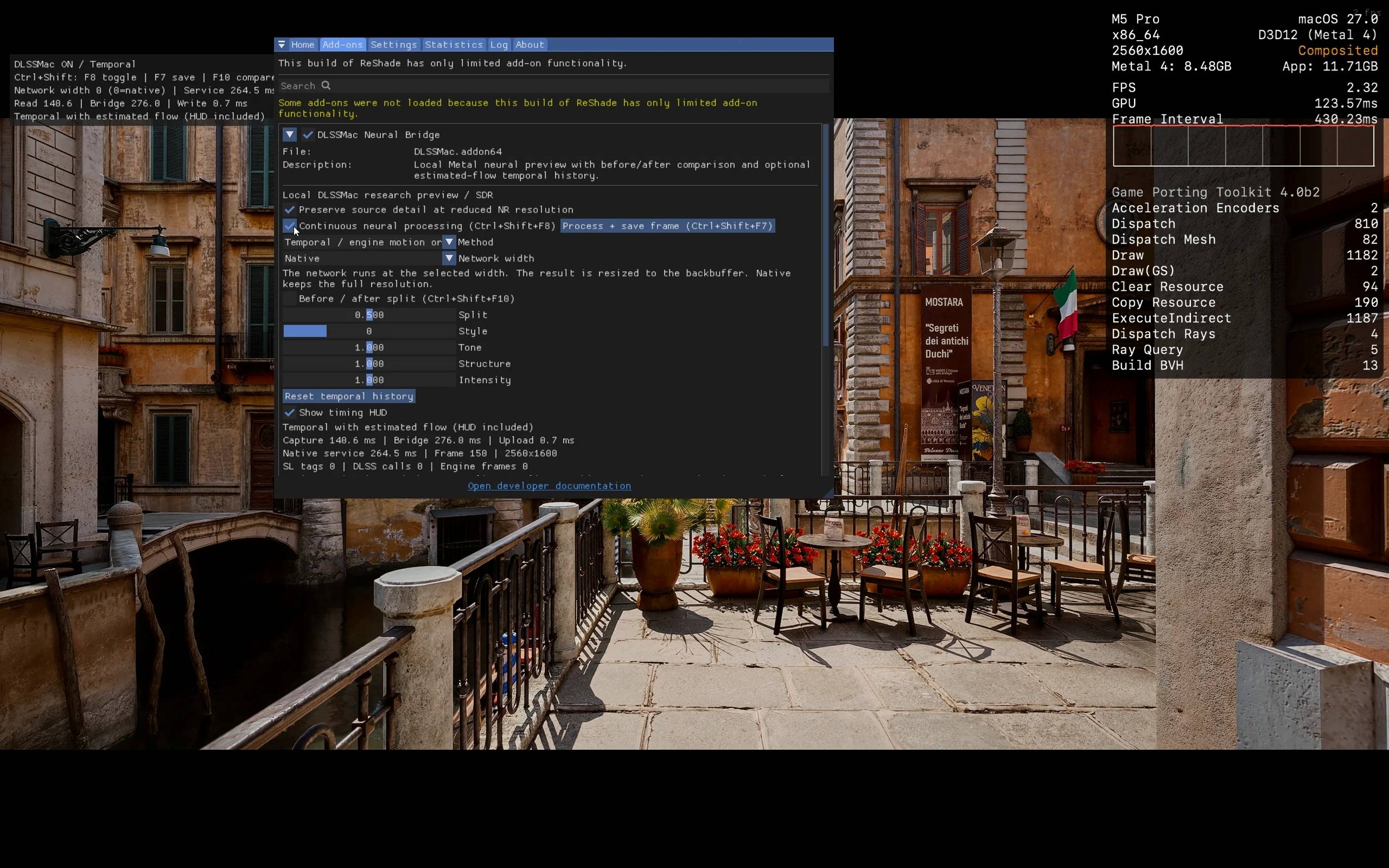
The test was led by developer @iamwavecut, who ported the neural rendering model of DLSS 5 to the Apple Silicon platform and used the Apple Metal framework to run natively; another developer @Mappsnet7 connected the Metal backend to the Windows gaming environment through ReShade and Game Porting Toolkit 4.0b2. On the M5 Pro's 16-core GPU, this solution successfully improves the realism of surface lighting, ambient light occlusion and depth of field, and significantly enhances picture details and three-dimensionality.

Performance, however, was disappointing. With DLSS 5 enabled, the M5 Pro's frame rate plummeted to 2.32 FPS at 1440p resolution, with input lag as high as 240 milliseconds, well above the desktop RTX 5050's levels. Reddit user AnyPomelo3352 pointed out that this performance collapse stems from the M5 Pro's lack of a dedicated FP8 hardware unit - DLSS 5's core operations rely on FP8 precision, and the M5 Pro can only route the neural rendering load to the FP16 path, resulting in no performance gains.
From a specification comparison, the M5 Pro's 16-core GPU only supports FP8 computing power of up to 26 TOPS, while the desktop RTX 5050 can reach about 105 TOPS, which is a huge gap. In addition, running neural inference through ReShade hooking GPTK4 itself will bring additional performance overhead, further dragging down the overall performance.

Although Apple is vigorously promoting the adaptation of its self-developed chips in the gaming field, the test results of DLSS 5 clearly show that M5 Pro and M5 Max are several generations behind in neural rendering architecture. Whether FP8 support will be introduced in the M6 series in the future is still unknown, but the current solution has highlighted the hardware bottleneck of Apple Silicon in AI graphics processing.
Comments