
Abstract:
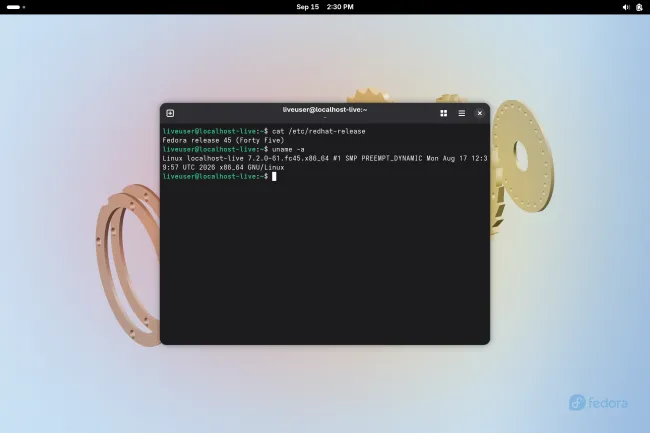
Fedora 45 Beta has now been officially released and has entered the public testing phase as planned. As a new generation version of Fedora Linux launched towards the end of the year, Fedora 45 has brought a large number of underlying and desktop environment updates. The most noteworthy one is the use of KMSCON to replace the traditional console inside the kernel, while adding support for Stratis storage installation and further strengthening system security and reproducibility of software builds.

One of the biggest underlying changes in Fedora 45 is to use KMSCON as the default virtual terminal console. KMSCON is a console implementation that runs in user space and can provide terminal display using the KMS (Kernel Mode Setting) graphics mode setting mechanism of the Linux kernel. Previously, Fedora has been using the console implementation in the kernel. This change means that Fedora is further moving some terminal functions from the kernel to user space for a more flexible implementation.
KMSCON was originally planned to be enabled in Fedora 44, but was postponed to Fedora 45 because the related work was not completed in time. This official entry into Fedora 45 Beta means that this long-term plan has finally made substantial progress.
In terms of storage, Fedora 45 adds support for Stratis Storage in the Anaconda installer. Stratis is a Linux storage management technology developed by Red Hat. The underlying layer combines XFS, LVM, LUKS and specialized management services to provide users with a more simplified storage pool and file system management method. Although Stratis has existed in Fedora for many years, users have previously been unable to deploy systems on the Stratis storage stack directly through the Fedora installer.
Fedora 45 also further tightens the system's ptrace permissions. ptrace is an important mechanism in Linux for tracking and debugging processes, but if abused by malicious programs, it may also become an important way to attack other processes. Therefore, Fedora 45 imposes stricter restrictions on ptrace by default to reduce potential security risks.
Package signature verification will also be further enhanced in Fedora 45. The system performs signature checking by default to ensure that the source and integrity of software packages can be verified, reducing the risk of malicious software packages or tampered software entering the system.
At the same time, Fedora 45 began to require that package builds be as reproducible as possible. The so-called reproducible build means that under the same source code and the same build environment conditions, the software should be able to generate the same or equivalent binary results. This not only helps verify whether software packages have been tampered with, but also improves the transparency and security of the entire Linux distribution supply chain.
Fedora 45 also adds a new DRM Panic front end. When a serious error occurs in the Linux kernel or even a kernel crash, DRM Panic can present error messages on the display device. Fedora has further improved the user experience of this feature this time, making it more similar to the Windows blue screen mechanism that users are familiar with, making it easier for ordinary users to understand that serious errors have occurred in the system, and at the same time, it is also convenient for technicians to perform fault diagnosis.
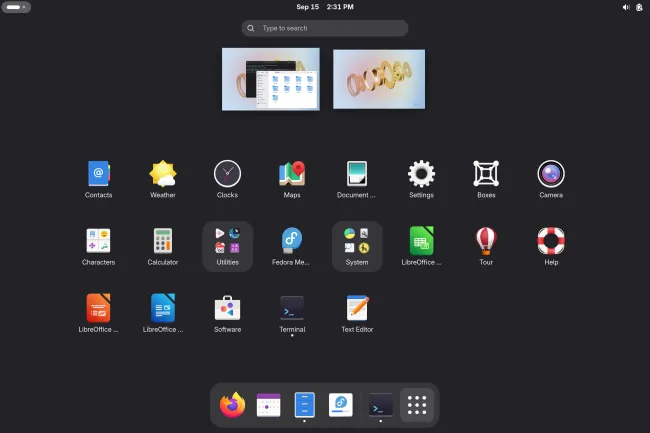
In terms of desktop environment, Fedora Workstation 45 will be equipped with the latest GNOME 51. GNOME 51 itself also contains a lot of improvements, including better desktop infrastructure and input device support. For users who use Fedora Workstation as their main desktop system, this will be one of the most intuitive changes in this version upgrade.
Fedora 45 also updates a large number of core software packages simultaneously. Among them, the Go programming language was upgraded to 1.27, Python was upgraded to 3.15, the GCC compiler was upgraded to 16.2, the GNU C Library was also upgraded to 2.44, LLVM was upgraded to 23, and the RPM package management system was upgraded to 6.1. Upgrades to these underlying components will provide developers and software maintainers with updated compilers, runtime libraries, and development tool chains.
In addition to the major changes mentioned above, Fedora 45 also contains a large number of package updates and other system-level improvements. As Fedora's consistent rapid iteration strategy, the new version will not only update the desktop environment, but will simultaneously promote upgrades at multiple levels such as the kernel, compiler, development tools, security mechanisms, installers, and system management components.
At present, Fedora 45 is still in the Beta testing stage, mainly for users who want to experience the new version in advance and help find problems. According to the current release plan, the official version of Fedora 45 is expected to be launched on October 20. If problems arise during the final testing process that require an extension, the alternate release date will be October 27.
The focus of Fedora 45 this time is not just to update the desktop software, but also to make various adjustments to the underlying system, security mechanism, storage management and software supply chain. If the final version can be launched as planned, this version will become a more important system-level update for Fedora in recent years.
Learn more:
https://lists.fedoraproject.org/archives/list/
[email protected]
/thread/FTPOQ3H47Y2MCHFVJ5C7P5CO25GDTJV3/
Comments