
Abstract:
Scientists have studied that the earth is round for more than 2,000 years, but supporters of the "flat earth theory" still firmly believe in it. Some people are even willing to "go to the end of the world" to find evidence, but they have not yet found the so-called end. Putting aside the shape of the Earth, researchers at the Royal Institute of Technology in Sweden and the University of Southampton in the UK recently developed a technology that proves that in the field of fiber optic sensing, flat structures may be significantly better than circular structures.
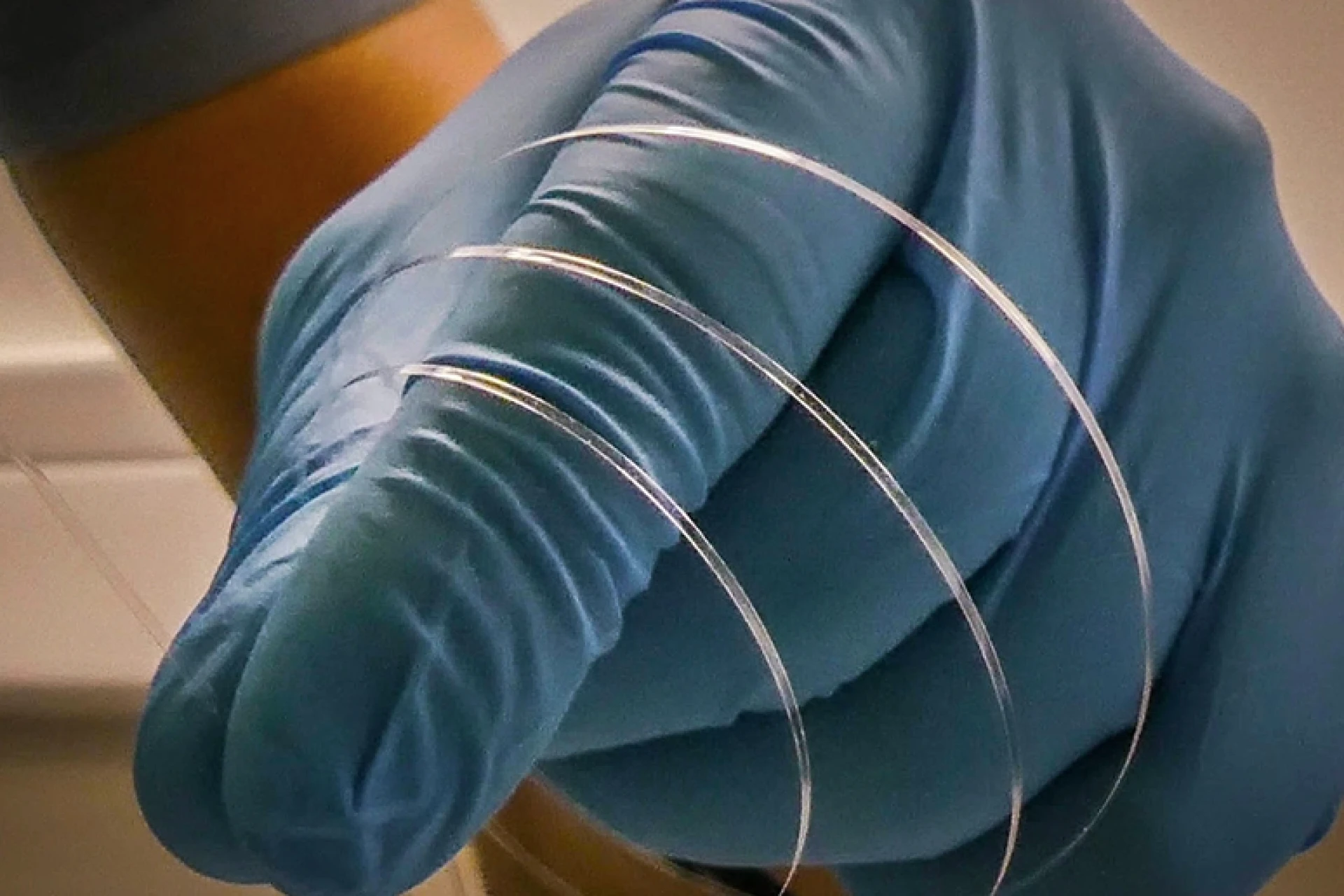
The research team developed a flat ribbon-shaped silica optical fiber. This kind of optical fiber can be structurally designed to produce a much stronger response to physical effects than traditional cylindrical optical fibers, so it can become a sensor with better performance. The researchers named it "High Aspect Ratio Flat Fiber" (HARFF). In a comparative test, the pressure sensitivity of this optical fiber was up to 1,000 times that of traditional optical fibers; another version filled with internal metal showed stronger temperature sensing capabilities. The research team has used a single experimental preform to draw this special optical fiber with a length of more than 120 meters, proving its manufacturing feasibility.
The most well-known use of optical fiber is as a filament of glass that transmits data, carrying information around the world through pulses of light. However, fiber optics are also very capable sensors. External effects such as stretch, pressure or temperature can slightly change the physical and optical properties of glass. These external effects can be measured by tracking the changes in light as it travels through the fiber.
A rough but intuitive analogy is a watering hose. When people squeeze a certain section of the hose, the water flow changes. By measuring the change in water flow, engineers can work out how much pressure is being applied. Fiber optic sensing uses a similar principle, but is much more sensitive. Researchers send light into optical fibers, measure how the light signals change, and use these changes to infer what the optical fiber has experienced.
One common approach is to use fiber Bragg gratings. These gratings are tiny periodic structures written inside optical fibers that reflect specific wavelengths of light. When an optical fiber is stretched or compressed, the wavelength of the reflected light changes, providing engineers with an "optical ruler" to measure strain.
Conventional silica optical fibers are typically cylindrical, a geometry ideal for measuring forces acting along the axis of the fiber. However, solid glass cylinders are weakly responsive to lateral forces and hydrostatic pressure from all directions around them, resulting in significant limitations on their sensitivity, which is one of the most desirable properties of sensing technology.
To solve this problem, the researchers changed the shape of the glass. Rather than making a round fiber first and then trying to flatten it, they designed HARFF into a flat structure at the preform stage, resulting in a solid structure with an aspect ratio close to 20:1. This ribbon-like flat geometry revolutionizes how optical fibers respond to external forces. Simply put, the force required to bend a round rod is not the same as bending a thin ruler. The flat structure will make the optical fiber respond more easily to bending forces like a ruler.
With HARFF, engineers can individually adjust the fiber's width, thickness, wall thickness, and internal channels to specifically design where the glass bends and where stress concentrates.
In the pressure sensor, the research team designed two longitudinally extending air channels inside the optical fiber. This intentionally designed asymmetric structure deforms when external pressure is applied, causing varying degrees of strain in different directions around the optical waveguide. As a result, a property of the fiber called "birefringence" also changes. Birefringence means that light traveling in two polarization directions perpendicular to each other will experience slightly different refractive indexes in the same piece of glass.
The researchers then wrote two identical fiber Bragg gratings into the optical waveguide, forming a tiny optical cavity between them. When light propagates within this optical cavity, it produces a characteristic interference pattern. When pressure deforms the glass, its birefringence changes and the interference pattern measurably shifts.
In simple terms, pressure deforms the ribbon fiber, which changes the optical properties of the glass, and the changed light signal tells the researchers how much pressure was applied.
The researchers put this proof-of-concept sensor into a pressure vessel for testing, with the test pressure reaching up to 0.40 MPa. The measurement results show that its peak-to-trough response reaches 7.24 dB/MPa; when calculated using another analysis method, the pressure sensitivity reaches a maximum of 31.6 rad/MPa. At the same time, the temperature cross-sensitivity is less than 1% of the pressure sensitivity, which helps researchers distinguish pressure changes from temperature changes.
The research team stated that compared with comparable optical fibers using elliptical cores and circular cross-sections, the sensitivity of HARFF has been improved by up to three orders of magnitude, which is about 1,000 times. They also claim that HARFF's performance improves by up to two orders of magnitude compared to other silica fiber designs optimized for hydrostatic pressure sensing.
In addition to pressure sensing, the researchers also demonstrated that the same basic glass platform can also be designed as a temperature sensor. In the temperature sensor, they filled an internal channel of the HARFF with a tin-based alloy. The thermal expansion coefficient of silicon dioxide is about 0.5×10⁻⁶/K, while the thermal expansion coefficient of this alloy is about 23×10⁻⁶/K. When the two are heated, the metal attempts to expand far beyond what the surrounding glass will allow. This difference in expansion creates stress in the silica, changing its birefringence and again forming an optical signal that can be measured.
The researchers believe they have not only created a more powerful sensor, but also transformed the fiber's geometry and internal structure into new engineering design variables.
Pavel Maniewski, a researcher at the Royal Institute of Technology, said that this is not just an optical fiber with a different appearance, but opens up a new design space for optical fibers. By changing the geometry, the glass itself can be made to respond more significantly to its surrounding physical environment.
By changing the fiber width, thickness, air channels, optical waveguide location, or the materials filling these channels, the same basic manufacturing platform is expected to be optimized for different types of sensing needs in the future. For example, embedding such optical fiber into a composite wing would allow monitoring of loads and strains without having to lay out a network of large numbers of traditional electronic sensors.
Similar optical fibers may also be used in fields such as drones, bridges, industrial structures and batteries. In these scenarios, changes in internal temperature or pressure may serve as early warning signs of equipment failure. In addition, optical fiber also has the advantages of being light in weight, small in size, and not affected by electromagnetic interference.
Of course, there's still quite a long way to go from an impressive laboratory optical fiber to a practical application that would allow aircraft to have something like a "glass nervous system." The current HARFF is still in the proof-of-concept stage. The researchers measured a light propagation loss of approximately 0.16 dB/meter, which they believe is primarily due to the experimental core geometry and the silica material used, rather than inherent limitations of the flat fiber itself.
In addition, the loss generated when HARFF is spliced with traditional optical fiber is usually less than 3 decibels, which means that there is still a lot of room for optimization of this technology.
The next step of the research team plans to further improve the fiber shape control capabilities, reduce optical loss, and promote HARFF from a proof-of-concept sensor to an actual system. The Royal Institute of Technology pointed out that smart drones, advanced composite materials and safer energy technologies are all possible future application directions of this technology.
It should be noted that this research focuses on fiber optic sensing, not telecommunications data transmission. In the telecommunications field, traditional circular optical fiber is still the mainstream standard.
This research has been published in the journal Nature Communications.
Comments