
Abstract:
Retired U.S. four-star general and former Central Intelligence Agency (CIA) Director David Petraeus recently stated that artificial intelligence may gradually develop from an auxiliary role in simply analyzing data to a core force that can directly participate in military decision-making in the next few years. According to his prediction, by around 2030, AI is expected to begin commanding a battlefield network composed of sensors and weapons, while the degree of direct human participation will be significantly reduced.
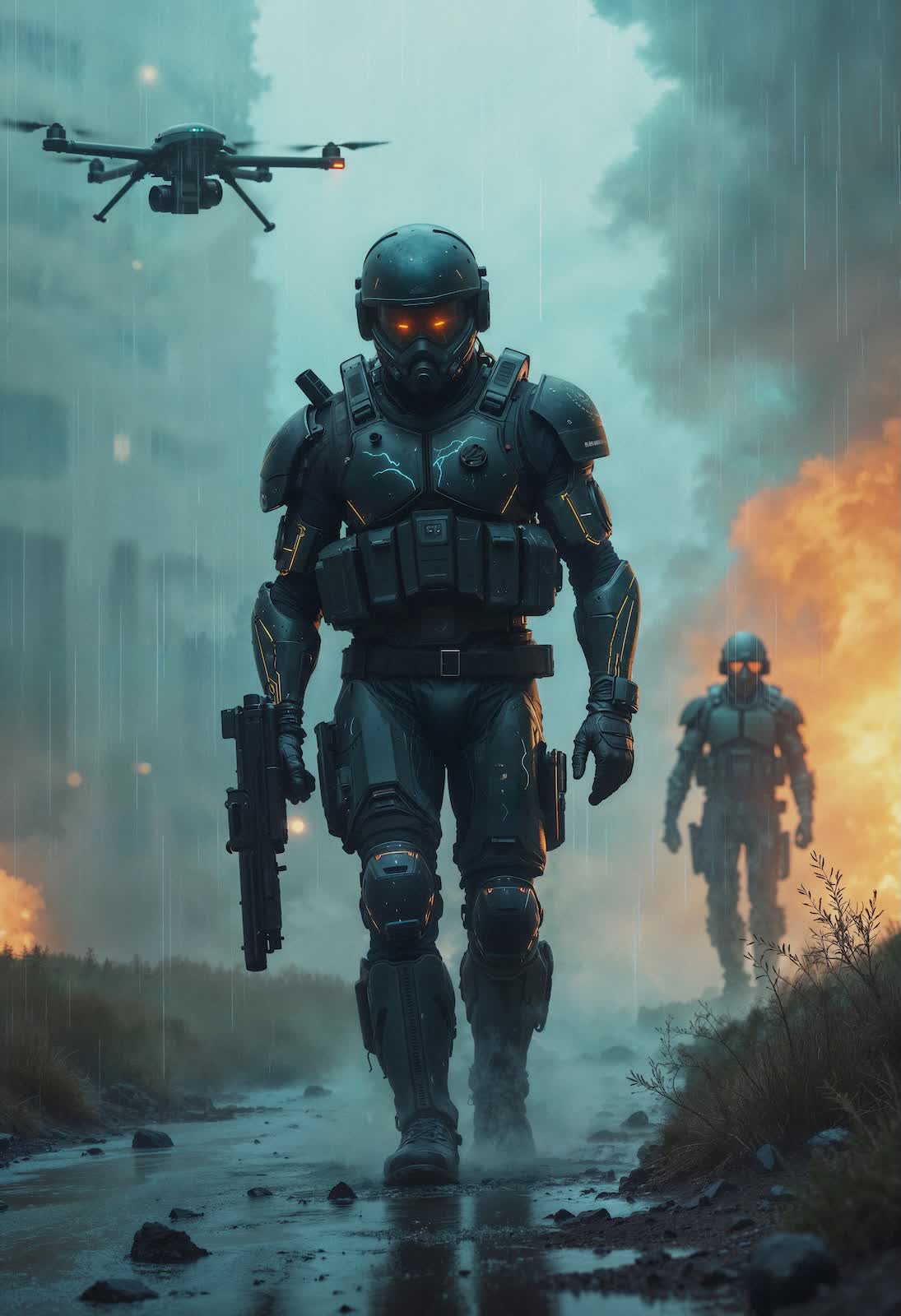
In an interview with the "Forecast2050" podcast, Petraeus said that in the next few years, the militaries of various countries will have autonomous systems, and even "autonomous systems composed of autonomous systems." He believes that the so-called "agent AI" (Agentic AI) will play the role of a staff officer and become an AI staff officer who never rests and does not need to eat or take vacations.
In his vision, the future battlefield is not one where individual drones perform tasks independently, but a large number of autonomous devices are connected through a unified command network. Autonomous sensors on the battlefield are responsible for continuously collecting intelligence and environmental data and transmitting this information to a central command system. The system is then able to issue commands and coordinate actions to the weapons platform with little or no human intervention.
Petraeus has further elaborated on this model in previous interviews with the media. He believes that the responsibilities of artificial intelligence in the future will go far beyond controlling a single drone or collating intelligence for commanders, but will be able to coordinate the collaborative operations of multiple machine clusters and manage cross-platform military operations. He has also said that autonomous systems will soon be able to operate collaboratively at the platoon and even battalion levels, sharing information and completing coordination without human intervention.
In addition to command and control capabilities, Petraeus also specifically mentioned the concept of "recursive learning", in which the AI model uses the data and computing processes it generates to continuously improve its capabilities. He believes that this self-improvement mechanism will become an important driving force for future military technological changes. However, he did not elaborate on how the military would verify, test and deploy such capabilities.
When talking about real-life battlefield applications, Petraeus predicts that by the end of 2026, the scale of use of autonomous unmanned systems on the Ukrainian battlefield will further expand. In the case of drones, one of the immediate impacts will be a reduction in the number of pilots needed, allowing the military to field more flying platforms with limited personnel growth.
However, the current publicly stated position of the U.S. military still emphasizes that "people are in the loop." Admiral Brad Cooper, commander of U.S. Central Command, said that the U.S. military has begun to use artificial intelligence to process and filter massive amounts of data, but did not disclose many details about specific application scenarios. He stressed that the final decision on when to fire, what targets to attack and whether to use weapons always rests with human operators.
Petraeus also pointed out that the transition to an autonomous war model is not only a technical issue, but also requires organizational reforms in military institutions. He believes that the UK may have the opportunity to play a leading role in this field because the UK military is relatively small, the Ministry of Defense command system is more centralized, and the proportion of budget allocation invested in unmanned systems is higher, although its overall economic size is smaller than that of the United States.
In contrast, he believes that the United States still lacks some of the institutional and organizational adjustments needed to complete this transformation. As artificial intelligence gradually moves toward the battlefield, the key challenge facing the military of various countries will not only be to establish autonomous systems that can coordinate complex combat tasks, but also to decide how much decision-making power and action authority should be given to these systems.
Comments