
Abstract:
In the basic laws of physics, objects with the same electric charge should repel each other. Since the deoxyribonucleic acid (DNA) molecule itself generally carries a negative charge, two DNA double helix strands usually produce strong electrostatic repulsion when they approach each other. However, inside living cells, DNA molecules must frequently achieve close contact and precise pairing to drive basic life processes such as gene recombination and gene silencing.
An international research team jointly led by the University of York and the University of Sheffield in the UK recently used high-resolution atomic force microscopy and molecular dynamics simulations to directly observe and reveal for the first time the microphysical mechanism by which DNA molecules overcome electrostatic repulsion and bite tightly like a "zipper."
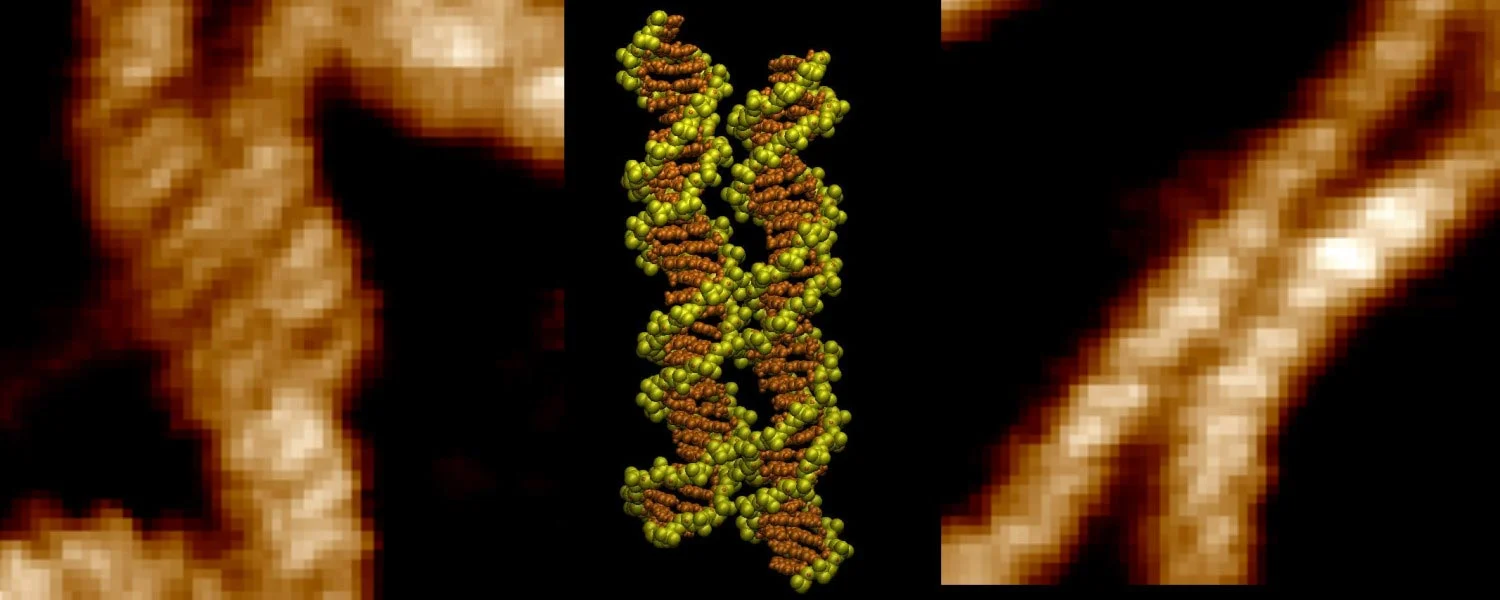
This experimental discovery provides the first direct visual evidence of the microstructure of the "electrostatic DNA zipper model" proposed about 20 years ago. Earlier theoretical hypotheses suggested that salt ions in the solution surrounding DNA may induce the formation of an alternating pattern of positive and negative charges on the surface of the helix, making two parallel DNA molecules closely interlocked like two interlocking spiral staircases. However, due to the extremely weak forces at the molecular scale and rapid dynamic changes, this hypothesis has always remained in the theoretical deduction stage and has not been directly verified by experimental imaging.
In this study, the scientific research team used a high-precision atomic force microscope to conduct fine surface scanning at the nanoscale on short-strand DNA samples, and clearly observed the highly precise alignment of the groove for groove of the two DNA strands. Simultaneous ultra-large-scale computer molecular dynamics simulations further revealed the driving force behind it: tiny metal ions with double positive charges (such as divalent cations) play a crucial "molecular bridge" role in the solution. These positively charged ions can be precisely inserted into the helical grooves of DNA, extending an interaction force like charged arms and pulling two negatively charged DNA molecules at the same time, thus completely canceling out and crossing the electrostatic repulsion barrier that originally hindered their approach.
The study further pointed out that the pairing strength between DNA strands is not uniformly distributed, but shows significant base sequence dependence. Specific DNA sequences have a stronger ability to bind to metal ions, forming a series of "pairing hotspots" in the genome that are prone to physical alignment and tight locking.
Scientists said that the elucidation of this microscopic mechanism has dual guiding significance for basic medicine and bioengineering. At the level of disease mechanisms, identifying DNA pairing hotspots in the genome can help researchers understand how when specific mutations disrupt normal chromatin assembly or recombination pairing, it can cause cellular abnormalities and even induce cancer; at the biotechnology level, mastering the physical laws of DNA's self-assembly by means of ion bridges will provide nanoengineers with new design guidelines for customizing high-strength, programmable artificial DNA nanostructures and drug delivery carriers.
Comments