
Abstract:
A new study finds that a species of ant with an unusually large head is challenging a fundamental rule of biology. According to the long-accepted law of "allometric scaling," animal body parts usually grow in size in predictable proportions, but researchers have found that some ants have evolved extra-large heads that far exceed theoretical predictions.
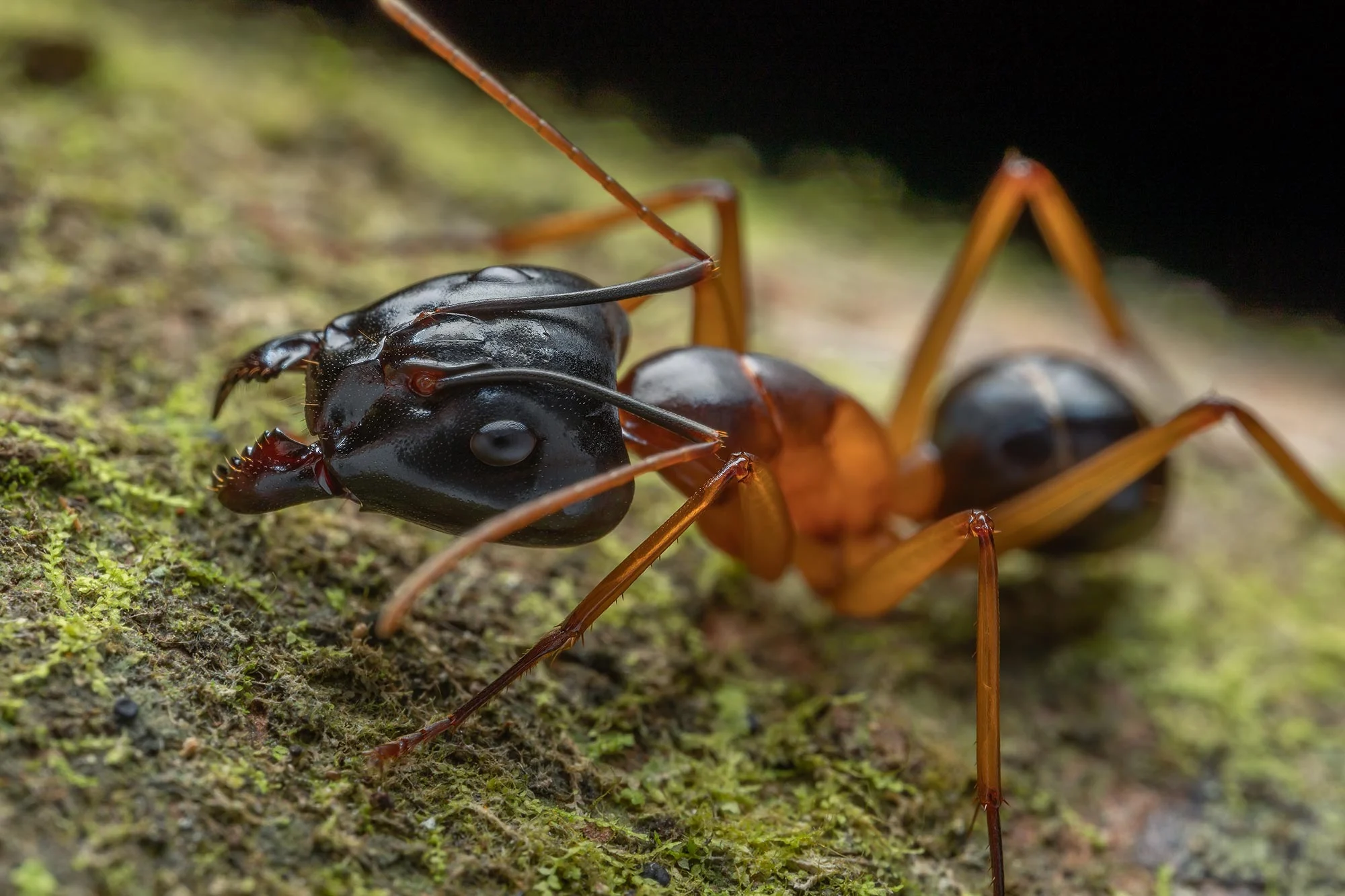
The research object is the "soldier ants" class in ant society. These ants specialize in defending nests, carrying large food items, and performing high-intensity tasks. Compared with ordinary worker ants, their most distinctive features are their unusually large heads and well-developed jaw muscles. In some species, the head size of soldier ants can reach several times the size of ordinary worker ants.
According to traditional biological theory, when a certain part of the body becomes too large, the supporting structures and related organs also need to be adjusted simultaneously. For example, a larger head carries more weight, requiring a stronger neck, thicker exoskeleton, and additional energy supply. Otherwise, the organism's ability to move will be severely limited.
However, after analyzing multiple ant species, the research team found that these soldier ants with oversized heads seem to have successfully bypassed this restriction. Rather than simply scaling up the entire body, they achieve the extreme enlargement of the head through a series of special adaptations.
The researchers used high-precision imaging and three-dimensional analysis technology to conduct detailed measurements of the head and body structure of the soldier ants. They found that as the head continues to grow, other parts of the ant's body do not expand exactly as expected, but instead maintain functional balance by changing body proportions, muscle layout, and internal structure.
Particularly in the muscle system responsible for controlling jaw movement, the researchers observed a highly optimized use of space. The interior of the huge head is fully modified to accommodate powerful biting muscles, allowing soldier ants to produce bite forces far beyond those of ordinary worker ants. This design allows them to undertake specialized tasks such as guarding nest entrances, cutting hard materials and even crushing seeds.
Research points out that this phenomenon reflects the ability of natural selection to break through many seemingly fixed biological constraints. When the ecological environment places strong demands on a certain function, the evolutionary process may create new solutions through structural reorganization and resource reallocation, rather than just following simple proportional growth rules.
Researchers believe that these "giant ants" provide scientists with a unique window into how organisms break through morphological limitations. They show that although the law of allometric growth can explain the developmental patterns of most organisms, under certain evolutionary pressures, organisms may still develop extreme forms beyond traditional predictions.
This research not only deepens people's understanding of the social division of labor and evolutionary mechanisms of ants, but also provides new ideas for exploring the design principles of animal body structures. The research team said that in the future, they will further analyze how these extreme head structures are formed during development, and how related genes and evolutionary mechanisms help ants break through biological limitations that have long been considered to exist.
Comments