
Abstract:
A survey released by the Japan Computer Entertainment Association (CESA) showed that 85.8% of game developers surveyed have used generative AI in their work. When faced with issues such as quality and copyright, manual confirmation, correction and supervision are still the most common management measures used by enterprises.
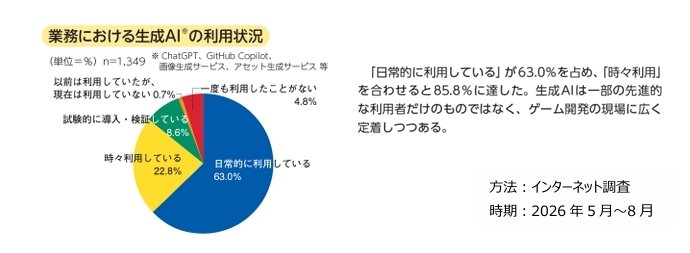
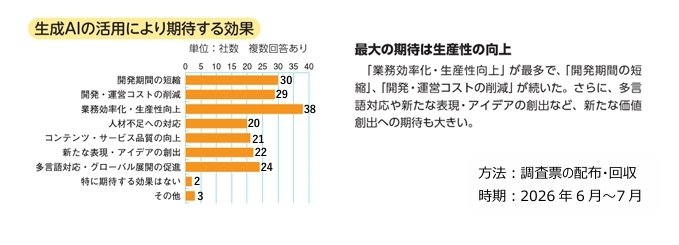
This survey is included in the "CESA Game Industry Report 2026 Preview" published by the Tokyo Game Show, and the survey targets are CESA member companies. When the interviewed companies introduce generative AI, the most expected effect is to improve work efficiency and productivity.
In terms of specific management methods, "manual confirmation, correction and supervision" received the most answers. Most companies have also formulated rules to limit or specify available tools and not directly use AI-generated content to control risks during actual use.
CESA believes that these results show that the Japanese game industry is establishing a safe application mechanism with manual supervision as the core, while continuing to explore the role of generative AI in improving productivity.
CESA Executive Director Tsutomu Masuda said that more than 80% of the game developers surveyed have used generative AI in their business processes, reflecting the widespread and steady application of this technology in the development site. However, rights issues, including copyright, are still of concern, and companies must fully consider these issues when introducing relevant technologies.
Tsu Masuda pointed out that the industry did not completely hand over the work to AI, but established a corresponding application system through manual confirmation and supervision. How to balance the application of new technologies, rights protection and human-centered game production quality will be an important issue that the industry needs to deal with in the future. The full version of "CESA Game Industry Report 2026" is planned to be launched in December 2026.
Comments