
Abstract:
Scientists are trying to use planets and dead stars to find traces of the most mysterious substance in the universe - dark matter. Although dark matter is thought to account for about 85% of all matter in the universe, humans have not yet directly observed it, and its nature remains a mystery. Researchers currently infer the existence of dark matter mainly based on its gravitational effects, but their composition is still poorly understood.
For decades, scientists have searched for particles that could explain dark matter, but have never directly detected any candidates. One possibility is that some dark matter particles move so slowly that they hardly leave a measurable signal in a laboratory on Earth. However, these particles may be easier to detect in objects larger than any ground-based detector, such as planets and stars.
Researchers Alejandro Ibarra, Merlin Reichard and Gaurav Tomar investigated whether these objects could act as "natural traps" for dark matter. The study, published in the Journal of Cosmology and Astrophysics, found no direct evidence of dark matter, but it helped rule out some of its possible properties.
Dark matter is known to act through gravity, but scientists suspect it may also have extremely weak electromagnetic properties. Some particles may carry extremely small electric charges or behave like tiny magnets, interacting with ordinary matter in imperceptible ways.
The speed of the particles may make these interactions more difficult to observe. When a slow-moving particle strikes material inside a detector, the energy it transfers may not be enough to produce a measurable signal. But inside a planet or star, even a small loss of energy may be enough to prevent particles from escaping the body's gravitational pull.
Over billions of years, these trapped particles may accumulate near the center of a planet or star. If their properties allow, they could eventually collide with each other and "annihilate" themselves, transforming into other particles. Some of the products may escape into space, while others may release energy and heat the surrounding material.
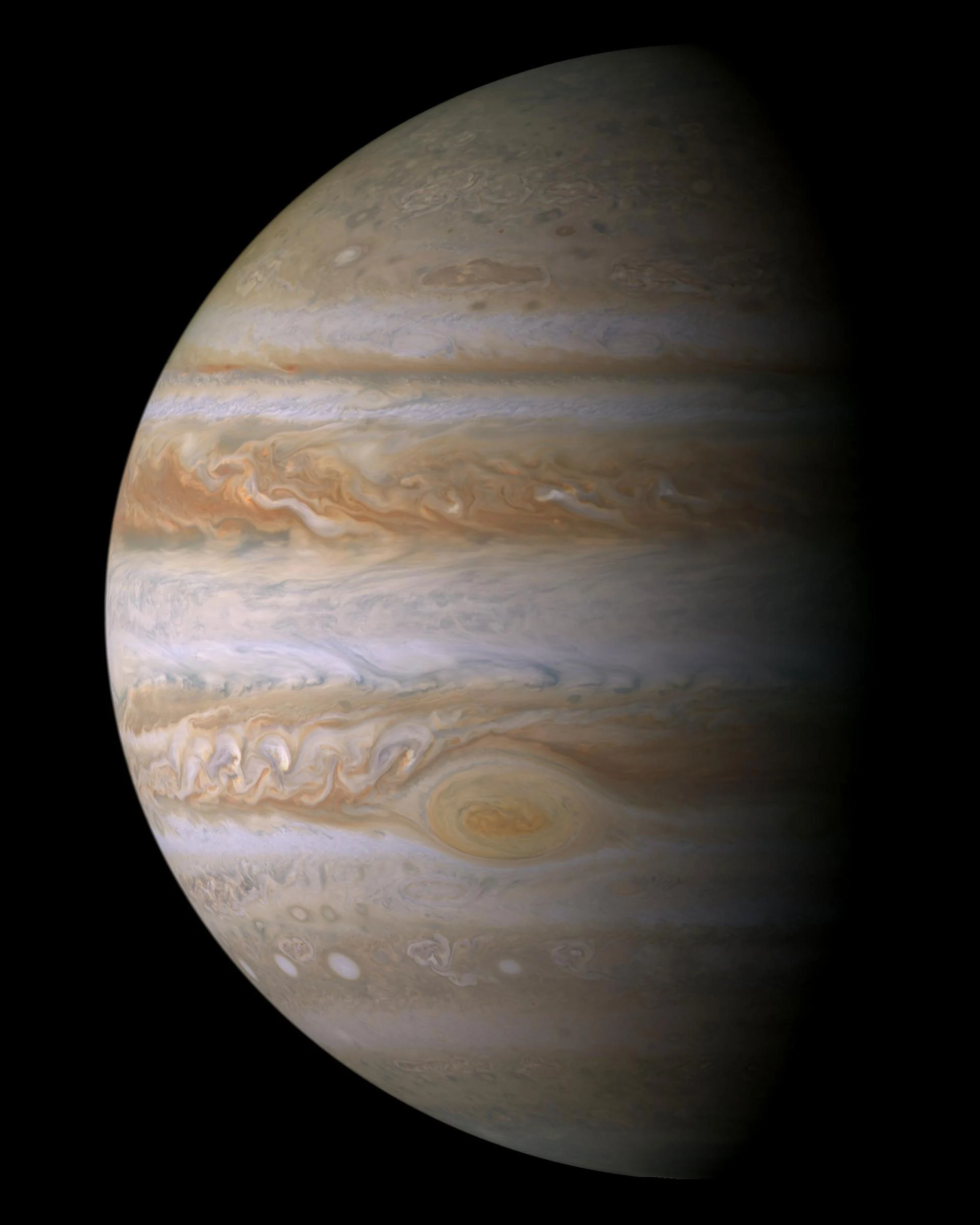
The research team examined four types of celestial bodies: the Earth, the Sun, Jupiter and white dwarfs. Gaurav Tomar, a researcher at the Quantum Space and Time Center of Sogang University in South Korea and the corresponding author of the study, said that specialized experiments such as the IceCube Neutrino Observatory in Antarctica have been searching for neutrinos from the sun and the Earth; for Jupiter and white dwarfs, the research team focused on investigating their possible additional heating effects.
Researchers used two methods to look for signs of dark matter. They analyzed existing neutrino search results for the Earth and Sun. Neutrinos are tiny particles that can penetrate large amounts of matter without being blocked; if dark matter particles annihilate deep within these objects, some of the resulting neutrinos may reach detectors, providing clues.
For Jupiter and white dwarfs - the dense remnants of dead stars - the team turned to heat. Unlike the Sun, these objects do not rely on continuous nuclear fusion for power, so they may be ideal subjects to test whether other sources of energy exist.
The researchers calculated the amount of heat that different types of dark matter might produce if captured by these objects and compared it with the energy actually released by the objects. If a dark matter model predicts that the heat produced exceeds the energy actually radiated by the object, the model may be ruled out.
By combining these calculations with existing observations, the team ruled out several combinations of dark matter particle mass and electromagnetic properties that had not been ruled out by previous experiments. Earth is particularly well-suited to studying particles with extremely small electric charges, while white dwarfs help constrain other possible electromagnetic interactions.
However, there is an important uncertainty surrounding the study results. How much dark matter an object can capture depends in part on the density of dark matter around it. For white dwarfs in particular, researchers can only rely on estimates because the local dark matter density is not always known.
Tomar pointed out that the research team does not know the dark matter density in the relevant region and can only use estimated values; if these values change, the limits set by the research may also become weaker or stronger. He was referring to the M4 star cluster, where the white dwarfs examined in this study are located. The amount of dark matter in this region has not been directly measured and can only be estimated through models.
Looking forward, Tomar suggests looking for cooler white dwarfs in regions where dark matter is thought to be denser. Because such stars emit relatively little heat, the additional heating caused by trapped dark matter particles may be easier to detect. Planets orbiting stars outside our solar system may also provide new opportunities to study whether dark matter is quietly accumulating inside celestial bodies.
The study, titled "Celestial Object Detection of Electromagnetic Interactions of Dark Matter," was completed by Alejandro Ibarra, Merlin Reichard, and Gaurav Tomar, and was released on August 27, 2026. Although the research has not announced the discovery of dark matter, it shows that Jupiter, the Earth, the sun and even distant white dwarfs may become important windows for humans to understand the dark matter of the universe.
Comments