
Abstract:
On the northern frontier of the Roman Empire, someone carved a name on a bowl nearly two thousand years ago. Today, the name is one of the most important clues for archaeological students about the lives of people on the fringes of the empire. The site, located in Redesdale, Northumberland, England, was excavated by Newcastle University. The research focused on how the Roman army obtained supplies. The archaeological team is examining the roads, workshops and buildings that supported life for the army and the civilians who accompanied it.
The summer 2026 excavations attracted 52 first-year Newcastle University students, who were divided into two groups and each worked at the site for two weeks. Students worked alongside volunteers from the Redesdale Archaeological Group and the excavation was directed by Archaeological Practice Ltd.
On the first day of excavation, student Elise Zalou unearthed a Roman gold chain in her first archaeological dig. This slender gold chain, approximately 7 centimeters long, is in excellent condition and could still be worn if intact. Roman goldsmiths shaped individual gold rings into a figure-eight shape, then folded and woven them into each other. This process, known as "ring-within-a-ring", could produce flexible chains, usually using extremely pure gold for fine jewelry, military amulets or decorative accessories.
Zalu said that the feeling of discovering the gold chain was unreal, especially since it happened on the first day of his first excavation. She had thought she would never encounter anything like this in her entire career, so was pleasantly surprised and grateful that studying archeology at Newcastle University gave her valuable field experience. Eric Turini from the School of History, Classics and Archeology at Newcastle University said that discovering gold artifacts is an experience that many archaeologists may not have throughout their careers, and it is extraordinary for a first-year student to discover a beautifully preserved Roman gold chain on his first day of exploration.
Also on the first day, student Shannon Wood discovered a folded sheet of lead with partially obscured cursive Latin letters etched into its surface. Archaeologists speculate that this may be a commercial seal used to mark ownership or track goods, perhaps related to the army's supply network; it may also carry private information, or it may have been used as a curse board. In the Roman world, people would carve prayers, grievances, and sometimes curses onto thin sheets of lead, fold them, and leave them in holy places. Further study of the inscription may shed light on its purpose.
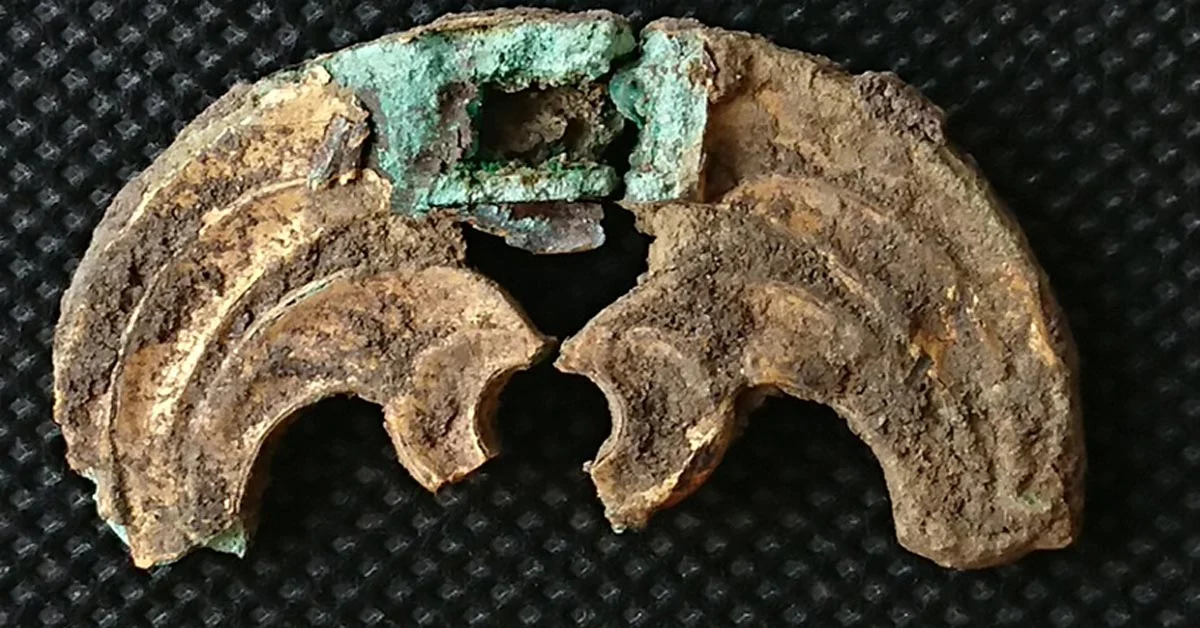
The next day, Megan Porter discovered a crescent-shaped bronze ornament known as the "Shield Cavalry Pendant." Its inwardly curved tip echoes the shape of ancient shields, and its surface is decorated with concentric ridges. Although corroded, much of the gilt remains. The ornament may have been suspended from a military belt, harness, or scabbard, and its craftsmanship suggests it may have belonged to a cavalry officer or other person of higher status.
Among the coins, spearheads and pottery, the students also found a Samian pottery bowl with a name engraved on it. The inscription can be read as "MARTIN[I]" or "MARTIN[US]", both pointing to a man named Martinus. Several other pottery sherds appear to bear the same name, suggesting that people who lived or worked at the site nearly two thousand years ago may have marked their names on the vessels.
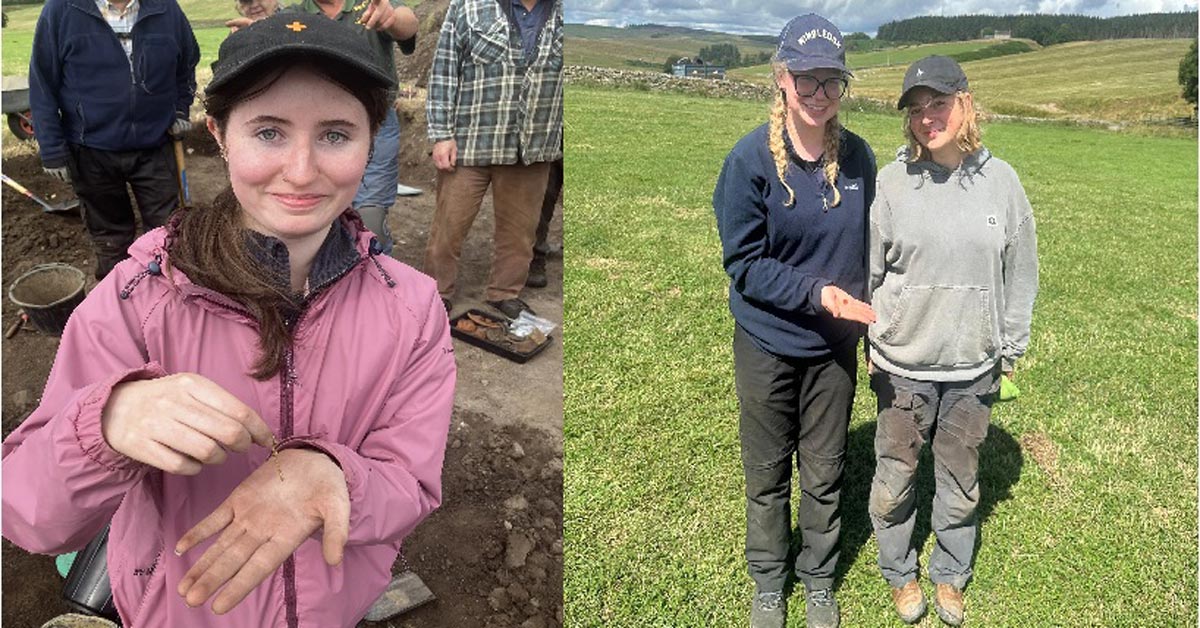
During the final week, students Macy Wertmov and Zoe Uyle discovered a polished orange carnelian with an image of Jupiter carved into it. The king of the Roman gods holds a scepter and a miniature figure of the goddess of victory, with an eagle at his feet. The engraved stones, known as intaglios, can be set in rings and pressed against warm wax for document authentication. This is the fourth intaglio gemstone unearthed from the site, with two discovered in 2025 and the first discovered in the 19th century.
Wortmov said the discovery of the gemstone was very exciting and that studying archeology at Newcastle University gave her practical experience and allowed her to work in a professional environment. Working with archaeologists allowed her to better understand the profession and meet new people. Yuyle said she loved her time at the field school, especially because everyone there was so friendly and helpful.
Researchers at Newcastle University and their partners have been investigating the Redesdale site since the early 1990s, with large-scale excavations conducted between 1992 and 1998 and in 2010. The current project, which began in 2021, has explored two large enclosures, known as the "annex areas", and recorded traces of their defenses, buildings, roads and industrial activity.
Site director Richard Carlton, a visiting scholar in archeology at Newcastle University, said the finds were exciting not only because of their outstanding quality, but also because of the stories they told. A gold chain, a seal gemstone, inscribed pottery and a decorative brooch illuminate the lives of the people who made this site work nearly two thousand years ago. Combined with the architectural and industrial remains the team is excavating, they also help people understand how the frontier worked and how Romans interacted with local communities.
Comments