
Abstract:
New Zealand's largest giant weta, wētāpunga, has established new wild populations outside its native islands through long-term artificial breeding and ex-situ protection. A retrospective study published by the research team in the "New Zealand Journal of Zoology" showed that conservation personnel have moved more than 11,000 artificially bred individuals to ten new locations; in the key monitoring areas of two islands, at least the fourth generation of individuals has been confirmed, and some areas have reached the fifth generation, indicating that the populations in these locations can reproduce and continue in the wild.
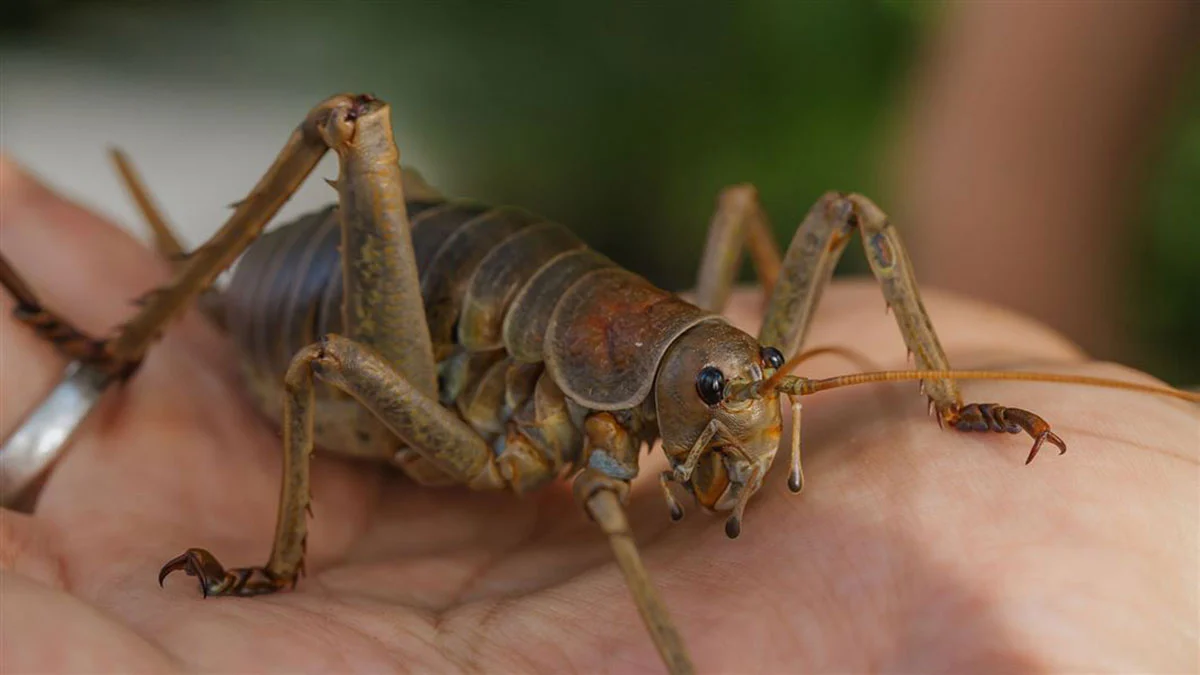
The scientific name of wētāpunga is Deinacrida heteracantha. It is the largest species of New Zealand giant weta and one of the heaviest orthopteran insects in the world. After European settlers developed land, destroyed habitats, and introduced exotic predators such as rats and weasels, the species disappeared from its original distribution areas such as Northland, Auckland, and Great Barrier Island in the mid-20th century. Only Te Hauturu-o-Toi, the remnant population on the small barrier island, remains in the wild. Surveys in the 1990s showed that the remaining population was limited and it was difficult to directly capture enough individuals to establish new populations in other locations, so conservationists turned to artificial breeding.
The breeding project started with collecting a small number of individuals from the small barrier island, and established the first captive breeding colony at Butterfly Creek in 2008. Auckland Zoo subsequently established a second breeding colony in 2012. The two institutions are gradually improving breeding methods, including allowing larvae to grow in collective nursery facilities, to increase the scale of breeding. Since 2010, the project has relocated individuals in batches to eight islands free of predatory mammals, as well as two mainland protected areas with protective fences north of Auckland; a total of 45 ex-situ releases have been conducted in 15 years. Auckland Zoo alone bred and released 8,874 animals between 2014 and 2025. The above figures are cumulative releases, not the total number of individuals currently surviving in the wild.
The monitoring focus is on Motuora Island and Tiritiri Matangi Island. Researchers calculated the generations based on observation records of adults and their offspring, footprint tunnels and other data: As of November 2025, fourth-generation individuals were found at both monitoring points on Motuora Island, and one monitoring point on Tiritiri Matangi Island reached the fourth generation and the other reached the fifth generation. The researchers pointed out that confirming multiple consecutive wild breeding generations is an important basis for judging that an ex-situ population has been successfully established. Continuous discoveries have been made at other release sites, but the intensity of monitoring at each site is not the same. It cannot be said that stable, self-sustaining populations have been formed at all ten sites.
The New Zealand Department of Conservation's species assessment shows that the wētāpunga's conservation level has improved from "National Endangered" in 2004 to "National Recovering" in 2022. However, it is still a threatened species, and long-term protection still relies on habitats free of introduced predators and continuous monitoring. The Aboriginal tribe Ngāti Manuhiri of the Small Barrier Island continues to participate in the project as local guardians and traditional land rights holders; community conservation groups provide funds and manpower for breeding, reintroduction and follow-up monitoring. The research team said that the experience accumulated from the project is also being used to breed another endangered giant weta, Māhoenui wētā, at the Otorohanga Kiwi House, and may provide reference for the protection of other endangered invertebrates.
Comments