
Abstract:
ASUS officially launched the ROG Xbox Ally X20 20th Anniversary Edition handheld console and opened pre-orders in the United States. This product is a high-end upgraded version of the ROG Xbox Ally X. The biggest change is the replacement of a 7.4-inch OLED display, and the upgrade of the TMR magnetic induction rocker, deformable cross keys and body grip structure. However, its core performance hardware has not changed, so this product is closer to a high-end upgrade focusing on screen, control and appearance, rather than a new performance platform.
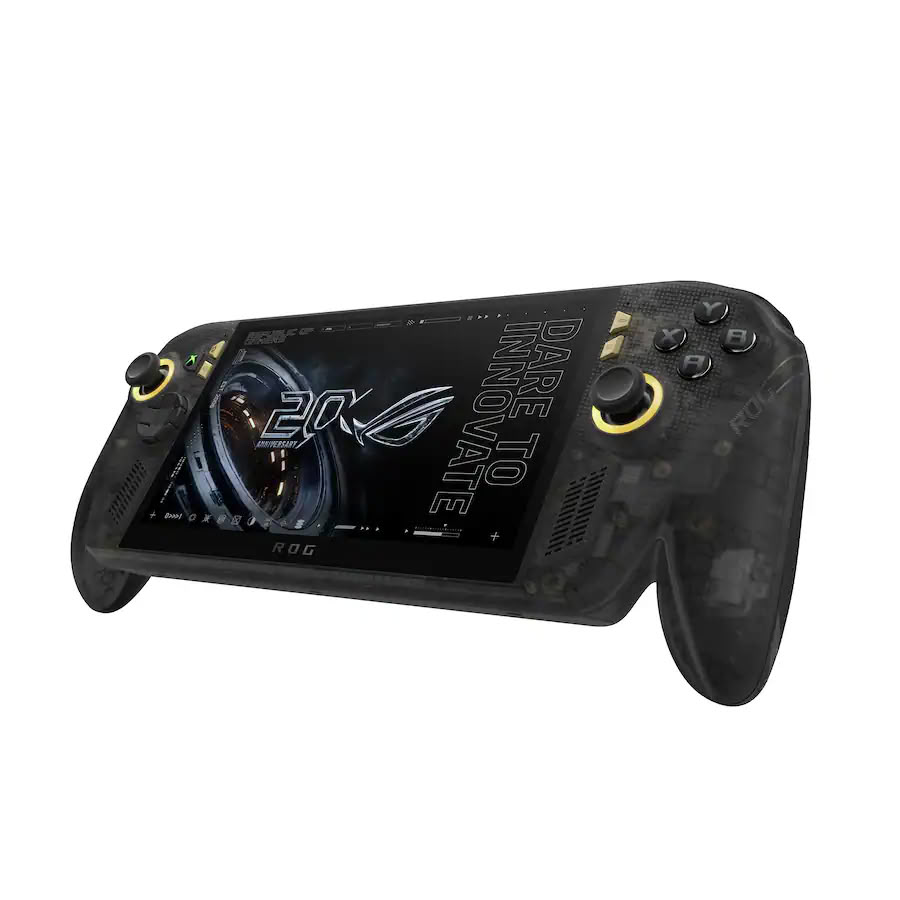
ROG Xbox Ally X20 is priced at US$1,299.99 in the United States, which is US$300 higher than the ROG Xbox Ally X currently priced at US$999.99. It is expected to be officially launched on October 15. When Asus initially announced this 20th anniversary product earlier this year, it was mainly sold as a luxury package containing ROG XREAL R1 Edition 20 AR glasses, but this time it launched a handheld version separately, which means that consumers do not need to buy the entire set of AR glasses to get the X20.
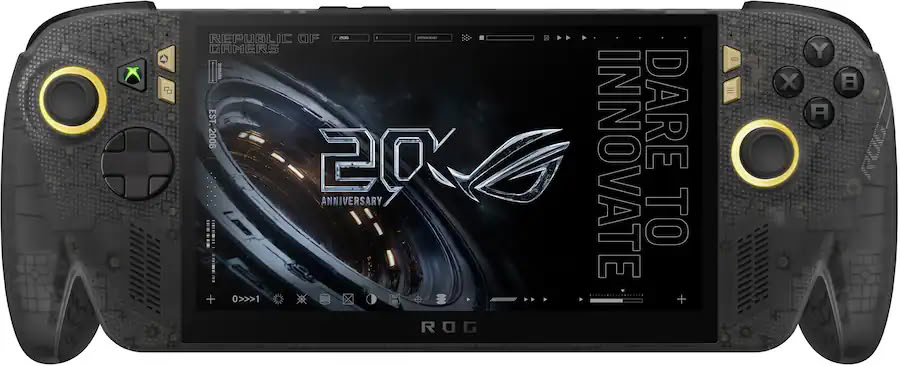
The most obvious upgrade of the X20 comes from the display. ASUS equips it with a 7.4-inch ROG Nebula HDR OLED screen with a resolution of 1920×1080, a refresh rate of 120Hz, and supports FreeSync Premium Pro variable refresh rate. The screen supports HDR display, with a peak brightness of up to 1,400 nits. It also adopts VESA DisplayHDR True Black certification and supports Dolby Vision.
In comparison, the regular ROG Xbox Ally X uses a 7-inch 120Hz LCD screen, so the OLED panel is not only larger in size, but also able to provide deeper blacks, higher contrast, and more obvious HDR effects. Asus has also narrowed the top bezel of the screen, allowing the 7.4-inch screen to fit into a body that is basically similar in size.
However, the X20 did not upgrade the processor. It is still powered by the AMD Ryzen AI Z2 Extreme processor, equipped with 24GB LPDDR5X-8000 memory and 1TB PCIe 4.0 SSD, while continuing to use an 80Wh battery. Therefore, when the processor, memory, storage capacity and battery capacity are basically the same, there is no new performance level between the X20 and the ordinary Ally X.
In other words, what users pay an extra $300 for is mainly an OLED display, a new control system, improved heat dissipation and grip design, and a 20th anniversary edition appearance, not a faster CPU or GPU. According to the currently announced configuration, there is no evidence that the X20 can obtain a significantly higher game frame rate than the ordinary Ally X under the same power consumption and game settings.
The control part is another important upgrade of the X20. ASUS has equipped it with a TMR joystick, which is a joystick using magnetic induction technology. Compared with traditional potentiometer rockers, the TMR solution uses non-contact magnetic sensors to detect the rocker position, which can reduce mechanical wear and reduce the risk of rocker drift after long-term use of traditional rockers.
Asus said that the X20's TMR joystick has a dead zone of about 3% and can recognize very subtle operations. It also uses a new algorithm to reduce the four-axis adsorption phenomenon and improve the accuracy of oblique input. This improvement will be more obvious for games such as fighting games and shooting games that require high accuracy in joystick and direction input.
The cross keys have also been redesigned and become one of the most distinctive features of the X20. Asus calls it the "Transforming D-pad," and players only need to slightly lift the D-pad and rotate it 90 degrees to switch between four-way and eight-way input modes.
The four-way mode is more suitable for retro games and games that require strict directional input, while the eight-way mode is more suitable for scenes such as fighting games that require a lot of oblique input. The interior of the cross key uses a hybrid structure of rubber and metal springs to improve key feedback.
The ABXY buttons have also been redesigned. The button surface is flatter and can be basically flush with the fuselage when pressed, making it easier for the thumb to slide from one button to another during continuous operation. The shoulder buttons and trigger buttons have also been adjusted, with the triggers having a deeper, smoother stroke and supporting Xbox's Impulse Triggers vibration feedback.
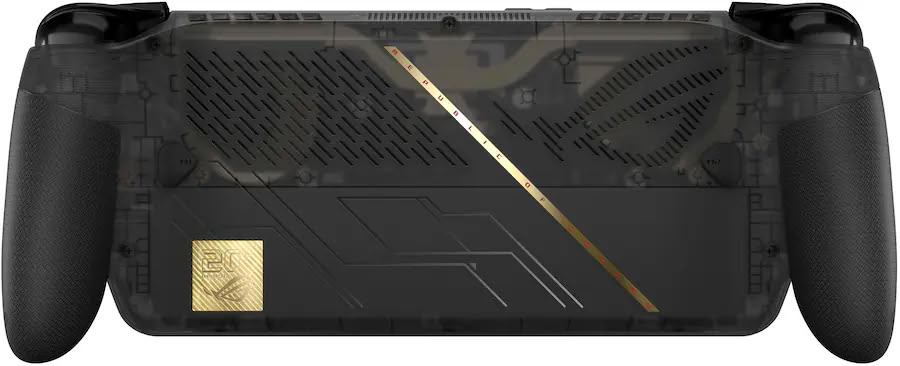
The grip part of the fuselage adopts a new rubberized anti-slip surface. ASUS has re-adjusted the grip shape and surface texture in the hope of reducing hand pressure while providing a more stable grip during long gaming sessions.
In appearance, the X20 uses a translucent black body with a golden internal structure and golden decoration to highlight the commemorative attributes of ROG's 20th anniversary. The transparent body allows you to see part of the internal structure, and the overall design is obviously different from the black appearance of the ordinary version.
In terms of connectivity, the X20 provides a USB4 interface and is compatible with Thunderbolt 4. It is also equipped with a USB 3.2 Gen 2 Type-C interface, both of which support DisplayPort 2.1 video output. In addition, ASUS has also upgraded the memory card interface to adopt the faster microSD Express standard.
The cooling system has also been adjusted. ASUS redesigned the fans and cooling fins, and adjusted the motherboard position by a few millimeters to improve internal airflow and cooling efficiency. For this kind of handheld machine that uses high-performance AMD mobile processors, the cooling capacity directly affects the sustained performance during long-term gaming, so although the processor has not changed, improvements in the cooling system may still help reduce temperatures and improve sustained performance stability.
X20 also launched a 20th anniversary package priced at $2,499.99. In addition to the handheld body, the package also includes ROG XREAL R1 Edition 20 AR glasses, a customized dbrand Killswitch protective case, a Pelican protective case, and a 68W power adapter.
Among them, ROG XREAL R1 Edition 20 uses Micro-OLED display technology, which can form a virtual large screen of up to approximately 171 inches in front of users, and supports a maximum refresh rate of 240Hz and a response time of approximately 0.01 milliseconds. The glasses support 3DoF head tracking and Anchor Mode, which allows the virtual screen to be fixed at a specific position in real space.
This set of AR glasses weighs about 90 grams and can be used by connecting the X20 with a USB-C cable. For users who want a large-screen gaming experience on a handheld console, this solution actually turns the X20 into a virtual large-screen gaming device that can be carried around.
However, the price of the US$2,499.99 package is US$1,200 higher than buying the X20 separately, and the current public information does not provide the complete price of all the accessories when purchased separately, so it is impossible to judge the specific price premium included in this package based solely on the official selling price.
The launch of X20 also means that the ROG Xbox Ally series begins to further extend into the high-end handheld market. The previous Ally X already used an 80Wh large-capacity battery and AMD Ryzen AI Z2 Extreme, but the X20 did not continue to improve core performance, but invested resources in OLED screens, control systems and industrial design.
From the perspective of product positioning, the X20 actually solves some of the most obvious shortcomings of the previous generation of products. Handheld users look directly at the screen for a long time, so the OLED display effect is easier to perceive directly than traditional LCD; the TMR joystick and redesigned cross keys enhance the control experience during long-term gaming.
But the $300 price difference also means consumers need to make a trade-off between performance and display experience. Ordinary Ally X and X20 use the same core processor, memory, SSD and battery. Therefore, if the user mainly focuses on game frame rate, then X20 does not provide corresponding hardware performance upgrades; if more emphasis is placed on OLED screen, HDR effect and control experience, then the upgrade of X20 will be more focused on these aspects.
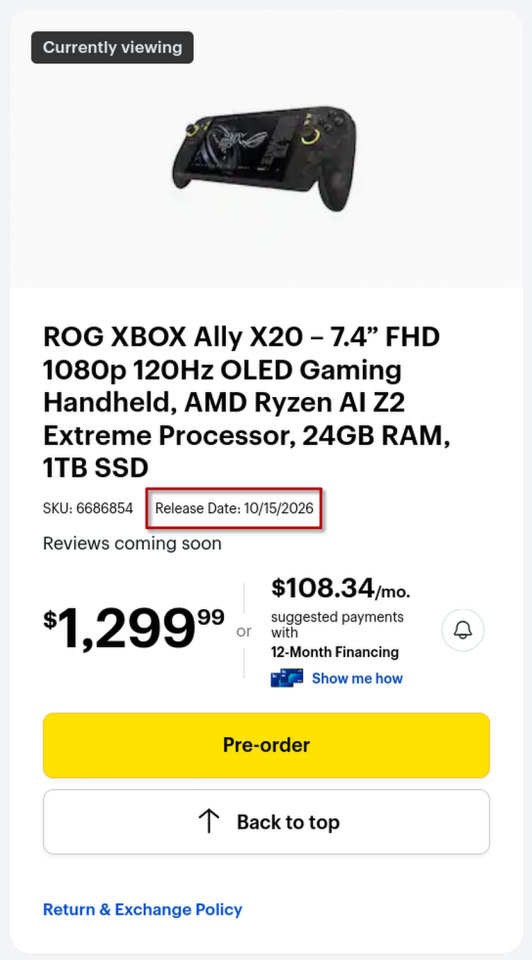
Currently, ROG Xbox Ally X20 has been pre-ordered in the United States, priced at US$1,299.99, and the official launch date is October 15th. Meanwhile, the regular ROG Xbox Ally X, priced at $999.99, will still be on sale. For Asus, the X20 is more like an attempt to develop the ROG Xbox Ally series towards high-end display and quality, rather than a performance upgrade in the traditional sense.
Comments