
Abstract:
According to reports,
the actual transaction price of the RTX 5080 on sale at major U.S. retailers has fully exceeded the $2,000 mark (approximately RMB 13,322).
The lowest available price of RTX 5080 has been pushed up from about US$1,200 (approximately RMB 7,994) two months ago to US$1,979.99 (approximately RMB 13,190), an increase of as much as US$800 (approximately RMB 5,329).
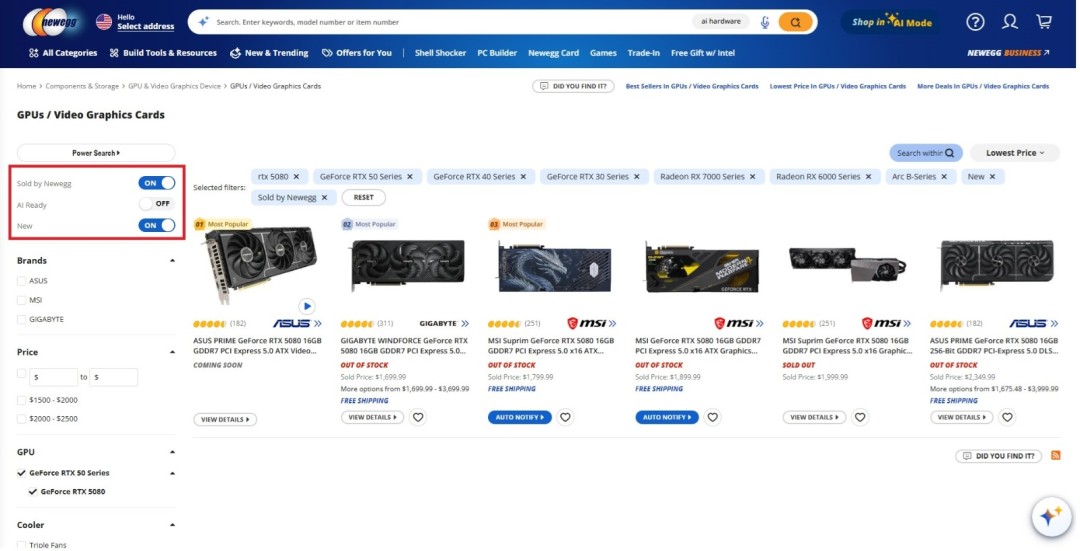
According to data, all new RTX 5080 products from Newegg's self-operated channels have been sold out or marked as coming soon.
Only third-party sellers are selling the products at a price of US$2,299 (approximately RMB 15,325), which is 130% higher than the official suggested retail price of US$999 (approximately RMB 6,659).
The lowest price offered by Micro Center is US$1,979.99 (approximately RMB 13,199) for Gigabyte Windforce SFF OC and MSI Suprim Liquid SOC, but it is only available for offline pickup.
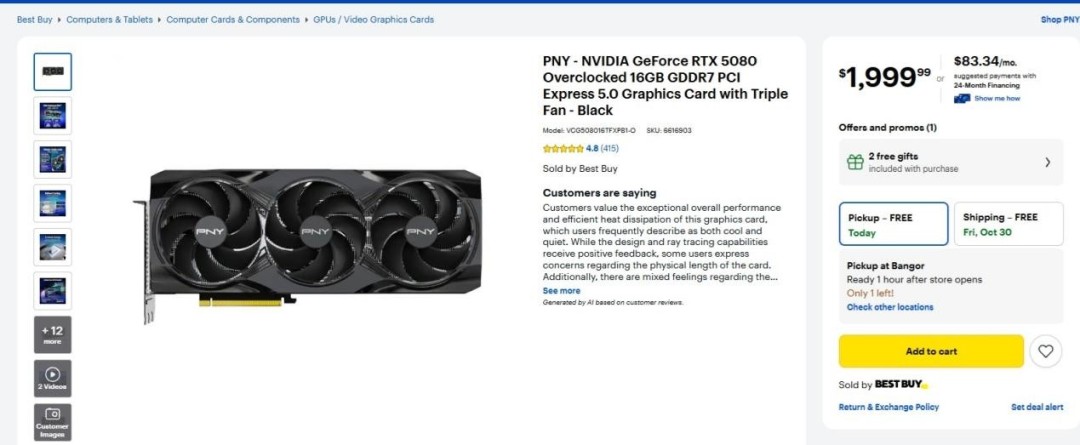
Best Buy PNY Triple Fan OC is priced at US$1,999.99 (approximately RMB 13,332) and is currently the only online ordering option.
The phenomenon of price inversion also occurs. Micro Center prices the lower-positioned ASUS PRIME OC at US$2,349.99 (approximately RMB 15,665), which is US$270 (approximately RMB 1,800) more expensive than the high-end ROG Astral OC. The pricing system has broken away from the product level logic.
The domestic market is also rising fiercely, which is in sharp contrast to the initial price. The first suggested retail price of the public version of RTX 5080 is 8,299 yuan, while the first price of the non-public version is generally between 8,999 and 9,999 yuan. Today, the prices of ASUS and Gigabyte RTX 5080 16G versions on JD.com have exceeded 22,000 yuan.
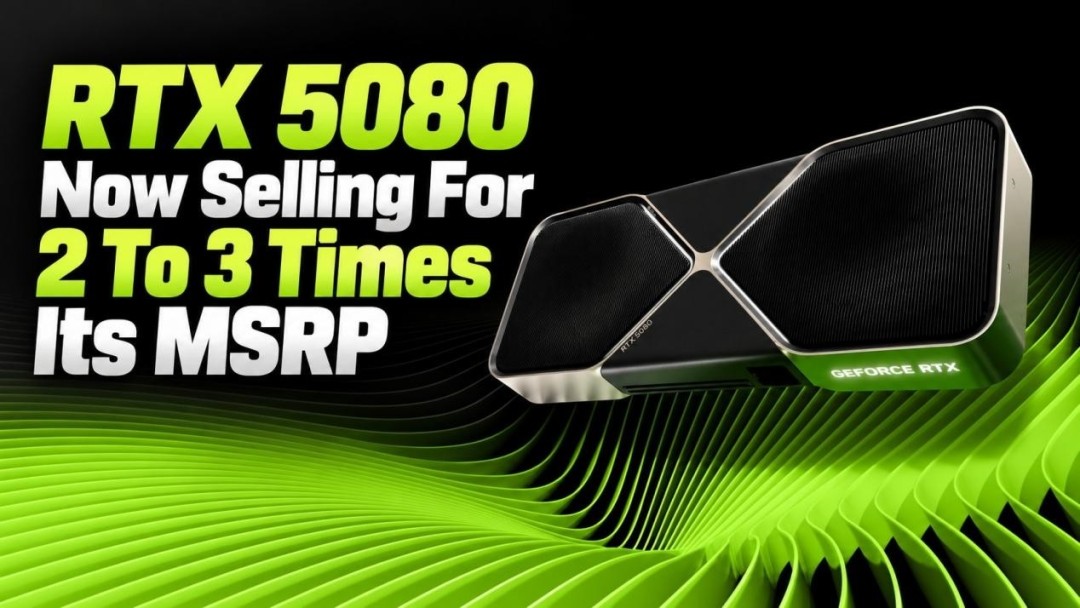
The root cause of the price increase lies in GDDR7 video memory. RTX 5080 is equipped with 16GB GDDR7, and DRAM original manufacturers are shifting their production capacity to more profitable HBM on a large scale, and the supply of consumer-grade video memory is systematically compressed.
SK Hynix has confirmed to investors this week that storage shortage will continue until 2030.
The increase in graphics memory costs is directly transmitted to AIB board manufacturers, and is ultimately fully borne by the retail end.Superposition factors cannot be ignored either. The RTX 5090 has basically disappeared from US channels, with some quotes as high as US$5,599 (approximately RMB 37,323). High-end players who originally aimed at the 5090 were forced to downgrade to the 5080, and demand is further concentrated on this sub-flagship.
At the same time, there are market rumors that Nvidia may replace the 16GB model with the 24GB version of the RTX 5080 and take over the 5090 product position. The expected discontinuation of the 16GB version is accelerating the channel price out of control. NVIDIA has yet to make any public statement on this round of price increases.
Comments