
Abstract:
Microsoft's Xbox game business may face the most significant strategic turning point since its establishment. As the U.S. Democratic Party regains control of Congress in the 2026 midterm elections, political controversies surrounding the construction of large data centers, investment in artificial intelligence infrastructure, and energy consumption have further expanded. A game industry analyst believes that this change in the political environment may prompt Microsoft to reassess the strategic value of the Xbox business and even consider selling it as a whole.
This view comes from Joost van Dreunen, a professor at New York University’s Stern School of Business and a game industry analyst. He once founded SuperData Research, a game market research organization, and has long been concerned about the business model and capital operation of the game industry.
Van Drunen published an article in his personal Substack column titled "The Election That Could Split Xbox", believing that the U.S. midterm elections may become an important turning point for Microsoft to adjust its business structure.
His core logic is that an important attitude shown by Democratic voters in this election is dissatisfaction with the rapid expansion of large data centers across the United States. According to previous reports by the Wall Street Journal, more than 40 towns and counties across the United States have held votes on data center-related measures, and at least 10 of them have passed measures to restrict construction or even completely ban related projects.
In addition, a national survey covering more than 79,000 registered voters showed that 56% of respondents believed that candidates’ positions on artificial intelligence and data centers were important factors affecting their voting choices.
This is not an inconsequential political change for Microsoft. In recent years, Microsoft has invested huge sums of money in building artificial intelligence infrastructure, including data centers, server clusters and related energy facilities. In order to devote more resources to the AI business, the company's game department has experienced multiple rounds of layoffs and studio closures, causing dissatisfaction among players and game industry practitioners.
If Democratic-controlled state and local governments further restrict data center construction, cancel relevant tax incentives, or raise project approval thresholds in the future, Microsoft's artificial intelligence infrastructure expansion costs may continue to rise.
Under such circumstances, it may become increasingly difficult for the Xbox business to gain strategic priority from Microsoft's top brass.
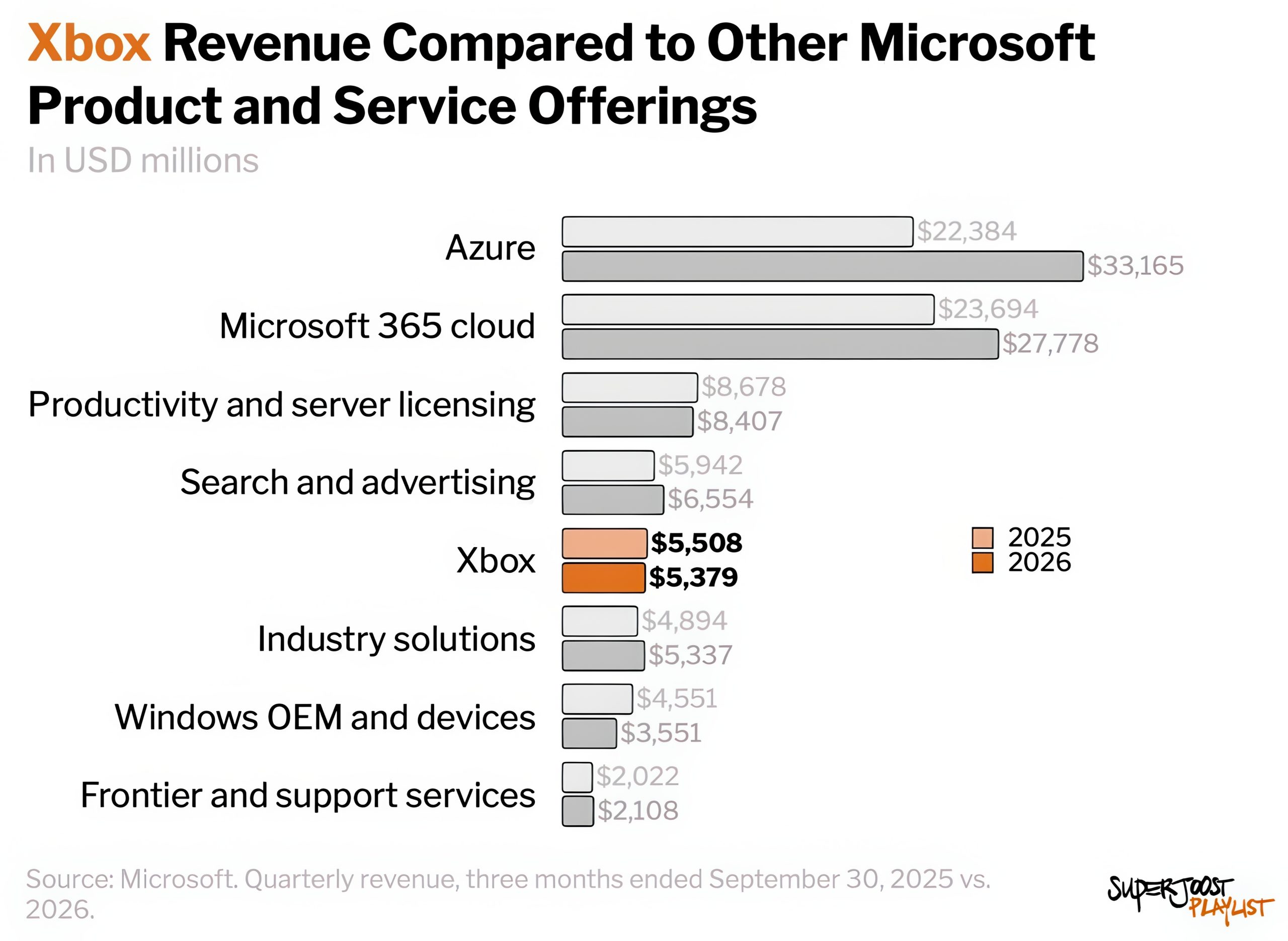
Van Drunen pointed out that Microsoft's gaming business revenue is still on a downward trend, but the rate of decline has slowed. In comparison, Microsoft's search and advertising business will achieve 10% growth in 2026, significantly faster than the gaming unit.
From the perspective of Microsoft's overall business layout, artificial intelligence and cloud computing have become one of the company's most important growth directions. Although the game business owns Xbox consoles, Game Pass subscription services and a large number of well-known game IPs, its strategic position in Microsoft's huge business system may be changing.
In fact, this is not the first time rumors of Xbox sales have appeared.
Just a few weeks ago, technology business media The Information reported that some undisclosed private equity investors had explored the possibility of acquiring the Xbox business from Microsoft. The relevant transaction valuation was said to be between US$100 billion and US$150 billion.
However, a Microsoft spokesperson made it clear at the time that Xbox was not included in the sale.
Van Drunen believes that although Microsoft currently denies the sale plan, this position may still change in the future as the artificial intelligence business continues to expand and the relative importance of the gaming department within the group decreases.
He also specifically mentioned the independent XP department recently established by Xbox head Asha Sharma. This department is mainly responsible for expanding Xbox’s game IP to other forms of entertainment such as movies and TV series.
In Van Drunen's view, this adjustment may make the Xbox business closer to a traditional entertainment and media company, instead of just a game console and software publishing department. For potential acquirers, Xbox, which has mature game IP, film and television development capabilities, and cross-media commercialization channels, may have broader investment value.
If a sale does occur in the future, the scale of the transaction will be staggering. Based on the previously reported valuation of US$100 billion to US$150 billion, this will become one of the largest potential transactions in the history of the global gaming industry, and may also completely change the relationship between Microsoft and the gaming market.
However, analysts also admit that there is still a lot of uncertainty about the extent to which the U.S. midterm elections will push Microsoft to sell Xbox. Local government restrictions on data center construction will first affect Microsoft's investment in artificial intelligence infrastructure. It does not mean that Microsoft must solve related problems by selling its gaming business.
In addition, Xbox has a large user base, a mature game distribution system and important intellectual property assets. Microsoft can also reallocate resources by adjusting its investment pace, selling some non-core assets, and reorganizing its gaming department without directly selling the entire business.
Therefore, the sale of Xbox is still only a possibility raised by industry analysts, and is not a formal transaction that Microsoft has launched.
But the discussion itself reflects a change in Microsoft's strategic focus: In the context of artificial intelligence becoming the core of competition among technology giants, the traditional game business is facing new pressure on resource allocation. For Xbox, whether it will continue to exist as an important business within Microsoft in the future, or whether it will eventually become an independent entertainment industry asset, may depend on how Microsoft weighs the long-term value of artificial intelligence investment and the game business.
Comments