
Abstract:
Samsung Electronics warned in its latest earnings call that the current tight global memory chip supply situation will not be alleviated in the short term, but may worsen in 2027, and supply constraints are expected to continue until 2028.
With the rapid expansion of the artificial intelligence industry, global demand for high-performance storage products continues to rise. Samsung said that more and more customers are taking the initiative to provide medium- and long-term demand forecasts, hoping to lock in future production capacity in advance. Order demands that cannot be met this year are likely to extend to next year, further exacerbating the imbalance between market supply and demand.
Jaejune Kim, executive vice president of Samsung's storage business, said that based on the customer demand currently received by the company, supply pressure in 2027 is expected to be more severe than in 2026. Since new wafer fabs and new production capacity usually take several years from construction to formal production, it is difficult for the industry to see a significant release of new supply before 2028.
In response to continued growing market demand, Samsung is actively expanding its advanced storage product layout. The company revealed that all HBM4 high-bandwidth memory production capacity in 2027 has been sold out, and related orders have been locked in advance by customers. At the same time, the new generation HBM4E product plans to start mass production in the first half of 2027 and increase shipment scale in the second half of the year.
In addition to HBM products, Samsung also stated that the market demand for high-speed DDR5 memory is also strong, especially products with specifications of 8000MT/s and above are favored by server customers. In the field of NAND flash memory, the company is accelerating the development of products for artificial intelligence applications, including PCIe Gen6 enterprise-class solid-state drives, high-density QLC SSDs and other AI infrastructure-related storage solutions.
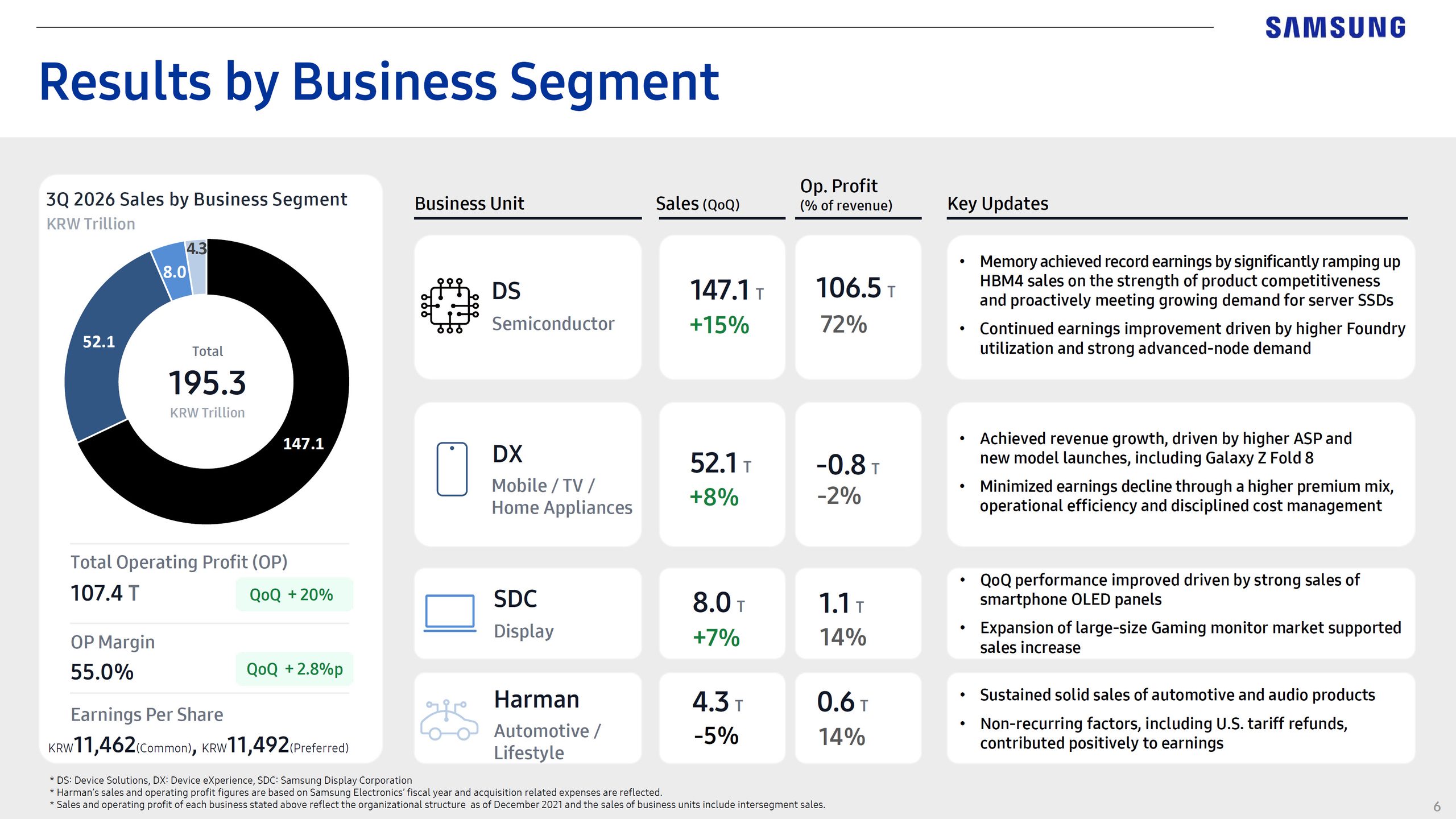
Thanks to the AI server construction boom, Samsung’s third quarter performance in 2026 hit a record high. Revenue in the quarter reached 195.3 trillion won, a year-on-year increase of 127% and a month-on-month increase of 14%. At the same time, Samsung became the first global technology company with operating profits exceeding 100 trillion won, with operating profits increasing 783% year-on-year and 20% month-on-month.
The company also continues to increase investment in research and development. Samsung's current R&D expenditure reaches 14.4 trillion won, a year-on-year increase of 63%. Relevant funds are mainly used to expand production capacity, develop next-generation storage technology and build new production facilities.
Among the business departments, Samsung’s DS department, which is responsible for the semiconductor business, performed particularly well. Driven by demand for HBM, DRAM and SSD products, the division's operating profit increased by 72% year-on-year, and revenue increased by 15%.
Samsung also revealed that more and more large AI companies and data center operators are seeking multi-year supply contracts to ensure a stable supply of memory chips in the future. In order to reduce the risk of market fluctuations, Samsung plans to include about 60% to 70% of its production capacity in the long-term supply agreement system. For customers who are willing to sign long-term purchasing contracts, the company will give higher priority supply guarantee.
Analysts believe that this means that in the next few years, advanced storage products will continue to prioritize the artificial intelligence data center market, while the share of production capacity available in the consumer electronics field may be relatively limited. Including smartphones, personal computers, graphics cards and various consumer-grade storage products, they may continue to face rising cost pressures.
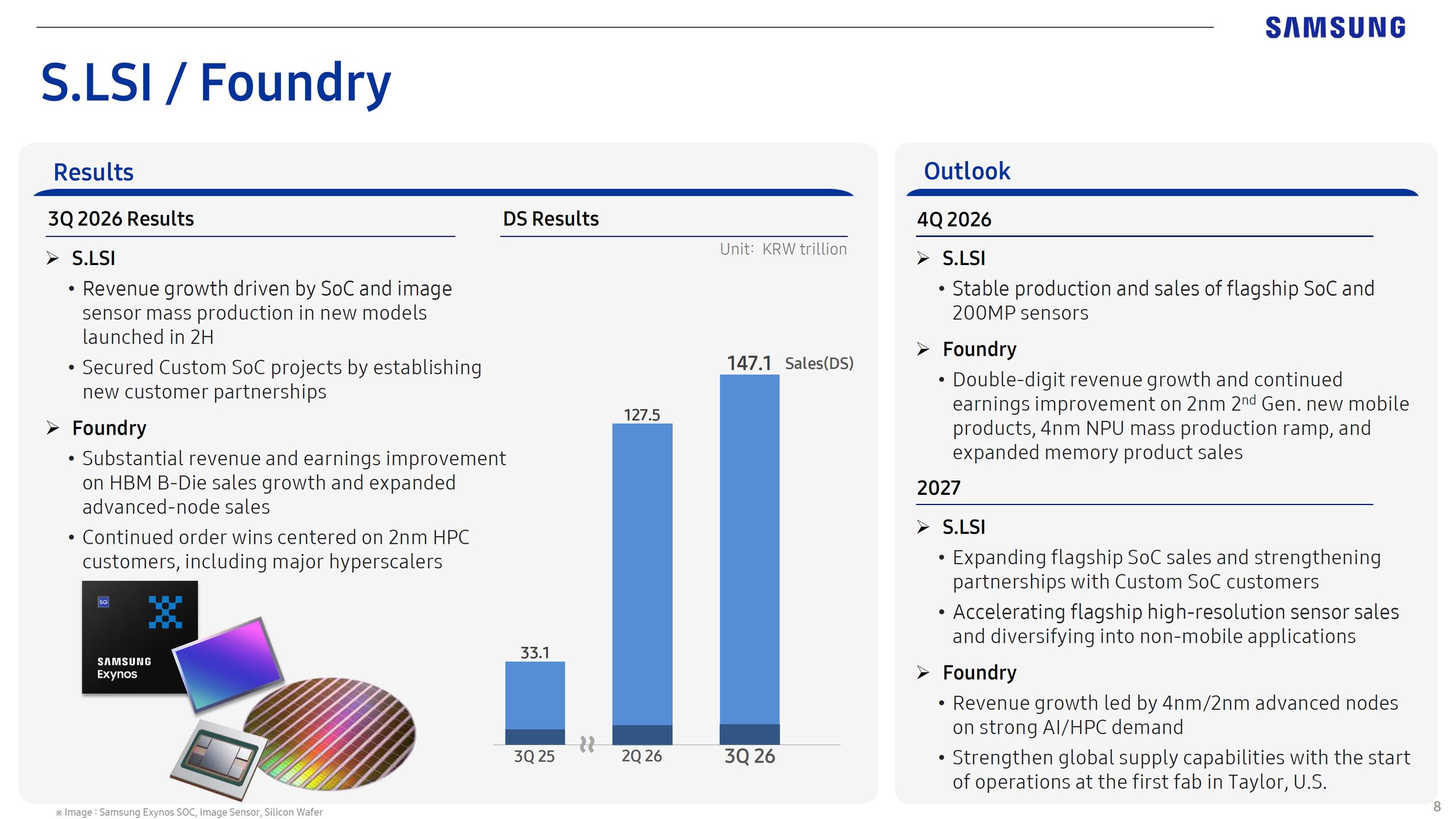
In terms of wafer foundry business, Samsung expects the scale of 2nm process orders to more than double this year. As customer demand for AI chips increases, 2-nanometer and 4-nanometer advanced processes will continue to create new growth drivers for the company. Among them, the 4-nanometer process has been adopted by many large American AI customers, and major 2-nanometer customer products are also scheduled to enter mass production in the second half of this year.
Based on the information released by Samsung, the storage demand brought by the AI wave is still in the stage of rapid expansion. Although storage manufacturers are actively expanding production capacity, due to the long construction period and the fact that a large amount of production capacity has been locked in long-term contracts in advance, it is difficult to fundamentally change the situation of short supply in the global storage market in the next few years. 2027 may even become the year with the greatest supply pressure.
Comments