
Abstract:
During World War II, the Allies proposed a whimsical idea—to use a composite material called Pykrete mixed with ice and wood pulp to build a huge explosion-resistant ice aircraft carrier. Now, inspired by this historical assumption, scientific researchers have successfully developed a new engineering construction material called "super ice" with a qualitative leap in performance through modern nanotechnology and bio-based composite structures. Its compressive strength is about 10 times higher than that of ordinary ice, and it has completely overcome the fatal weakness of traditional ice that is easily broken.
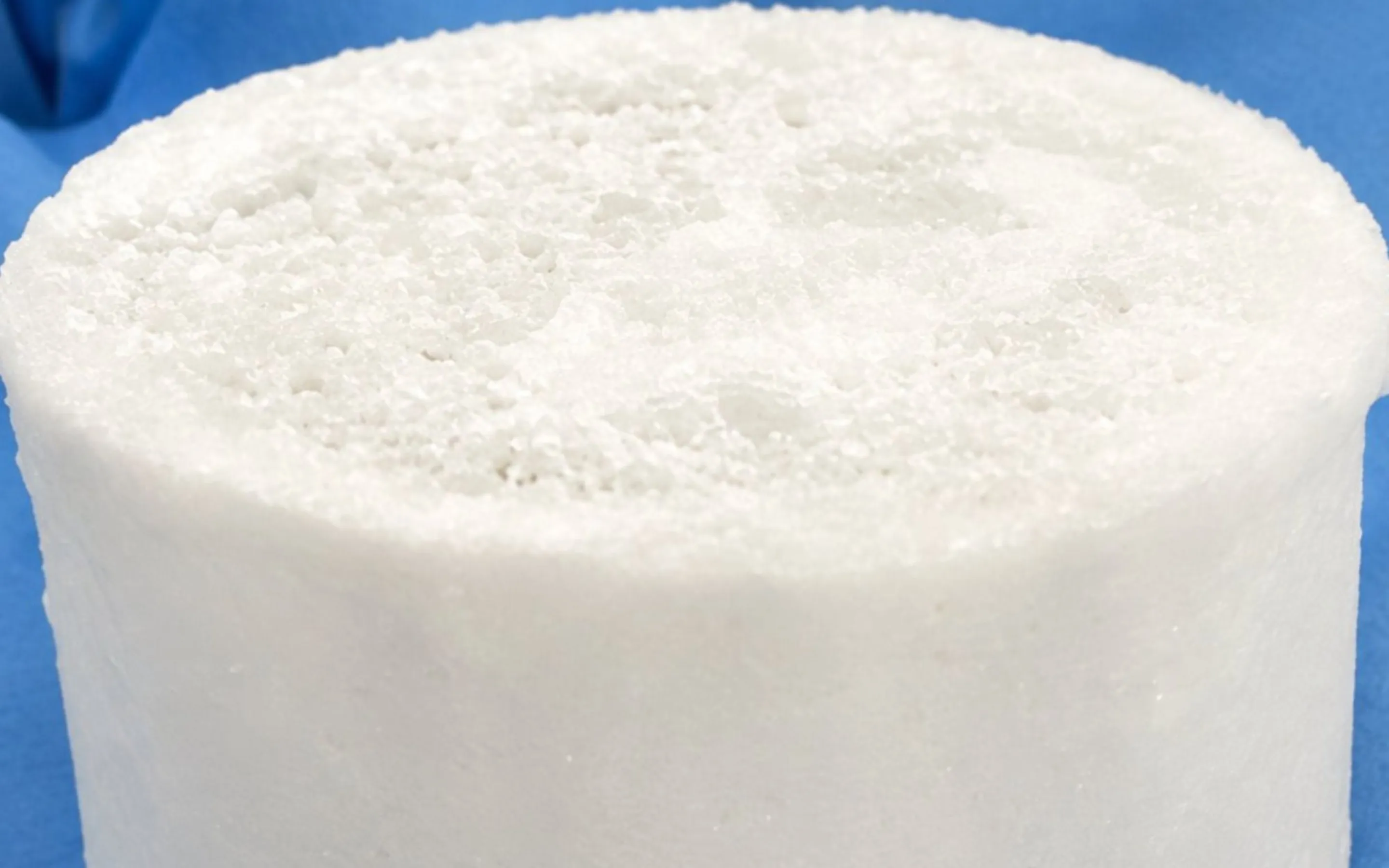
As an extremely abundant and cheap natural resource in extremely cold areas, ice has long been difficult to use as a reliable load-bearing structural material due to its high brittleness. Although ordinary pure ice has a certain hardness, when it is impacted or subjected to uneven force, tiny internal cracks will spread through it at an extremely fast speed, causing the entire structure to catastrophically shatter in an instant without warning. Although Parkerite during World War II proved that fiber can prevent crack propagation, its microscopic bonding strength and physical properties were still rough due to the technical conditions at the time.
In order to completely overcome this material mechanics bottleneck, the scientific research team started from the molecular and nanoscale, integrating plant cellulose (such as nanocellulose crystals) and special protein molecules into water in precise proportions for freezing and crystallization. During the freezing process of water molecules, these highly dispersed biological nanofibers intersperse and interweave between the ice crystal particles to form a dense three-dimensional reinforced network; at the same time, the protein molecules provide strong intermolecular adhesion at the interface, effectively preventing the continuous penetration and uncontrolled expansion of micro-cracks inside the ice crystals.
Mechanical test data shows that the compression limit of this new type of "super ice" is about ten times that of ordinary ice, which is comparable to the mechanical bearing capacity of some engineering-grade cement mortars. What is even more groundbreaking is its toughness: experiments have confirmed that the material can absorb a full 70 times higher mechanical impact energy than ordinary ice before completely breaking and destroying. Even when the surface is damaged by a heavy blow, the intertwined nanofibers inside it will "anchor" the matrix, showing progressive deformation characteristics similar to tough composite materials, completely bidding farewell to the fragile properties of traditional ice disintegration and crushing.
In addition to its excellent physical and mechanical strength, the material also has green attributes such as pure biodegradation, zero carbon emissions and local materials. Researchers pointed out that this new type of strong reinforced ice provides an attractive and low-cost structural material toolbox for infrastructure construction of polar scientific research stations, temporary engineering construction in alpine permafrost zones, polar cold chain and storage and transportation protection, and even in-situ engineering utilization of polar water ice resources on the moon or Mars in the future.
Comments