
Abstract:
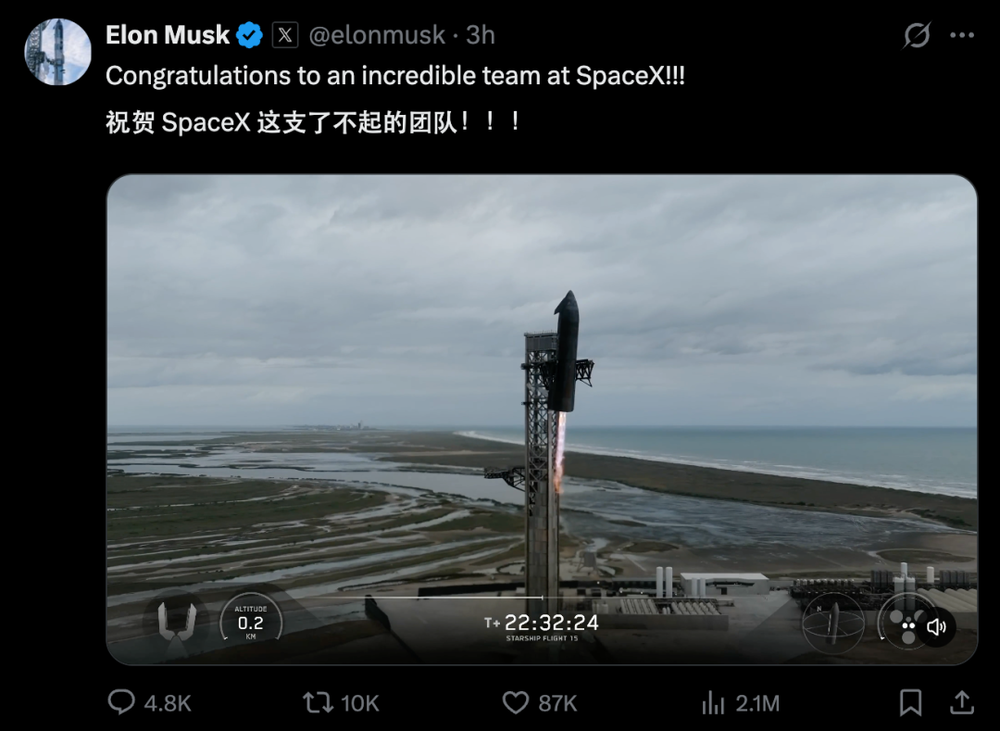
Early this morning, SpaceX once again staged a scene worthy of a science fiction movie. After more than 22 hours of space flight and 14 orbits around the earth, a giant spacecraft about 52 meters high re-entered the atmosphere and flew back to the Starship Base in Texas, USA. Not far from the ground, the starship re-ignited the engine, completed the final flip and deceleration, and accurately entered between the two huge mechanical arms of the launch tower. Then, the engine was shut down and the robotic arm steadily caught the spacecraft.
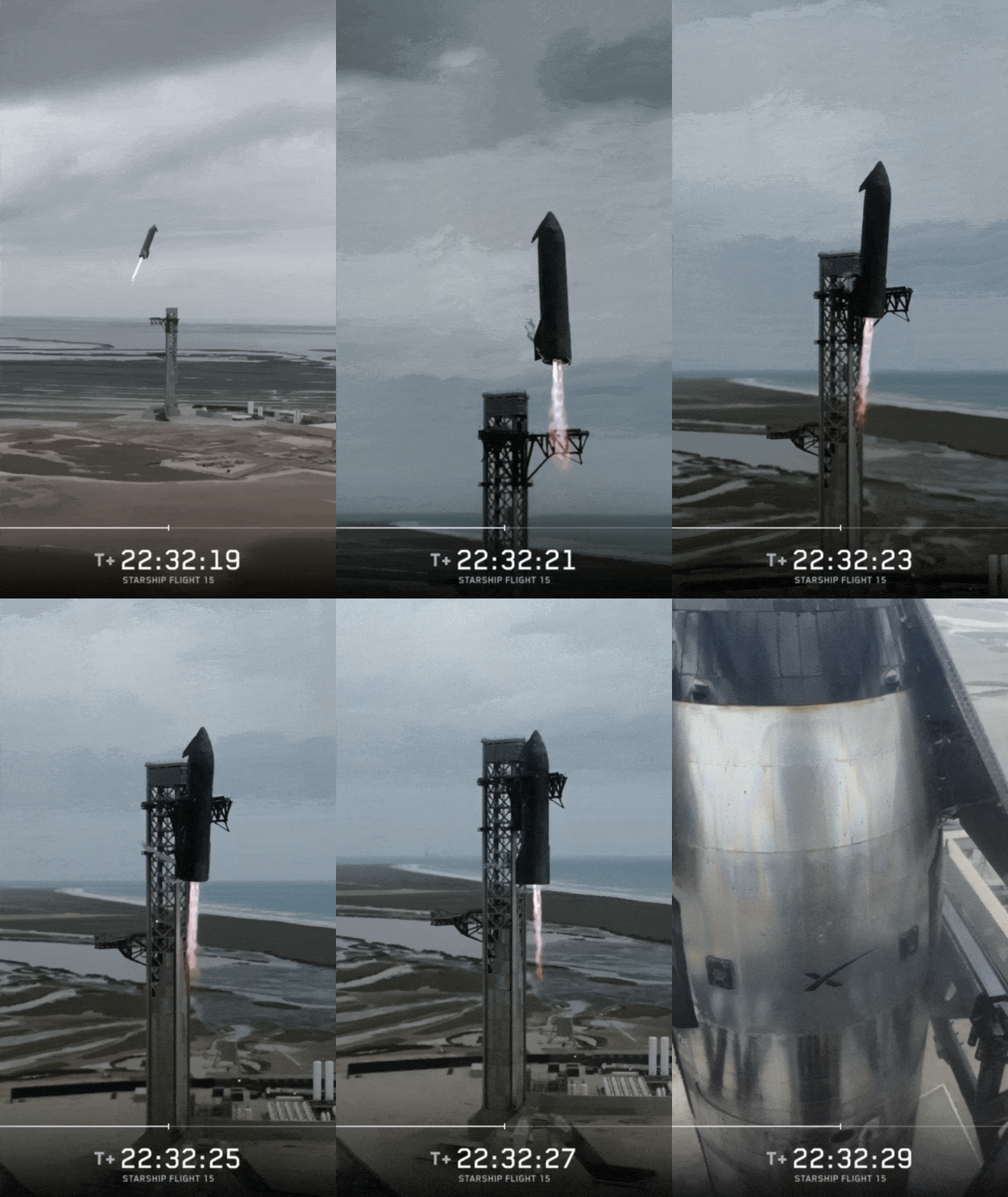
This is the first time that humans have successfully used a launch tower robotic arm to capture a starship returning from Earth orbit. It also means that SpaceX is a big step closer to a fully reusable orbital transportation system.
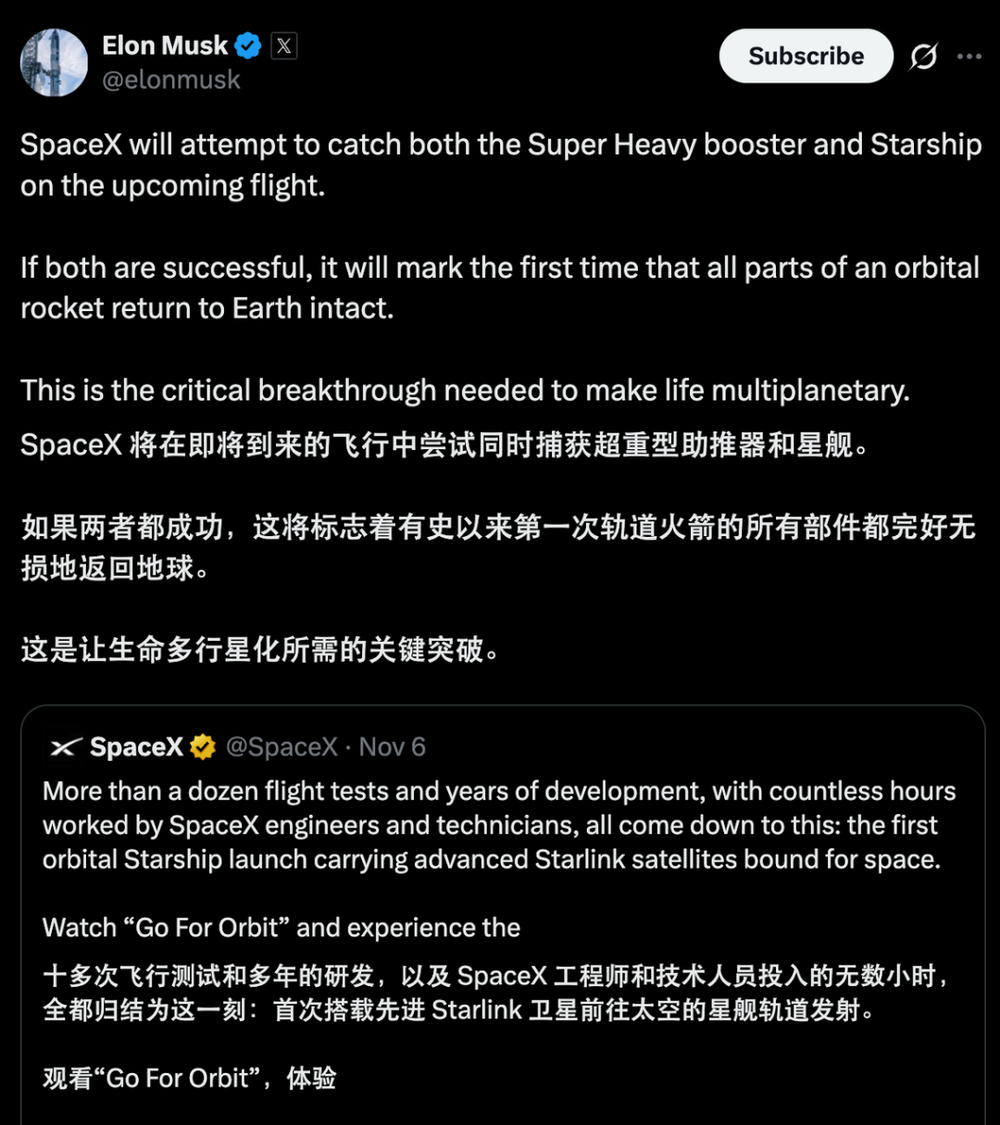
Before launch, Musk said on X that SpaceX will try to capture the super-heavy booster and the starship upper stage at the same time. If both are successful, it would mean the first complete return of all major flight segments of an orbital rocket to Earth.
He called it "the key breakthrough needed to make life a multi-planetary species."
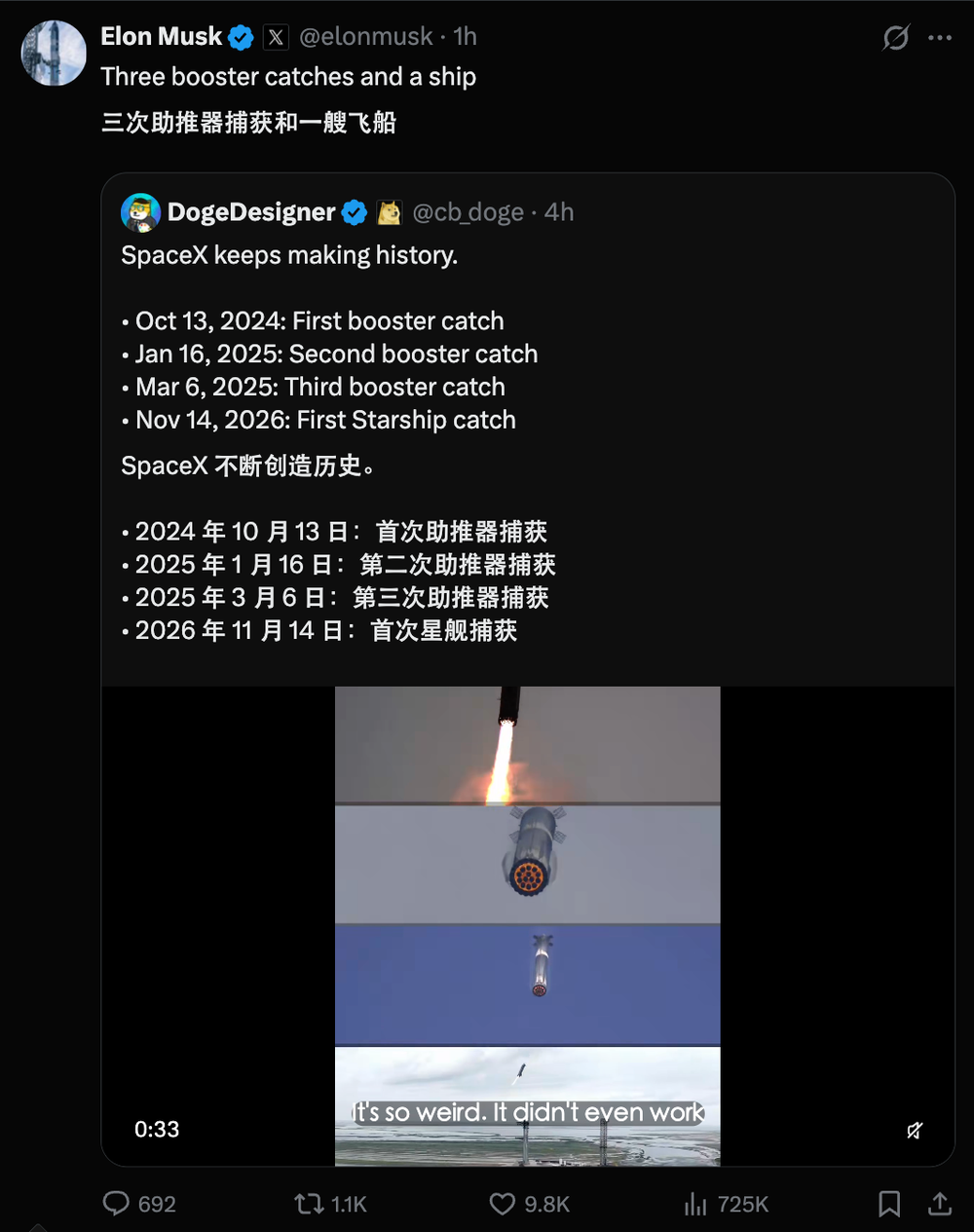
However, SpaceX did not achieve the expected "double recovery" this time. The Super Heavy booster experienced an abnormality during its return and eventually crashed into the Gulf of Mexico. What really made history was the starship upper stage.
Returning from space and being caught by "chopsticks"
How difficult is it?
Over the past decade or so, SpaceX has proven through Falcon 9 that rockets cannot only be used once.
After launch, Falcon 9's first-stage booster can re-ignite, decelerate and land vertically, and then resume its mission after inspection and refurbishment. This technology significantly changes the cost structure of commercial spaceflight.
But Falcon 9 always has a limitation: its second-stage rocket cannot be recovered.
SpaceX’s starship hopes to extend this reusability to the entire launch system.
The complete starship system is about 124 meters high and consists of a super-heavy booster equipped with 33 Raptor engines below and a starship spacecraft above.
According to the design, the super-heavy booster is responsible for sending the starship into space and then returning to the launch site; the starship continues to accelerate into orbit, deploy satellites or perform other tasks, and finally returns to Earth.
Both parts can be reused, allowing space transportation to gradually approach the operation mode of civil aviation.
But the difficulty is that returning a spacecraft from space is much more complicated than recovering a first-stage booster.
The first-stage booster separated at a relatively low speed and experienced a relatively short return process. The starship entering low-Earth orbit flies at a speed of about 7.8 kilometers per second. To allow such a behemoth to return safely, a series of problems such as high-speed reentry, thermal protection, attitude control and precise landing must be solved at the same time.
The most difficult one is thermal protection.
When the starship re-enters the atmosphere at orbital speed, the air ahead is violently compressed, forming an extremely high-temperature airflow. The spacecraft relies on thousands of insulation tiles covering the windward side to protect the stainless steel rocket body from high temperature damage.
These insulation tiles must not only withstand the severe vibrations during launch, but also experience the space environment and high-speed reentry, and they must remain as intact as possible.
In previous test flights, SpaceX has been testing the reliability of insulation tiles, and even took the initiative to remove some tiles to observe the performance of local areas under extreme high temperatures.
For this 15th test flight, SpaceX further improved the fixing method of the insulation tiles and adopted a new curved insulation tile design in an attempt to reduce local heating between the gaps between the tiles.
Interestingly, the Starship also deployed 26 Starlink V3 satellites this time, some of which are equipped with special cameras to check the status of the Starship's heat shield from the outside.
In other words, the satellites sent into space by the starship must in turn help check whether the spacecraft can return safely.
After surviving the most dangerous re-entry stage, another extreme operation has just begun.
The starship does not always land with its tail pointed down like a traditional rocket. It will first descend in an attitude that is approximately its belly facing the wind, using its huge hull to increase air resistance, and at the same time adjust its flight attitude and trajectory through four front and rear flaps.
This style is called the Belly Flop.
When the spacecraft approaches the ground, the Raptor engine is re-ignited, and the thrust is used to quickly flip the ship body to a vertical attitude. It then continuously adjusts the thrust and position, and finally enters between the two robotic arms of the launch tower.
This is the "rocket with chopsticks" familiar to the outside world.
It sounds like a difficult acrobatics, but behind the scenes it involves the coordinated work of multiple systems such as engine thrust control, navigation and positioning, attitude adjustment, and robotic arm control.
Why do you have to adopt this seemingly risky approach? The reasons are weight and efficiency.
Traditional landing legs will increase the structural mass of the rocket itself and affect the carrying capacity. Allowing ground-based launch towers to undertake support and capture tasks can reduce the additional structures that the spacecraft needs to carry.
What’s more important is that the spacecraft can return directly to the launch tower, potentially eliminating the need for tedious steps such as recovery, transportation and re-hoisting at sea.
Of course, this also makes the recycling process more dangerous. Once the spacecraft deviates significantly in the last few seconds, not only the spacecraft may be lost, but the expensive launch tower may also be damaged.
Therefore, SpaceX has set up multiple status check nodes for this mission and has reserved a sea backup plan. Only if both the spacecraft and ground facilities meet the conditions will the robotic arm capture continue.
In the end, the starship successfully completed the entire process from orbital flight, atmospheric re-entry to launch tower capture.
Previously, SpaceX has achieved the robotic arm capture of the Super Heavy booster many times, but the upper stage returning from orbit was not actually caught until this time.
Distance complete reuse
There are still a few final levels
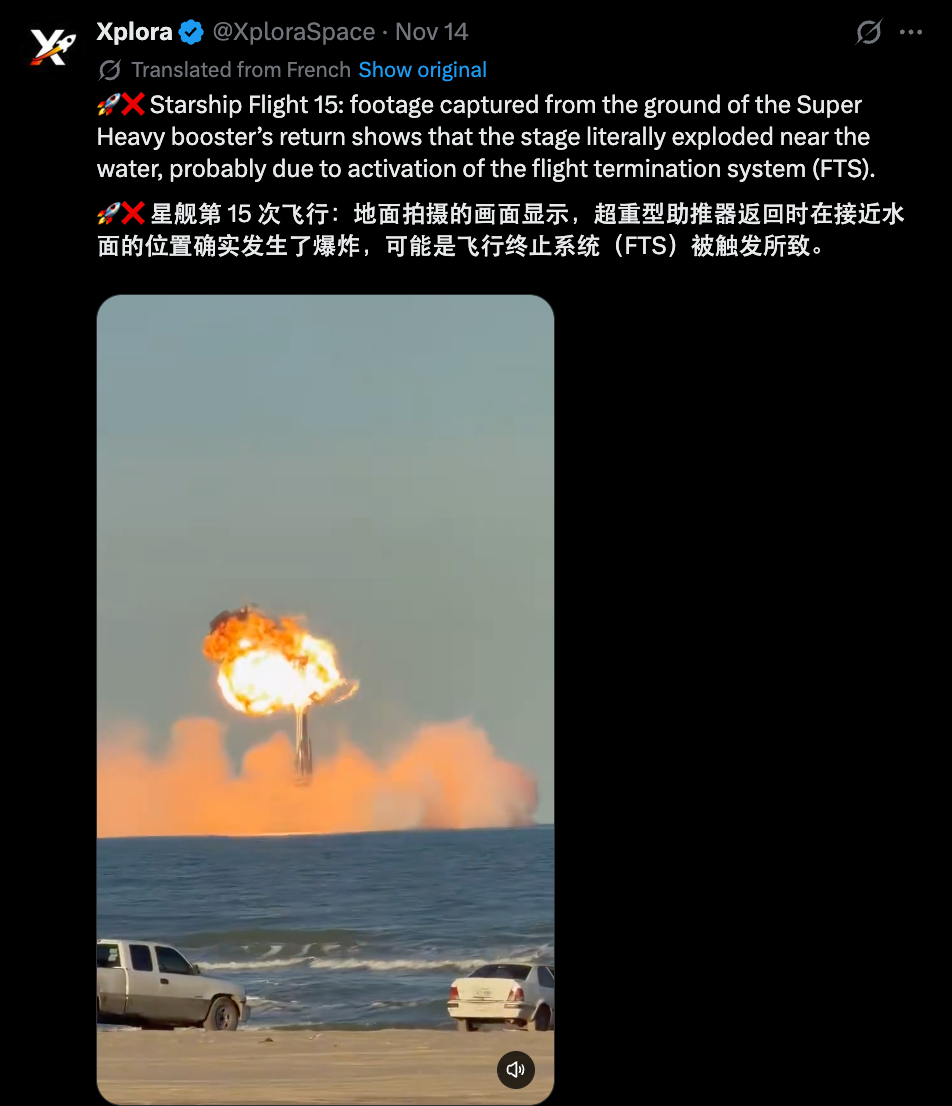
It is worth noting that during the same launch, the super-heavy booster suffered a recovery failure.
About 6 minutes after launch, the booster experienced an abnormality during its return and failed to meet the conditions for returning to the launch tower. The flight control system then canceled the capture and allowed it to fly to a preset area in the Gulf of Mexico.
Musk explained on
He proposed two possible directions for improvement: improving the performance and consistency of the Raptor engine, and adjusting the engine shutdown timing to retain more return propellant. However, the final cause still requires a complete analysis of the telemetry data.
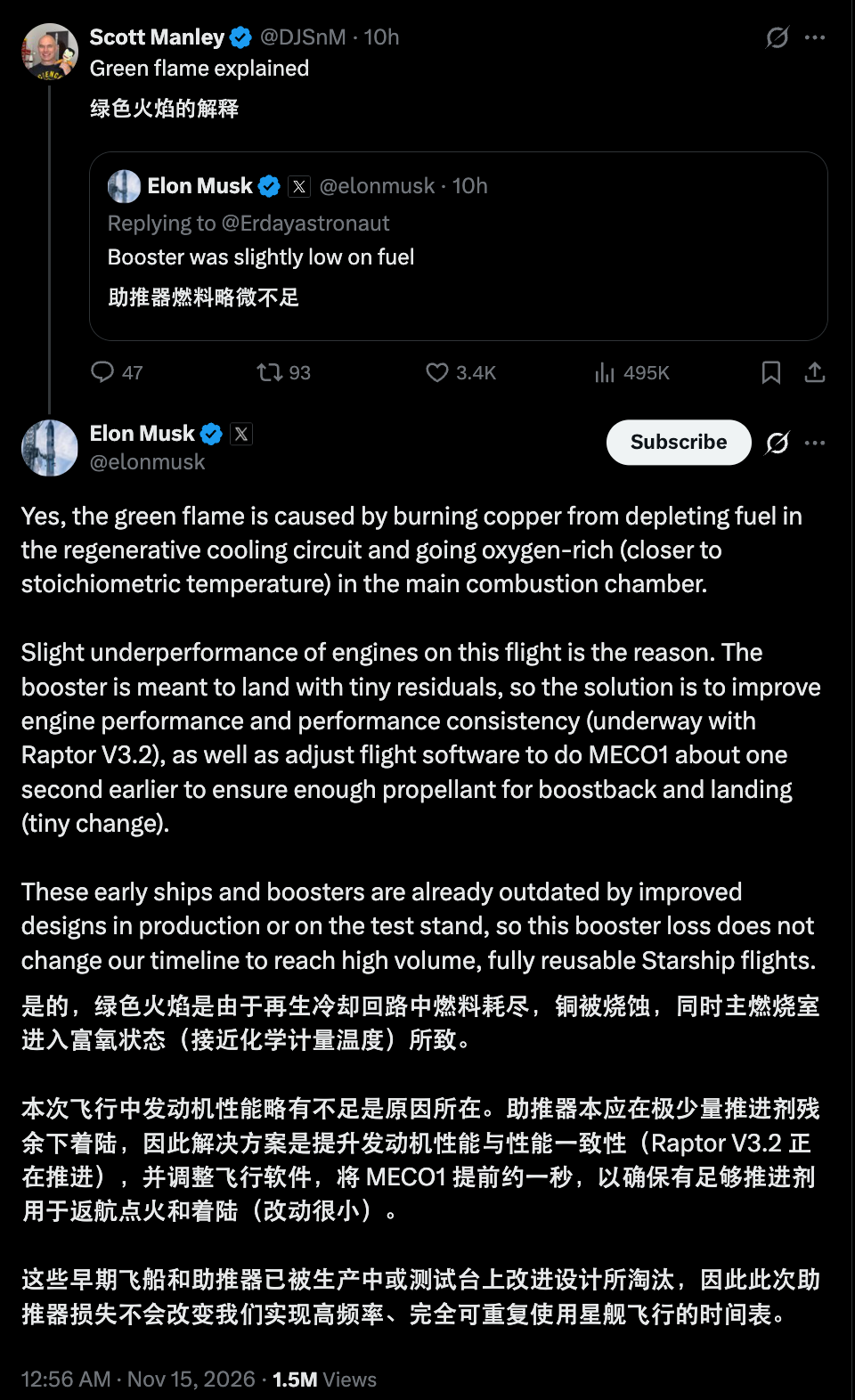
This also exposes a core challenge of complete reuse: the rocket must maximize the carrying efficiency while leaving enough propellant for return.
Leaving more propellant means the payload may be reduced; leaving too little propellant may cause the engine to lose its recovery capability due to fluctuations in engine performance.
But in comparison, the technology verified by the starship upper class this time is more breakthrough.
Previously, SpaceX has proven that the first stage rocket can be reused. The real problem that needs to be overcome is to allow the upper stage to return intact after completing the orbital mission.
Of course, successful recycling and complete reuse are still two different concepts.
Next, SpaceX still needs to prove that: the recovered starship can fly again, the insulation tiles can withstand multiple high-temperature re-entries, the engine and flight control system have high enough reliability, and the process of inspection, refurbishment and refilling of propellant is efficient enough.
Otherwise, even if it can be successfully recovered every time, if the maintenance cost is still high and the preparation period is still long, it will be difficult for the starship to truly achieve high-frequency operation.
Starship recycling
It’s not just space launches that have changed
SpaceX has been trying to change a basic logic of the aerospace industry: If an aircraft has to be scrapped every time it flies, how expensive will air transportation be today?
The Rockets have been facing similar problems for a long time.
Falcon 9 has transformed the economics of commercial spaceflight through first-level reuse. Starship hopes to go one step further and make the entire delivery system reusable.
If future starships can complete inspection, refueling and re-launch in a shorter period of time, rocket manufacturing costs can be spread over more tasks, and the cost of a single orbital transportation is also expected to be further reduced.
The most direct benefit may be SpaceX’s own Starlink network.
In addition to completing the recovery, this test flight also successfully deployed 26 Starlink V3 satellites. According to data released by SpaceX, the network capacity provided by these satellites is approximately equivalent to Falcon 9's 10 Starlink V2 Mini satellite launch missions.
Once starships achieve high-frequency operations in the future, SpaceX will be able to put larger-scale, higher-performance satellites into orbit at lower transportation costs.
Beyond Starlink, concepts such as space data centers, large-scale orbital infrastructure, and deep space transportation also require strong low-cost carrying capabilities.
The further goals are the moon and Mars.
NASA has selected Starship as one of the manned lunar landing system solutions for the Artemis program. But before actually carrying out the moon landing mission, SpaceX must also solve technical problems such as in-orbit propellant transfer, large-scale cryogenic propellant storage, and deep space flight.
This means that the starship was picked up by a robotic arm for the first time, which is far from the end.
From the first overall test flight in 2023, to the first capture of the super-heavy booster in 2024, to the successful pickup of the starship returning from orbit today, SpaceX is gradually turning those seemingly crazy engineering ideas into reality.
But for the future that Musk is looking forward to, the real watershed may be yet to come.
When the same starship can fly into space for the second, third or even more times, and when rocket recovery is no longer a global science and technology news, but becomes a daily operation of space launches, SpaceX is truly close to the future it wants to achieve.
Comments