
Abstract:
On September 8, according to the automotive website Electrek, a Tesla Model 3 ran through a stop sign in the town of Buena Vista, New Jersey, USA, and collided with a Honda Civic that was turning left through the intersection. The driver of the Civic, 82-year-old Stephen Field, died.
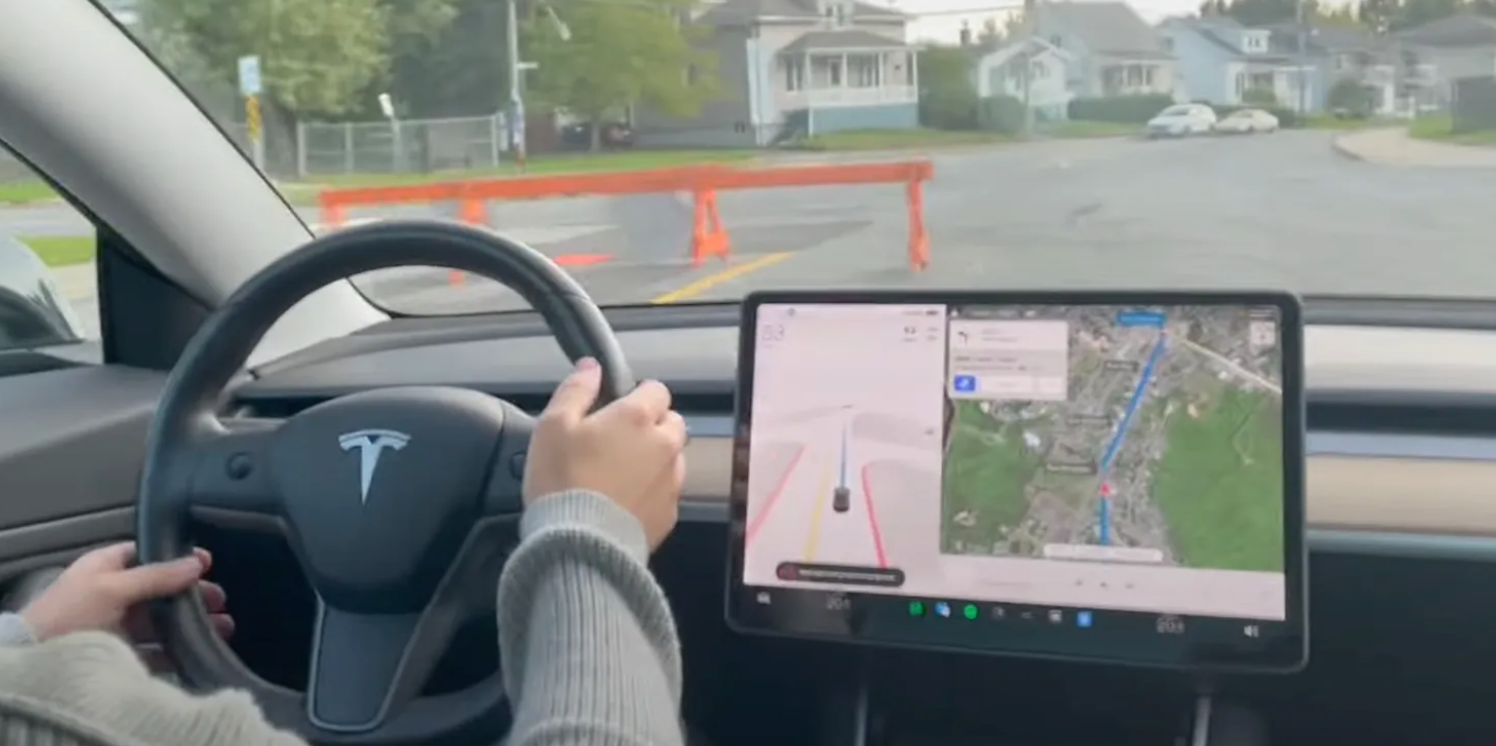
Tesla FSD test system
The police reported this as an accident where the vehicle failed to stop properly. However, one key detail that has not been made public: Tesla's own data shows that the car's assisted driving system was turned on at the time. This is part of an ongoing investigation by Electrek to compare reported crashes with blacked-out data Tesla submits to the National Highway Traffic Safety Administration (NHTSA).
At approximately 6:57 pm on Sunday, July 6, 2025, the New Jersey State Police received a call and rushed to the intersection of County Road 671 and Chestnut Avenue in Buena Vista Township, Atlantic County. New Jersey State Police spokesman Jeffrey Lebron said a Tesla Model 3 failed to stop at a stop sign and hit a Honda Civic that was turning left.
Field, the driver of the Civic, died of his injuries. The Tesla driver and three passengers were injured and were sent to the hospital for treatment with moderate injuries. The accident is still under investigation.
The few local media reports described the accident only as an incident in which the Tesla failed to stop at a stop sign. Not a single report mentioned Autopilot (automatic assisted driving system), "FSD" (fully autonomous driving system) or any assisted driving system. The public only knows that this was an ordinary human error accident.
Tesla data exposed
But that's not the case. Under a standing general order issued by NHTSA, automakers must report accidents if their Level 2 driver assistance systems were enabled within 30 seconds before a crash. Tesla filed a report on the accident.
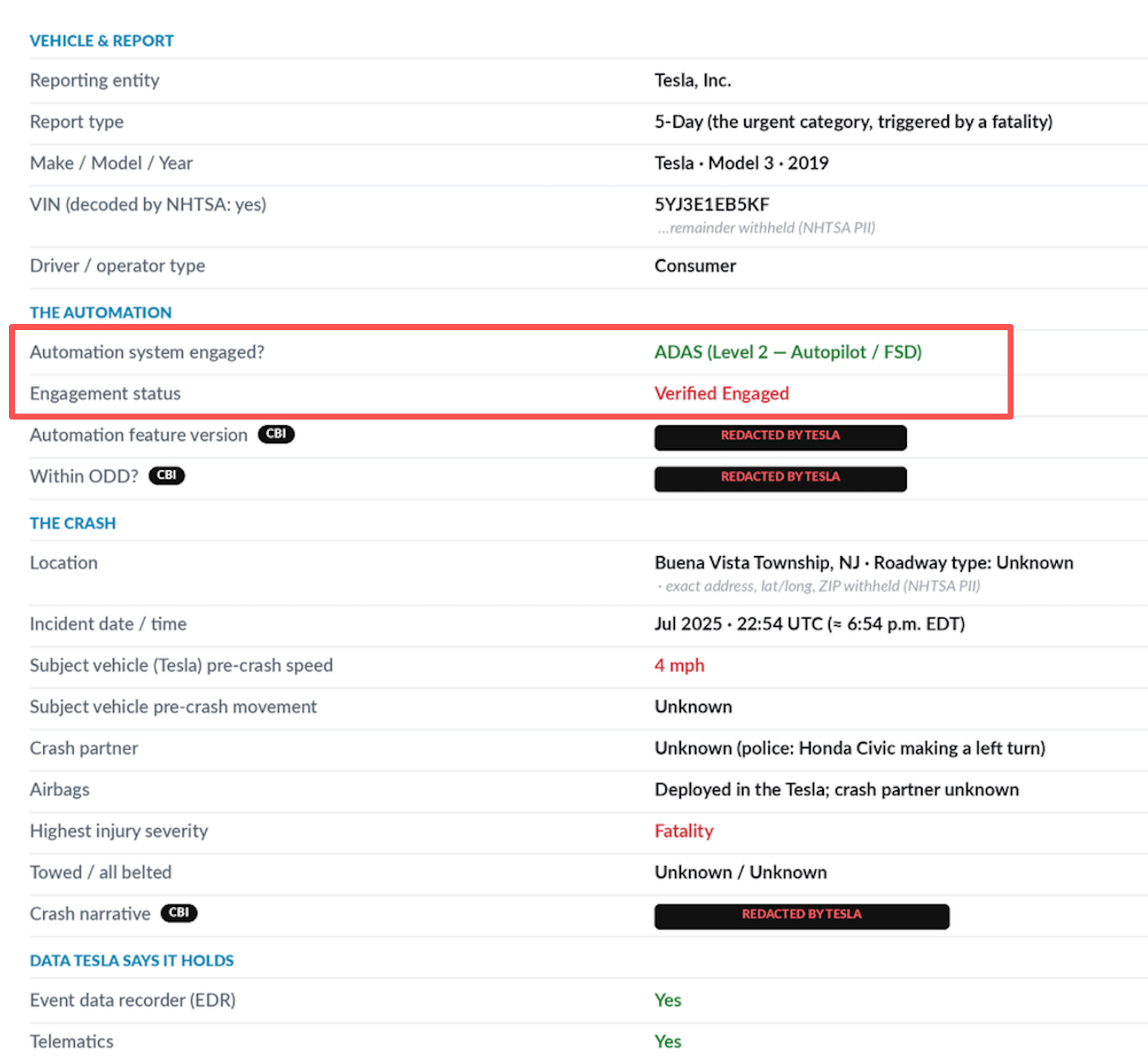
Tesla confirms turning on assisted driving system
The report shows that Tesla confirmed that the vehicle involved was a 2019 Model 3 and marked the "enablement status" of the automation system as "Verified Engaged". This means that Tesla confirmed through the vehicle's own telematics system data that the system was enabled at the time. The report documented one fatality and said Tesla holds the vehicle's event data recorder (EDR) and telematics system data.
However, Tesla later blacked out three key fields that could explain the accident: the accident, the software version, and whether the road being traveled was within the scope of the system's approval. All were blacked out as "confidential business information," the same approach Tesla uses on 99.9% of its accident reports.
FSD?
Because Tesla has blackened the software version, it is currently impossible to accurately determine whether the basic version of Autopilot or FSD was running in this accident. But the characteristics of the intersection pointed to FSD.
Recognizing stop signs and deciding whether to park are urban road functions and fall within the functional scope of FSD. The basic version of Autopilot is a lane keeping system designed for highways and does not respond to stop signs.
Therefore, a vehicle that does not stop when passing a stop sign and has confirmed that the assisted driving system is turned on is likely to be running FSD.
But this is not certain. There have been cases where Teslas with base Autopilot drove into intersections where the system was not designed to work and went right through the intersection because the driver engaged Autopilot on roads where the system was not designed to work and the system did not respond to stop signs. In either case, the verdict is not in Tesla's favor: One system is not supposed to handle stop signs, while the other is a product Tesla sells as "Autopilot."
If it is indeed FSD, there is a second possibility, but this is just a speculation. In the fatal accident in Katy, Texas, a Tesla with FSD turned on veered off the road and killed a woman sitting in her house. Tesla released the data surprisingly quickly at the time, saying the driver had overridden system controls by pressing the accelerator pedal.
Electrek speculated at the time that drivers using FSD in neighborhoods dotted with stop signs would sometimes put their foot on the accelerator pedal, ready to press it to rush the vehicle through a slow parking maneuver. This habit can easily lead to pedal misuse, pressing the accelerator pedal instead of the brakes when you least should. This is just speculation, but Tesla blacked out the accident and the data in the event data recorder when it could have confirmed or ruled out the possibility in just one sentence.
Comments